User:Argoncano/draft
| Part of a series of articles about |
| Quantum mechanics |
|---|
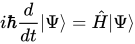


Within the interpretations of quantum mechanics, Two-Time relativistic Bohmian Model (TTBM) is a deterministic theory proposed between 2021 and 2024 by Giuseppe Raguní that aims to resolve the paradoxical aspects of quantum mechanics by introducing an extra time dimension () as only hidden variable [1] [2] [3]. Motions in , called intrinsic, are oscillatory and determine the quantum uncertainties of the observables. They are caused by a Bohmian quantum potential, but TTBM instead of David Bohm's original equation of motion [4] , adopts two distinct equations, one for the classical t-motion and one for the generic intrinsic one. Given the independence of from the common experiential time t, intrinsic motions are instantaneous with respect to any observer, exhibiting ubiquity and explicit nonlocality. The theory predicts a nonstandard relativistic correction of the uncertainty principle.
Definition and basics
The postulates of the theory are as follows:
1. The spatial coordinates of the particle are functions of two independent temporal parameters, t and . Motions in , called intrinsic, are not directly observable, occur in all directions and are responsible for quantum uncertainties.
2. The particle is represented by the wavefunction: where and , being the action, the Hamiltonian, the external potential, the quantum potential and the momentum relative to time t.
Eq. (1) obeys the Klein-Gordon equation (generalized, if ) maintaining the standard interpretation for .


3. For t-motion and each -motion, the following continuity equations hold, respectively: where is the intrinsic velocity in the generic direction .


4. The t-motion and the generic directional -motion of the particle are described by the equations:where is the Lorentz factor referred to and the mass of the particle.


As a consequence of the hypothesis that -motions give rise to quantum uncertainties (point 1), it can be shown that special relativity cannot hold for them [2]. Nevertheless, the maximum value of is still : in fact, it represents the quantum uncertainty on the component of , which cannot be greater than .


Thus, TTBM adds a Newtonian time to the usual four-dimensional t-spacetime. However, due to the independence of the two times and the omnidirectionality of the -motions, the position function does not represent the commonly understood trajectory, but rather a three-dimensional object of the t-spacetime: while t remains constant, the particle can -oscillate an arbitrary number of times in any direction. The result is an empiric indeterminism, due to nonexistence of a specific function and no longer to a conceptual dualism, as in the standard interpretation.


Free particle
For , eq. (4) just informs that is constant.

On the other hand, assuming for a bell-shaped curve with maximum , after three integrations and approximating around , the following expression for the quantum potential is found [2]: where is an adimensional positive arbitrary constant and , with referred to , the component of the classical velocity in direction .


Eq. (7) is the potential of a harmonic oscillator, so eq. (5) provides the following solutions for the abscissa and for the velocity of the particle: By imposing , one obtains , which generalizes the standard Zitterbewegung if is of the order of unity [5] [6]. However, here this motion arises by self-interaction with its own wavefunction, without the need to evoke the antiparticle. According to point 1 of the theory, the amplitude represents the minimum positional uncertainty in of the particle. The uncertainty principle is therefore written: with a novel directional Lorentz factor to divide: TTBM predicts that, at ultrarelativistic speeds, the quantum uncertainties in direction of motion is negligible.


By the conservation of energy:

where is a purely quantum energy independent of , one gets, replacing , that - and so - also oscillates in with an amplitude ; thus this value represents the quantum uncertainty in a measure of energy for a free particle with minimal positional uncertainty. Multiplying by half-period of oscillation, which expresses the quantum uncertainty in a measure of -time, we find the following time-energy uncertainty:


Note that is not simply never negligible: it is always very large, even in the non-relativistic limit. Its maximum value, in fact, is at least of the order of , regardless of the value of . However, it only has the effect of spreading the particle in a volume of space around physical states that are independent of the quantum potential. Such states - atomic orbits and stationary solutions in a box are examples of them - can therefore be found by the standard treatment, ignoring the quantum potential.

It is therefore concluded that there is an infinite amount of energy in the spreading volume, of radius , of the particle. This is not too surprising given the introduction of the extra time parameter and has a virtual character (see Empiricism section).
The non-relativistic () and limit cases are obtained just approximating in the previous equations (respectively, with and 1), so getting still high frequency oscillatory motions in .


The standard Zitterbewegung , can be reobtained by imposing that is constant and interpretating the oscillatory motion in as occurring in [2].

Generalized Uncertainty Principle
Being caused by , oscillatory -motions similar to those found for the free case also occur in the presence of a common (i.e. ) external potential. Exceptions could arise for potentials comparable to , that is at quark level [3]. Except for this case (which could cause significant changes to the uncertainty relations), one can therefore generalise the uncertainty principles obtained in the previous paragraph, which predict relativistic anisotropy. In particular, the Time-Energy Uncertainty Relation is:


where is half-period of the intrinsic oscillation, the corresponding oscillation of the quantum potential and the Lorentz factor of the classical velocity component in direction .


The expected discrepancy from standard predictions is usually very small but could be detected by an angular test in high energy accelerators.

Empiricism
Except for the aforementioned relativistic discrepancy of the uncertainty principle, which is normally negligible, the experimental predictions of TTBM are almost coincident with the standard ones. Almost, because the theory, while assuming the Klein-Gordon equation, still does not admit the Dirac equation, conjecturing that it is only an approximation, albeit an extraordinarily precise one for spin (see TTBM and standard spin relativistic wave equations subsection) [3]. However, until this is unproven, the refined and well-tested predictions of the Dirac equation are beyond the reach of TTBM.

Putting that aside, the TTBM empiricism follows that of Feynman's sum of histories, specifying that the different histories are actually realized in time , so being instantaneous with respect to -time, i.e. with respect to an observer. The most emblematic cases will be illustrated.
Generic motion of a particle in vacuum
Below, the phenomenology for the generic case of a particle moving in a vacuum but with the possibility of encountering macroscopic obstacles (such as slits) will be described (see figure).
Evolution with self-interactions
Starting from the minimum initial positional uncertainty , as long the energy of the particle does not change during its motion, the growth of the positional uncertainty is the same as in the standard case: At a fixed instant, represents the radius of a sphere-like figure within which the particle, due to the omnidirectional -oscillations, is spread: relative to time , i.e. empirically, the particle must be considered as simultaneously present in every point of this volume.


The infinite "self-particles" interact in -time with each other in all possible physical ways: each kind of force-mediating particles (photons, vector bosons, etc.) oscillates itself in -time according to the same laws (8) and (9). Mutual exchanges of such particles correspond to what in the standard point of view is described as emission and reabsorption of virtual particles, obtaining excellent experimental verifications.
Interferences
As predicted by Feynman's sum over histories standard formulation, each path is associated with a wave, whose phase factor is , where is the action [7] [8] [9]. However, TTBM specifies that is the sum of a classical and a purely quantum action, respectively given by [3]:

and


And it is precisely the latter that, as long as the particle does not undergo energy variations, differs significantly for each path, thus being the main cause of the self-interferences.
Furthermore, TTBM requires that the paths are contained in the volume swept by (while in Feynman's formulation they are not bounded). Then, in particular, two-slits diffraction happens provided that both slits are internal in .
Collapses
On the other side, Collapses occur as a consequence of an energetic change of the particle: after an inelastic collision, a subgroup of waves changes its classical action and interferes in a particularly destructive way (because interference due to variations of is added) with all the other waves. This constitutes an observable (but not necessarily observed) -event, capable of dramatically restricting , with a minimum value of the Compton length order. From a macroscopic view, the intrinsic movements stop [3].


Observation itself has no special role: such a collapse happens regardless of whether the inelastic collision is with a detector or it is unobserved (e.g. with a residual air molecule).
Zigzag paths and superluminality
In TTBM, zigzag paths that violate the conservation of -momentum - but admitted as legitimate in Feynman's formulation - are properly physical (i.e. real trajectories), although unobservable. In fact, they are able to be obtained by composition of with one or more . And since the -movements are perceived as instantaneous, this can also explain the speed of light being exceeded for certain trajectories [3].

Infinite virtual energy
The infinite energy instantaneously distributed in the sphere-like volume at any -instant is in line with that which arises by considering the self-interactions - called virtual - of a particle in standard quantum mechanics. TTBM considers such interactions to be real, while any measurement will cause a collapse, detecting only one particle (the only one there is) with its finite energy. Due to the hiddenness of the time , the increasingly larger energies predicted by entering the infinitesimal are so real (as experiments excellently confirm) but never directly observed.
Entanglement
According to TTBM, in case of quantum entanglement between various particles, the state of the entangled property has to be represented by a wave packet that, oscillating in , connects all the particles however far away they may be from each other. The -oscillation causes the result of a measurement of the property at a certain instant to be unpredictable if not probabilistically [3]. This restores full realism to the property even before any measurements; unlike de Broglie-Bohm theory itself, where, for example, in the case of two spin-entangled particles, the spin of each particle is not a pre-existing intrinsic property, but a contestual quantity [10] [11].

Measurement of the property will cause a phase change in a subset of wavefunctions in a certain region of space. This will result in -interferences with other wavefunctions of the system, capable of influencing - istantly with respect to the usual time - the physical properties of any other particle.

Atomic orbitals and boxes
According to TTBM, atomic orbitals are formed precisely because of -oscillations: they are nothing more than electrons instantaneously spread around the nucleus. The oscillatory -motions, radial and tangential, which give rise and static nature to the trajectories are indeed found for the case of circular motion [3]. It is also concluded that an electron reaching the fundamental orbit of hydrogen from the outside, takes about to convert into an orbital .

Even in the case of a particle in a box, there must be similar intrinsic motions that diffuse the particle within it. In fact, the infinite potential merely confines the particle, while inside the box is zero. As a consequence, also in an ideal gas, where interactions with the walls and intermolecular are elastic, the gas molecules should be spread within the box.
Macroscopic matter
Under normal conditions, intrinsic oscillations of macroscopic bodies are strongly suppressed. Indeed, compared to a particle, the body is vastly more likely to interact energetically with its surroundings, changing its energy. This will cause it to collapse at the slightest oscillation (see Free particle subsection). Now, already for equal to one picogram, it about 15 orders of magnitude smaller than the Compton wavelength of the electron! However, in conditions of very high vacuum, the growth of given by eq. (14) may not be counteracted by any collapse and the spreading of matter, of any size, may increase indefinitely. This could have major consequences (see Possible contribution to dark matter subsection).

Other questions and conjectures
In this section, some fundamental questions raised by the theory and still unanswered are presented.
TTBM and problem of Time in quantum mechanics
In standard quantum mechanics, time does not satisfy the mathematical properties to constitute an observable: it must be treated as a classical, Newtonian parameter, external to the theory [12] [13]. Of course, this is unsatisfactory, because it is equivalent to supposing the existence of a "universal clock" which, under penalty of contradiction, cannot be studied within the theory itself; which thus remains incomplete [13].
Related to this problem is the derivation and interpretation of the Time-Energy Uncertainty Relation [14] [15] [16] [17] [18] [19]. According to Altaie, Hogdson and Beige <<the proposal set forth by several authors of considering an intrinsic measurement of quantum time, besides having the conventional external time , is compelling>> [20]. In this direction, Page and Wootters hypothesized that this intrinsic time could be represented by an appropriate dynamic variable of the system studied [21].
However, Unruh and Wald were skeptical about this approach and proposed an alternative that recalls the premises of TTBM: they suggest the consideration of a <<non-measurable intrinsic time that provides the essential background structure of Quantum Mechanics [...]. In this viewpoint, an observer has access to time orderings of his observations given by the label whose numerical values are of no significance except for the ordering they provide>> [13]. Indeed, in TTBM the (only) link between and is the fact that the -oscillation semiperiod, , represents the uncertainty . Then, time can emerge as an ordered set of "instants" . By the way, is variable, and only an energetic interaction would be able to determine the next measurable instant [3]. Finally, the intrinsic time defined in TTBM leads without ambiguity to a Time-Energy Uncertainty Relation, given by eq. (13).


TTBM and standard spin relativistic wave equations
In the theory's ambitions, -oscillations should explain spin. If this were true, then the correct and complete description of the spin states would not belong properly to a law involving only -time, such as the Klein Gordon, Dirac, Proca, Rarita-Schwinger or Pauli-Fierz equations. As the most important example, the results obtained from the Dirac equation, although extraordinarily precise for , should just be an approximation, resulting from considering the -oscillations as -oscillations (in fact such is the standard Zitterbewegung). If it is really so, only the Klein-Gordon equation would maintain a fundamental role, because it, consistently with his dealing with -time, totally ignores the spin, implicitly assigning it a null value.

However, these considerations remain for now only a conjecture, because TTBM is not able, at present time, to derive, with the necessary approximations, any of the above-mentioned standard wave equations.
Possible contribution to dark matter
-oscillations are normally negligible for macroscopic matter (see Macroscopic matter subsection). However, in a non-interacting environment, things can be very different. In fact, eq. (14) indicates a growth of the spreading volume, which continues until the body collides with something, modifying its energy and collapsing. If this does not happen, the body spreads into an increasingly larger space, regardless of its size.
Could this even happen for cold stars? There don't seem to be any objections in principle. Moving away from the nucleus of a galaxy, the pressure decreases more and more. Here, on the basis of the model, provided that the probability of its energy variation through collisions with other matter is practically zero, there would be no impediment for cold and inert matter, of any size, to spread out more and more through -motions. Such spread matter, since it does not interact with anything (in particular, neither by emitting nor absorbing photons), would be completely invisible, apart from curving spacetime.
TTBM therefore suggests that a part, not yet estimated, of dark matter could be explained in this way.
See also

- Path integral formulation
- de Broglie-Bohm theory
- Hidden variable theory
- Double slit experiment
- Quantum nonlocality
- Indeterminism
- Uncertainty Principle
- Quantum entanglement
- Multiple time dimensions
- Relativistic wave equations
- Dark matter
- Problem of Time
- Time-Energy Uncertainty Relation
- Atomic orbitals
- Particle in a box
References
- ^ Raguní, Giuseppe (2021). "Bohmian Zitterbewegung". arXiv [quant-ph]. arXiv:2106.05827.
- ^ a b c d Raguní, Giuseppe (2024). "Consequences of a Two Time relativistic Bohmian model". Communications in Theoretical Physics. 76 (7): 075106. arXiv:2209.05343. doi:10.1088/1572-9494/ad48fe.
- ^ a b c d e f g h i Raguní, Giuseppe (2024). "Two-Time relativistic Bohmian model of Quantum Mechanics". arXiv [quant-ph]. arXiv:2409.09049. doi:10.48550/arXiv.2409.09049.
- ^ Bohm, David and Hiley, Basil: The Undivided Universe: An Ontological Interpretation of Quantum Theory, edition published in the Taylor & Francis e-library 2009 (first edition Routledge, 1993), ISBN 0-203-98038-7, p. 29.
- ^ Schrödinger, Erwin (1930). "Sitzungber. Preuss. Akad. Wiss". Phys. Math. Kl. 24 (418): 3.
- ^ Dirac, P.A.M.: The Principles of Quantum Mechanics, Oxford University Press - fourth edition 1958, p. 261.
- ^ Feynman, Richard (1948). "Space-time approach to nonrelativistic Quantum Mechanics". Rev. Mod. Phys. 20: 367.
- ^ Feynman, Richard (1948). "Space-time approach to Quantum Electrodynamics". Phys. Rev. 74: 939.
- ^ Feynman, Richard: Q.E.D. - The Strange Theory of Light and Matter, Princeton University Press 1988, p. 53.
- ^ Gondran, Michel and Gondran Alexander (2014). "Measurement in the de Broglie‐Bohm Interpretation: Double‐Slit, Stern‐Gerlach, and EPR‐B". Physics Research International. 2014 (1): 605908.
- ^ Vink, Jeroen C. (2022). "Spin and Contextuality in Extended de Broglie-Bohm-Bell Quantum Mechanics". Foundations of Physics. 52 (5): 97.
- ^ Pauli Wolfgang, Die Allgeimenen Prinzipien der Wellenmechanik, ed. by S. Fludge (Handbuch d. Physik, Springer) 1958, p.60
- ^ a b c Unruh W G and Wald R M (1989). "Time and the interpretation of canonical quantum gravity". Phys. Rev. D. 40: 2598.
- ^ Briggs J S and Rost J M (2001). "On the Derivation of the Time-Dependent Equation of Schrödinger". Found. Phys. 31: 693.
- ^ Dodonov V V and Dodonov A V (2015). "Energy–time and frequency–time uncertainty relations: exact inequalities". Phys. Scr. 90: 074049.
- ^ Deffner S and Campbell S (2017). "Quantum speed limits: from Heisenberg's uncertainty principle to optimal quantum control". J. Phys. A: Math. Theor. 50: 453001.
- ^ Aharonov Y and Bohm D (1961). "Time in the Quantum Theory and the Uncertainty Relation for Time and Energy". Phys. Rev. 122: 1649.
- ^ Mandelstamm M and Tamm I (1945). "The uncertainty relation between energy and time in nonrelativistic quantum mechanics". J. Phys. (U.S.S.R.). 9: 249.
- ^ Busch P. "The time-energy uncertainty relation", in Time in quantum mechanics, ed. Springer 2002, p. 69.
- ^ Altaie M B, Hodgson D and Beige A (2022). "Time and quantum clocks: A review of recent developments". Frontiers in Physics. 10: 897305.
- ^ Page D N and Wootters W K (1983). "Evolution without Evolution: Dynamics Described by Stationary Observables". Phys. Rev. D. 27: 2885.
External links
- Could an extra time dimension reconcile quantum entanglement with local causality?
- Intuition for multiple temporal dimensions
- Time gains an extra dimension
- New Phase of Matter Opens Portal to Extra Time Dimension
- There are 2 dimensions of time, theoretical physicist states
- Dirac’s acrobatics
- Why isn't Feynman's path integral taught more widely and earlier in today's academic physics curricula?
- The Feynman Path Integral
- Dark Matter Might Not Be What We Thought”: Ultra-Diffuse Galaxies Offer New Clues
- Why dark matter is still one of the biggest open problems in science

Content Disclaimer
Informasi ini disarikan dari Wikipedia dan disajikan kembali untuk tujuan edukasi. Konten tersedia di bawah lisensi CC BY-SA 3.0. Kami tidak bertanggung jawab atas ketidakakuratan data yang bersumber dari kontribusi publik tersebut.
- The information displayed on this website is sourced in part or in whole from Wikipedia and has been adapted for the purpose of restating it. We strive to provide accurate and relevant information, however:
- There is no guarantee of absolute accuracy. Wikipedia is an open, collaborative project that can be edited by anyone, so information is subject to change.
- It is not intended to constitute professional advice. The content displayed is for informational and educational purposes only. For important decisions (e.g., medical, legal, or financial), please consult a professional.
- Content copyright. Wikipedia is licensed under the Creative Commons Attribution-ShareAlike License (CC BY-SA). This means that content may be reused with appropriate attribution and shared under a similar license.
- Responsible use. Any risk arising from the use of information from this website is entirely the responsibility of the user.