Portal:Physics

The Physics Portal


Physics is the scientific study of matter, its fundamental constituents, its motion and behavior through space and time, and the related entities of energy and force. It is one of the most fundamental scientific disciplines. A scientist who specializes in the field of physics is called a physicist.
Physics is one of the oldest academic disciplines. Over much of the past two millennia, physics, chemistry, biology, and certain branches of mathematics were part of natural philosophy, but during the Scientific Revolution in the 17th century, these natural sciences branched into separate research endeavors. Physics intersects with many interdisciplinary areas of research, such as biophysics and quantum chemistry, and the boundaries of physics are not rigidly defined. New ideas in physics often explain the fundamental mechanisms studied by other sciences and suggest new avenues of research in these and other academic disciplines, such as mathematics and philosophy.
Advances in physics often enable new technologies. For example, advances in the understanding of electromagnetism, solid-state physics, and nuclear physics led directly to the development of technologies that have transformed modern society, such as television, computers, domestic appliances, and nuclear weapons; advances in thermodynamics led to the development of industrialization; and advances in mechanics inspired the development of calculus. (Full article...)
 Featured article -


Gerard Kitchen O'Neill (February 6, 1927 – April 27, 1992) was an American physicist and space activist. As a faculty member of Princeton University, he invented a device called the particle storage ring for high-energy physics experiments. Later, he invented a magnetic launcher called the mass driver. In the 1970s, he developed a plan to build human settlements in outer space, including a space habitat design known as the O'Neill cylinder. He founded the Space Studies Institute, an organization devoted to funding research into space manufacturing and colonization.
O'Neill began researching high-energy particle physics at Princeton in 1954, after he received his doctorate from Cornell University. Two years later, he published his theory for a particle storage ring. This invention allowed particle accelerators at much higher energies than had previously been possible. In 1965 at Stanford University, he performed the first colliding beam physics experiment. (Full article...)
Did you know -

- ... that Aristotle's ideas of physics held that because an object could not move without an immediate source of energy, arrows created a vacuum behind them that pushed them through the air.
- ... that there are up to 6 candidates for the Theory of everything, minus String theory and Loop quantum gravity?
Selected image -

Related portals


 Good articles -

-
![Image 1 Franck in 1925 James Franck (German: [ˈdʒɛɪ̯ms ˈfʁaŋk] ⓘ; 26 August 1882 – 21 May 1964) was a German–American physicist who shared the 1925 Nobel Prize in Physics with Gustav Hertz "for their discovery of the laws governing the impact of an electron upon an atom." Franck completed his doctorate in 1906 and his habilitation in 1911 at the Frederick William University in Berlin, where he lectured and taught until 1918, having reached the position of professor extraordinarius. He served as a volunteer in the German Army during World War I. He was seriously injured in 1917 in a gas attack and was awarded the Iron Cross 1st Class. (Full article...)](//upload.wikimedia.org/wikipedia/en/d/d2/Blank.png)
James Franck (German: [ˈdʒɛɪ̯ms ˈfʁaŋk] ⓘ; 26 August 1882 – 21 May 1964) was a German–American physicist who shared the 1925 Nobel Prize in Physics with Gustav Hertz "for their discovery of the laws governing the impact of an electron upon an atom."
Franck completed his doctorate in 1906 and his habilitation in 1911 at the Frederick William University in Berlin, where he lectured and taught until 1918, having reached the position of professor extraordinarius. He served as a volunteer in the German Army during World War I. He was seriously injured in 1917 in a gas attack and was awarded the Iron Cross 1st Class. (Full article...) -

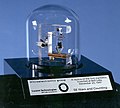
DU Spectrophotometer, National Technical Laboratories, 1947
The DU spectrophotometer or Beckman DU, introduced in 1941, was the first commercially viable scientific instrument for measuring the amount of ultraviolet light absorbed by a substance. This model of spectrophotometer enabled scientists to easily examine and identify a given substance based on its absorption spectrum, the pattern of light absorbed at different wavelengths. Arnold O. Beckman's National Technical Laboratories (later Beckman Instruments) developed three in-house prototype models (A, B, C) and one limited distribution model (D) before moving to full commercial production with the DU. Approximately 30,000 DU spectrophotometers were manufactured and sold between 1941 and 1976.
Sometimes referred to as a UV–Vis spectrophotometer because it measured both the ultraviolet (UV) and visible spectra, the DU spectrophotometer is credited as being a truly revolutionary technology. It yielded more accurate results than previous methods for determining the chemical composition of a complex substance, and substantially reduced the time needed for an accurate analysis from weeks or hours to minutes. The Beckman DU was essential to several critical secret research projects during World War II, including the development of penicillin and synthetic rubber. (Full article...) -

An electron backscatter diffraction pattern of monocrystalline silicon, taken at 20 kV with a field-emission electron source
Electron backscatter diffraction (EBSD) is a scanning electron microscopy (SEM) technique used to study the crystallographic structure of materials. EBSD is carried out in a scanning electron microscope equipped with an EBSD detector comprising at least a phosphorescent screen, a compact lens and a low-light camera. In the microscope an incident beam of electrons hits a tilted sample. As backscattered electrons leave the sample, they interact with the atoms and are both elastically diffracted and lose energy, leaving the sample at various scattering angles before reaching the phosphor screen forming Kikuchi patterns (EBSPs). The EBSD spatial resolution depends on many factors, including the nature of the material under study and the sample preparation. They can be indexed to provide information about the material's grain structure, grain orientation, and phase at the micro-scale. EBSD is used for impurities and defect studies, plastic deformation, and statistical analysis for average misorientation, grain size, and crystallographic texture. EBSD can also be combined with energy-dispersive X-ray spectroscopy (EDS), cathodoluminescence (CL), and wavelength-dispersive X-ray spectroscopy (WDS) for advanced phase identification and materials discovery.
The change and sharpness of the electron backscatter patterns (EBSPs) provide information about lattice distortion in the diffracting volume. Pattern sharpness can be used to assess the level of plasticity. Changes in the EBSP zone axis position can be used to measure the residual stress and small lattice rotations. EBSD can also provide information about the density of geometrically necessary dislocations (GNDs). However, the lattice distortion is measured relative to a reference pattern (EBSP0). The choice of reference pattern affects the measurement precision; e.g., a reference pattern deformed in tension will directly reduce the tensile strain magnitude derived from a high-resolution map while indirectly influencing the magnitude of other components and the spatial distribution of strain. Furthermore, the choice of EBSP0 slightly affects the GND density distribution and magnitude. (Full article...) -

A kilogram mass and three metric measuring devices: a tape measure in centimetres, a thermometer in degrees Celsius, and a multimeter that measures potential in volts, current in amperes and resistance in ohms.
The metric system is a system of measurement that standardises a set of base units and a nomenclature for describing relatively large and small quantities using decimal-based multiplicative unit prefixes. Though the rules governing the metric system have changed over time, the modern definition, the International System of Units (SI), defines the metric prefixes and seven base units: metre (m), kilogram (kg), second (s), ampere (A), kelvin (K), mole (mol), and candela (cd).
An SI derived unit is a named combination of base units, such as the hertz (cycles per second), newton (kg⋅m/s2), and tesla (1 kg⋅s−2⋅A−1). In the case of degrees Celsius, it is a shifted scale derived from the kelvin. Certain units have been officially accepted for use with the SI. Some of these are decimalised, like the litre and electronvolt, and are considered "metric". Others, like the astronomical unit are not. Ancient non-metric but SI-accepted multiples of time, minute and hour, are base 60 (sexagesimal). Similarly, the angular measure degree and submultiples,
arcminute, and arcsecond, are also sexagesimal and SI-accepted. (Full article...) -

The Wow! signal represented as "6EQUJ5". The original printout with Ehman's handwritten exclamation is preserved by Ohio History Connection.
The Wow! signal was a strong narrowband radio signal detected on August 15, 1977, by Ohio State University's Big Ear radio telescope in the United States, then used to support the search for extraterrestrial intelligence. The signal appeared to come from the direction of the constellation Sagittarius and bore expected hallmarks of extraterrestrial origin.
Astronomer Jerry R. Ehman discovered the anomaly a few days later while reviewing the recorded data. On the computer printout, he circled the reading of the signal's intensity, "6EQUJ5", and wrote the comment "Wow!" beside it, leading to the event's widely used name. (Full article...) -
A Type Ia supernova (read: "type one-A") is a supernova that occurs in binary systems (two stars orbiting one another) in which one of the stars is a white dwarf. The other star can be anything from a giant star to an even smaller white dwarf.
Physically, carbon–oxygen white dwarfs with a low rate of rotation are limited to below 1.44 solar masses (M☉). Beyond this "critical mass", they reignite and in some cases trigger a supernova explosion; this critical mass is often referred to as the Chandrasekhar mass, but is marginally different from the absolute Chandrasekhar limit, where electron degeneracy pressure is unable to prevent catastrophic collapse. If a white dwarf gradually accretes mass from a binary companion, or merges with a second white dwarf, the general hypothesis is that a white dwarf's core will reach the ignition temperature for carbon fusion as it approaches the Chandrasekhar mass. Within a few seconds of initiation of nuclear fusion, a substantial fraction of the matter in the white dwarf undergoes a runaway reaction, releasing enough energy (1×1044 J) to unbind the star in a supernova explosion. (Full article...) -
Luis Walter Alvarez (June 13, 1911 – September 1, 1988) was an American experimental physicist, inventor, and professor who was awarded the Nobel Prize in Physics in 1968 for his discovery of resonance states in particle physics using the hydrogen bubble chamber. In 2007 the American Journal of Physics commented, "Luis Alvarez was one of the most brilliant and productive experimental physicists of the twentieth century."
After receiving his PhD from the University of Chicago in 1936, Alvarez went to work for Ernest Lawrence at the Radiation Laboratory at the University of California, Berkeley. Alvarez devised a set of experiments to observe K-electron capture in radioactive nuclei, predicted by the beta decay theory but never before observed. He produced tritium using the cyclotron and measured its lifetime. In collaboration with Felix Bloch, he measured the magnetic moment of the neutron. (Full article...) -

Thorntonbank Wind Farm, using REpower 5M 5 MW turbines in the North Sea off the coast of Belgium
A wind turbine is a device that converts the kinetic energy of wind into electrical energy. As of 2024[update], hundreds of thousands of large turbines, in installations known as wind farms, were generating over 1,136 gigawatts of power, with 117 GW added each year. Wind turbines are an increasingly important source of intermittent renewable energy, and are used in many countries to lower energy costs and reduce reliance on fossil fuels. One study claimed that, as of 2009,[update] wind had the "lowest relative greenhouse gas emissions, the least water consumption demands and the most favorable social impacts" compared to photovoltaic, hydro, geothermal, coal and gas energy sources.
Wind turbines are manufactured in a wide range of sizes, with either horizontal or vertical axes, though horizontal is most common. Commercial power production horizontal-axis turbines usually have three blades, upwind of their towers. Vertical-axis turbines can be made to varied designs, including the "eggbeater" Darrieus, the giromill with straight blades, the Savonius with scoops suitable for rooftops and ships, airborne with wings tethered to the ground, floating (mounted on a floating platform), and various unconventional types such as with counter-rotating blades. (Full article...) -

Experiments on European robins, which are migratory, suggest their magnetic sense makes use of the quantum radical pair mechanism.
Magnetoreception is a sense which allows an organism to detect the Earth's magnetic field. Animals with this sense include some arthropods, molluscs, and vertebrates (fish, amphibians, reptiles, birds, and mammals). The sense is mainly used for orientation and navigation, but it may help some animals to form regional maps. Experiments on migratory birds provide evidence that they make use of a cryptochrome protein in the eye, relying on the quantum radical pair mechanism to perceive magnetic fields. This effect is extremely sensitive to weak magnetic fields, and readily disturbed by radio-frequency interference, unlike a conventional iron compass. Some bacteria orient passively using magnetite crystals; the mechanism has not been reliably detected in eukaryotes.
Cartilaginous fish including sharks and stingrays can detect small variations in electric potential with their electroreceptive organs, the ampullae of Lorenzini. These appear to be able to detect magnetic fields by induction. There is some evidence that these fish use magnetic fields in navigation. (Full article...) -
Magnetic resonance imaging (MRI) is a medical imaging technique used in radiology to generate pictures of the anatomy and the physiological processes inside the body. MRI scanners use strong magnetic fields, magnetic field gradients, and radio waves to form images of the organs in the body. MRI does not involve X-rays or the use of ionizing radiation, which distinguishes it from computed tomography (CT) and positron emission tomography (PET) scans. MRI is a medical application of nuclear magnetic resonance (NMR) which can also be used for imaging in other NMR applications, such as NMR spectroscopy.
MRI is widely used in hospitals and clinics for medical diagnosis, staging and follow-up of disease. Compared to CT, MRI provides better contrast in images of soft tissues, e.g. in the brain or abdomen. However, it may be perceived as less comfortable by patients, due to the usually longer and louder measurements with the subject in a long, confining tube, although "open" MRI designs mostly relieve this. Additionally, implants and other non-removable metal in the body can pose a risk and may exclude some patients from undergoing an MRI examination safely. (Full article...) -

The Leibstadt Nuclear Power Plant in Switzerland
Nuclear power is the use of nuclear reactions to produce electricity. Nuclear power can be obtained from nuclear fission, nuclear decay and nuclear fusion reactions. Presently, the vast majority of electricity from nuclear power is produced by nuclear fission of uranium and plutonium in nuclear power plants. Nuclear decay processes are used in niche applications such as radioisotope thermoelectric generators in some space probes such as Voyager 2. Reactors producing controlled fusion power have been operated since 1958 but have yet to generate net power and are not expected to be commercially available in the near future.
The first nuclear power plant was built in the 1950s. The global installed nuclear capacity grew to 100 GW in the late 1970s, and then expanded during the 1980s, reaching 300 GW by 1990. The 1979 Three Mile Island accident in the United States and the 1986 Chernobyl disaster in the Soviet Union resulted in increased regulation and public opposition to nuclear power plants. Nuclear power plants supplied 2,602 terawatt hours (TWh) of electricity in 2023, equivalent to about 9% of global electricity generation, and were the second largest low-carbon power source after hydroelectricity. As of November 2025,[update] there are 416 civilian fission reactors in the world, with overall capacity of 376 GW, 63 under construction and 87 planned, with a combined capacity of 66 GW and 84 GW, respectively. The United States has the largest fleet of nuclear reactors, generating almost 800 TWh per year with an average capacity factor of 92%. The average global capacity factor is 89%. Most new reactors under construction are generation III reactors in Asia. (Full article...) -

The SI system after the 2019 definition: Base units as defined in terms of physical constants and other base units. Here, means is used in the definition of .
In 2019, four of the seven SI base units specified in the International System of Quantities were redefined in terms of natural physical constants, rather than human artefacts such as the standard kilogram. Effective 20 May 2019, the 144th anniversary of the Metre Convention, the kilogram, ampere, kelvin, and mole are defined by setting exact numerical values, when expressed in SI units, for the Planck constant (h), the elementary electric charge (e), the Boltzmann constant (kB), and the Avogadro constant (NA), respectively. The second, metre, and candela had previously been redefined using physical constants. The four new definitions aimed to improve the SI without changing the value of any units, ensuring continuity with existing measurements. In November 2018, the 26th General Conference on Weights and Measures (CGPM) unanimously approved these changes, which the International Committee for Weights and Measures (CIPM) had proposed earlier that year after determining that previously agreed conditions for the change had been met. These conditions were satisfied by a series of experiments that measured the constants to high accuracy relative to the old SI definitions, and were the culmination of decades of research.
The previous major change of the metric system occurred in 1960 when the International System of Units (SI) was formally published. At this time the metre was redefined: the definition was changed from the prototype of the metre to a certain number of wavelengths of a spectral line of a krypton-86 radiation, making it derivable from universal natural phenomena. The kilogram remained defined by a physical prototype, leaving it the only artefact upon which the SI unit definitions depended. At this time the SI, as a coherent system, was constructed around seven base units, powers of which were used to construct all other units. With the 2019 redefinition, the SI is constructed around seven defining constants, allowing all units to be constructed directly from these constants. The designation of base units is retained but is no longer essential to define the SI units. (Full article...) -
Arne Edwin Slettebak (August 8, 1925 – May 20, 1999) was an American astronomer who served as chair of the astronomy department at the Ohio State University from 1962 to 1987 and director of the Perkins Observatory from 1959 to 1978.
Slettebak was born in the Free City of Danzig before emigrating to the United States at a young age. He obtained a degree in physics in 1945 and his doctorate in astronomy in 1949, the latter under the supervision of William Wilson Morgan with a thesis on O-type and B-type stars. Slettebak joined the Ohio State University shortly after graduating and was instrumental in re-establishing a separate astronomy department there. His principal research interests were in stellar rotation and Be stars, and he published over 90 papers, abstracts and articles. (Full article...) -
Johann Carl Friedrich Gauss (/ɡaʊs/ ⓘ; German: Gauß; [kaʁl ˈfʁiːdʁɪç ˈɡaʊs] ⓘ; Latin: Carolus Fridericus Gauss; 30 April 1777 – 23 February 1855) was a German mathematician, astronomer, geodesist, and physicist, who contributed to many fields in mathematics and science. His mathematical contributions spanned the branches of number theory, algebra, analysis, geometry, statistics, and probability. Gauss was director of the Göttingen Observatory in Germany and professor of astronomy from 1807 until his death in 1855.
From an early age, Gauss was known as a child prodigy in mathematics. While studying at the University of Göttingen, he propounded several mathematical theorems. As an independent scholar, he wrote the masterpieces Disquisitiones Arithmeticae and Theoria motus corporum coelestium. Gauss produced the second and third complete proofs of the fundamental theorem of algebra. He also introduced the triple bar symbol (≡) for congruence. In number theory, he made numerous contributions, such as the composition law, the law of quadratic reciprocity, and proved the triangular case of the Fermat polygonal number theorem. He also contributed to the theory of binary and ternary quadratic forms, and the theory of hypergeometric series. When Gauss was only 19 years old, he proved the construction of the heptadecagon, the first progress in regular polygon construction in over 2000 years. He also introduced the concept of Gaussian curvature and proved its key properties, especially with his Theorema Egregium. Gauss was the first to prove Gauss's inequality. Further, he was instrumental in the development of the arithmetic–geometric mean. Due to Gauss's extensive and fundamental contributions to science and mathematics, more than 100 mathematical and scientific concepts are named after him. (Full article...) -
Boyce Dawkins McDaniel (June 11, 1917 – May 8, 2002) was an American nuclear physicist who worked on the Manhattan Project and later directed the Cornell University Laboratory of Nuclear Studies (LNS). McDaniel was skilled in constructing "atom smashing" devices to study the fundamental structure of matter and helped to build the most powerful particle accelerators of his time. Together with his graduate student, he invented the pair spectrometer.
During World War II, McDaniel used his electronics expertise to help develop cyclotrons used to separate Uranium isotopes. McDaniel is also noted as having performed the final check on the first atomic bomb prior to its detonation in the Trinity test, during a lightning storm. (Full article...)
![Image 1 Franck in 1925 James Franck (German: [ˈdʒɛɪ̯ms ˈfʁaŋk] ⓘ; 26 August 1882 – 21 May 1964) was a German–American physicist who shared the 1925 Nobel Prize in Physics with Gustav Hertz "for their discovery of the laws governing the impact of an electron upon an atom." Franck completed his doctorate in 1906 and his habilitation in 1911 at the Frederick William University in Berlin, where he lectured and taught until 1918, having reached the position of professor extraordinarius. He served as a volunteer in the German Army during World War I. He was seriously injured in 1917 in a gas attack and was awarded the Iron Cross 1st Class. (Full article...)](https://dosen.profillengkap.com/en/File:Blank.png)


_Si.png)


.jpg)


June anniversaries

- 1 June 1831 – James Clark Ross discovers the North Magnetic Pole.
- 1 June 1869 – Thomas Edison receives a patent for his electric voting machine.
- 1 June 1910 – Robert Falcon Scott expedition leaves England for South Pole.
- 1 June 1978 – First Patent Cooperation Treaty international filings.
- 1 June 1980 – Cable News Network (CNN) begins broadcasting.
- 1 June 1990 – Bush and Gorbachev sign chemical weapons ban.
- 1 June 2000 – Patent Law Treaty is signed.
- 2 June 1966 – Surveyor 1 lands on the Moon.
- 2 June 2003 - ESA launches Mars Express probe to Mars.
- 3 June 1965 - First American spacewalk, mission Gemini IV
- 3 June 1973 – A Soviet supersonic Tupolev Tu-144 crashes.
- 4 June 781 BC – First historic solar eclipse is recorded in China.
- 4 June 1973 – A patent for the ATM is granted.
- 4 June 1996 - First flight. Ariane 5 rocket explodes after roughly 20 seconds.
- 5 June 1977 – Apple II, personal computer goes on sale.
Birthdays
- 1 June 1633 – Geminiano Montanari, Italian astronomer (d. 1687)
- 1 June 1796 – Nicolas Léonard Sadi Carnot, French physicist (d. 1832)
- 1 June 1899 – Edward Charles Titchmarsh, English mathematician (d. 1963)
- 1 June 1907 – Frank Whittle, invented jet engine. (d. 1996)
- 1 June 1917 – William S. Knowles Nobel Prize laureate
- 1 June 1940 – Kip Thorne, American physicist
- 2 June 1930 – Pete Conrad, American astronaut (d. 1999)
- 2 June 1949 – Heather Couper, British astronomer
- 3 June 1659 – David Gregory, Scottish astronomer (d. 1708)
- 3 June 1923 – Igor Shafarevich, Russian mathematician
- 4 June 1704 – Benjamin Huntsman, English inventor and manufacturer (d. 1776)
- 4 June 1877 – Heinrich Wieland, German biochemist & Nobel laureate (d. 1957)
- 4 June 1916 – Robert F. Furchgott, American chemist & Nobel laureate (d. 2009)
- 4 June 1967 – Robert Shane Kimbrough, American astronaut
- 5 June 1760 – Johan Gadolin, Finnish scientist (d. 1852)
- 5 June 1819 – John Couch Adams, English astronomer (d. 1892)
- 5 June 1862 – Allvar Gullstrand, Swedish ophthalmologist Nobel laureate (d. 1930)
- 5 June 1900 – Dennis Gabor, Hungarian physicist, Nobel laureate (d. 1979)
- 5 June 1965 – Michael E. Brown, American astronomer
- 13 June 1831 - James Clerk Maxwell, Scottish physicist (d. 1879)
General images
-
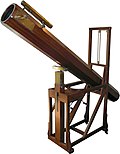
-
 One possible signature of a Higgs boson from a simulated proton–proton collision. It decays almost immediately into two jets of hadrons and two electrons, visible as lines. (from History of physics)
 -
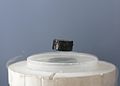 A magnet levitating above a high-temperature superconductor. Today some physicists are working to understand high-temperature superconductivity using the AdS/CFT correspondence. (from Condensed matter physics)
 -
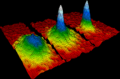 The first Bose–Einstein condensate observed in a gas of ultracold rubidium atoms. The blue and white areas represent higher density. (from Condensed matter physics)
 -
 Star maps by the 11th century Chinese polymath Su Song are the oldest known woodblock-printed star maps to have survived to the present day. This example, dated 1092, employs the cylindricalequirectangular projection. (from History of physics)
 -
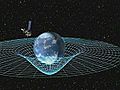 Einstein proposed that gravitation results from masses (or their equivalent energies) curving ("bending") the spacetime in which they exist, altering the paths they follow within it. (from History of physics)
 -
 Classical physics (Rayleigh–Jeans law, black line) failed to explain black-body radiation – the so-called ultraviolet catastrophe. The quantum description (Planck's law, colored lines) is said to be modern physics. (from Modern physics)
 -
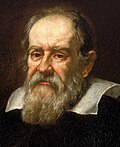 Galileo Galilei (1564–1642), early proponent of the modern scientific worldview and method (from History of physics)
 -

-
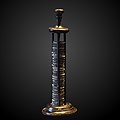 The Voltaic pile, the first battery was invented by Alessandro Volta in 1800 (from History of physics)
 -
-
-
 Richard Feynman's Los Alamos ID badge (from History of physics)
 -
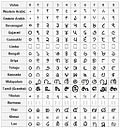 The Hindu-Arabic numeral system. The inscriptions on the edicts of Ashoka (3rd century BCE) display this number system being used by the Imperial Mauryas. (from History of physics)
 -
 Chien-Shiung Wu worked on parity violation in 1956 and announced her results in January 1957. (from History of physics)
 -
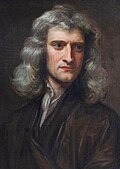 Sir Isaac Newton (1642–1727) (from History of physics)
 -
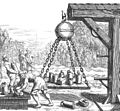 Magdeburg hemispheres, an experiment by Otto von Guericke where two metal hemispheres are held together by vacuum and cannot be separated even if large forces are applied. (from History of physics)
 -
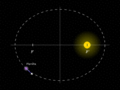 Johannes Kepler's first law of planetary motion states that planets move in elliptical orbits about the Sun. (from History of physics)
 -
 The Standard Model (from History of physics)
 -
-
 The ancient Greek mathematician Archimedes, developer of ideas regarding fluid mechanics and buoyancy. (from History of physics)
 -

-
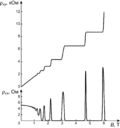 The quantum Hall effect: Components of the Hall resistivity as a function of the external magnetic field (from Condensed matter physics)
 -
 Composite montage comparing Jupiter (left) and its four Galilean moons (from top: Io, Europa, Ganymede, Callisto) (from History of physics)
 -
 An engraving of Benjamin Franklin's kite experiment used to study lightning. (from History of physics)
 -
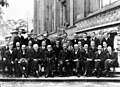 1927 Solvay Conference included prominent physicists Albert Einstein, Werner Heisenberg, Max Planck, Hendrik Lorentz, Niels Bohr, Marie Curie, Erwin Schrödinger, Paul Dirac (from History of physics)
 -
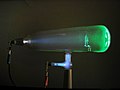 Crookes tube used to study cathode rays. It led to the discovery of the electron by J. J. Thomson. (from History of physics)
 -
 Hydrogen emission spectrum is discrete (here in log scale). The lines can only be explained with quantum mechanics. (from History of physics)
 -
 James Prescott Joule's apparatus for measuring the mechanical equivalent of heat which the "work" of the falling weight is converted into the "heat" of agitation in the water. (from History of physics)
 -
 Newton's cannonball, a though experiment by Newton relating the motion of a projectile and orbiting of planets. (from History of physics)
 -
 Christiaan Huygens (1629–1695) (from History of physics)
 -
 Maxwell's demon, thought experiment by James Clerk Maxwell to describe the kinetic theory of gases and describe how a microscopic creature could lead to violations of the second law of thermodynamics. (from History of physics)
 -
 Heike Kamerlingh Onnes and Johannes van der Waals with the helium liquefactor at Leiden in 1908 (from Condensed matter physics)
 -
 Albert Einstein (1879–1955), ca. 1905 (from History of physics)
 -
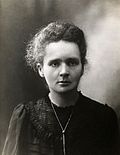 Marie Skłodowska-Curie
(1867–1934) received Nobel prizes in physics (1903) and chemistry (1911). (from History of physics) -

-
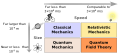 Classical physics is usually concerned with everyday conditions: speeds are much lower than the speed of light, sizes are much greater than that of atoms, yet very small in astronomical terms. Modern physics, however, is concerned with high velocities, small distances, and very large energies. (from Modern physics)
 -
 Image of X-ray diffraction pattern from a protein crystal (from Condensed matter physics)
 -
 A Feynman diagram representing (left to right) the production of a photon (blue sine wave) from the annihilation of an electron and its complementary antiparticle, the positron. The photon becomes a quark–antiquark pair and a gluon (green spiral) is released. (from History of physics)
 -
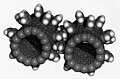 Computer simulation of nanogears made of fullerene molecules. It is hoped that advances in nanoscience will lead to machines working on the molecular scale. (from Condensed matter physics)


_in_1958.jpg)


.png)


.png)


.png)


Categories

Fundamentals: Concepts in physics | Constants | Physical quantities | Units of measure | Mass | Length | Time | Space | Energy | Matter | Force | Gravity | Electricity | Magnetism | Waves
Basic physics: Mechanics | Electromagnetism | Statistical mechanics | Thermodynamics | Quantum mechanics | Theory of relativity | Optics | Acoustics
Specific fields: Acoustics | Astrophysics | Atomic physics | Molecular physics | Optical physics | Computational physics | Condensed matter physics | Nuclear physics | Particle physics | Plasma physics
Tools: Detectors | Interferometry | Measurement | Radiometry | Spectroscopy | Transducers
Background: Physicists | History of physics | Philosophy of physics | Physics education | Physics journals | Physics organizations
Other: Fiction about physics | Physics lists | Physics software | Physics stubs
Physics topics
Classical physics traditionally includes the fields of mechanics, optics, electricity, magnetism, acoustics and thermodynamics. The term Modern physics is normally used for fields which rely heavily on quantum theory, including quantum mechanics, atomic physics, nuclear physics, particle physics and condensed matter physics. General and special relativity are usually considered to be part of modern physics as well.
More recognized content

Associated Wikimedia
The following Wikimedia Foundation sister projects provide more on this subject:
-
 Commons
Free media repository -
 Wikidata
Free knowledge base -
 Wikiquote
Collection of quotations -
 Wikisource
Free-content library -
 Wikiversity
Free learning tools -
 Wikivoyage
Free travel guide -
 Wiktionary
Dictionary and thesaurus


Sources
Portals on Wikipedia


Content Disclaimer
Informasi ini disarikan dari Wikipedia dan disajikan kembali untuk tujuan edukasi. Konten tersedia di bawah lisensi CC BY-SA 3.0. Kami tidak bertanggung jawab atas ketidakakuratan data yang bersumber dari kontribusi publik tersebut.
- The information displayed on this website is sourced in part or in whole from Wikipedia and has been adapted for the purpose of restating it. We strive to provide accurate and relevant information, however:
- There is no guarantee of absolute accuracy. Wikipedia is an open, collaborative project that can be edited by anyone, so information is subject to change.
- It is not intended to constitute professional advice. The content displayed is for informational and educational purposes only. For important decisions (e.g., medical, legal, or financial), please consult a professional.
- Content copyright. Wikipedia is licensed under the Creative Commons Attribution-ShareAlike License (CC BY-SA). This means that content may be reused with appropriate attribution and shared under a similar license.
- Responsible use. Any risk arising from the use of information from this website is entirely the responsibility of the user.