Talk:Self-phase modulation
 | This article is rated Start-class on Wikipedia's content assessment scale. It is of interest to the following WikiProjects: | ||||||||||
| |||||||||||
.jpg)

It is vague (at best) how one arrives at the phase in the derivation:
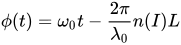
Also, this is stated without citation. My guess is that it has to do with the electric field, which is hidden in this discussion of the pulse intensity, but I'm not sure, and I'd like someone to clarify. Wolfman81 (talk) 21:07, 9 June 2009 (UTC)
- 2 pi n / wavelength = wavevector, k
- So what you're looking at is basically wt-kx, where x=L is some distance 2603:8080:2B00:11D4:5164:1D40:F797:C693 (talk) 01:14, 14 September 2024 (UTC)
"This variation in refractive index will produce a phase shift in the pulse, leading to a symmetric broadening of the pulse's frequency spectrum." This is only true for symmetric pulses where the current chirp has the same sign as . In all other cases SPM only results in a change of the spectrum. I was very suprised the first time I propagated a negatively chirped pulse into a positive material. The spectrum got narrower. --Erik Zeek 20:06, 1 December 2005 (UTC)

Re-writing the article because I don't think the derivation below is correct. In particular the frequency shift doesn't seem to have the correct form. --Bob Mellish 00:41, 4 November 2005 (UTC)
Negative Nonlinearities
Part of the text in this article assumes that the nonlinear coefficient n_{2} is positive. Matthew Rollings (talk) 20:20, 1 February 2009 (UTC)
Original derivation
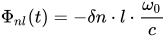
where is the refractive index, is the propagation distance in the medium, is the velocity of light in vacuum and is the carrier-frequency of the pulse.


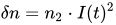
is the second order change of the nonlinear refractive index. The instantaneous frequency is given by

with
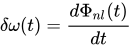
being the phase velocity. In case of a common hyperbolic secant pulse shape the intensity is given by
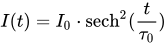
Therefore the nonlinear phase of this pulse becomes

and the instantaneous frequency is shifted by the term

Content Disclaimer
Informasi ini disarikan dari Wikipedia dan disajikan kembali untuk tujuan edukasi. Konten tersedia di bawah lisensi CC BY-SA 3.0. Kami tidak bertanggung jawab atas ketidakakuratan data yang bersumber dari kontribusi publik tersebut.
- The information displayed on this website is sourced in part or in whole from Wikipedia and has been adapted for the purpose of restating it. We strive to provide accurate and relevant information, however:
- There is no guarantee of absolute accuracy. Wikipedia is an open, collaborative project that can be edited by anyone, so information is subject to change.
- It is not intended to constitute professional advice. The content displayed is for informational and educational purposes only. For important decisions (e.g., medical, legal, or financial), please consult a professional.
- Content copyright. Wikipedia is licensed under the Creative Commons Attribution-ShareAlike License (CC BY-SA). This means that content may be reused with appropriate attribution and shared under a similar license.
- Responsible use. Any risk arising from the use of information from this website is entirely the responsibility of the user.