Talk:Reflection phase change
| This is the talk page for discussing improvements to the Reflection phase change article. This is not a forum for general discussion of the subject of the article. |
Article policies
|
| Find sources: Google (books · news · scholar · free images · WP refs) · FENS · JSTOR · TWL |
 | This article is rated Start-class on Wikipedia's content assessment scale. It is of interest to the following WikiProjects: | ||||||||||
| |||||||||||
.jpg)

Phase shifts other than 180 degrees
I believe the 180 degree phase shift is actually an approximation. If you use the full complex refractive index (absorption included)you get phase shifts such as 160 degrees. See http://www.opticsinfobase.org/josa/abstract.cfm?uri=josa-54-5-612 — Preceding unsigned comment added by 131.111.185.3 (talk) 14:18, 5 March 2015 (UTC)
- Yes, the same result is evident from the transmission line case if complex values for impedance are considered. SpinningSpark 11:58, 30 January 2022 (UTC)
Application to transmission lines
The reflection coefficient for transmission lines in terms of characteristic impedance is given by,
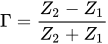
where the subscripts refer to the first and second medium respectively. From,
- and


for a lossless line, where L and C are respectively the inductance and capacitance per unit length, the reflection coefficient in terms of velocities is,

which implies that the phase inversion occurs at,

and not at,

This can equally be stated in terms of capacitance or permeability/permittivity. Can anyone shed any light on this? SpinningSpark 12:13, 30 January 2022 (UTC)
Content Disclaimer
Informasi ini disarikan dari Wikipedia dan disajikan kembali untuk tujuan edukasi. Konten tersedia di bawah lisensi CC BY-SA 3.0. Kami tidak bertanggung jawab atas ketidakakuratan data yang bersumber dari kontribusi publik tersebut.
- The information displayed on this website is sourced in part or in whole from Wikipedia and has been adapted for the purpose of restating it. We strive to provide accurate and relevant information, however:
- There is no guarantee of absolute accuracy. Wikipedia is an open, collaborative project that can be edited by anyone, so information is subject to change.
- It is not intended to constitute professional advice. The content displayed is for informational and educational purposes only. For important decisions (e.g., medical, legal, or financial), please consult a professional.
- Content copyright. Wikipedia is licensed under the Creative Commons Attribution-ShareAlike License (CC BY-SA). This means that content may be reused with appropriate attribution and shared under a similar license.
- Responsible use. Any risk arising from the use of information from this website is entirely the responsibility of the user.