Talk:Gibbs algorithm
 | This article is rated Stub-class on Wikipedia's content assessment scale. It is of interest to the following WikiProjects: | ||||||||||
| |||||||||||
.jpg)

Gibbs measure
This page mentions two things: The Gibbs Algorithm and the Gibbs Distribution. In my opinion, both are important and should be separated. According to various Markov Random Field literature, the Gibbs distribution takes the form of:

where
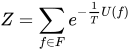
is a normalizing factor. T is a constant called the temperature, and U(f) is an energy function. For a specific choice of U(f), this leads to the (Gaussian) Normal_distribution.
Maybe the Gibbs distrubution should redirect to the Gibbs_measure (Unsigned, User:146.50.1.141, January 2007)
- Now fixed. linas (talk) 21:16, 30 August 2008 (UTC)
Gibbs Algorithm vs Gibbs Sampler
This article states that the Gibbs Algorithm is different from the Gibbs Sampler. But I encountered various interpretations of Markov Random Fields in terms of maximizing the Entropy, which is often defined as
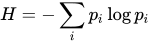
This makes the Gibbs algorithm probably a special case of Markov chain Monte Carlo iterations. For an interpretation of Markov Random Fields in terms of Entropy see for example here [1] op page 5/6. (Unsigned, User:146.50.1.141, January 2007)
On a similar note the article states is the 'average log probability'. The expression given (entropy) is the negative of that quantity. This makes the language about 'minimising the average log probability' confusing - since we should actually be maximising it. - Summary, I think there is a sign error. — Preceding unsigned comment added by 62.25.109.195 (talk) 11:54, 18 December 2013 (UTC)

Content Disclaimer
Informasi ini disarikan dari Wikipedia dan disajikan kembali untuk tujuan edukasi. Konten tersedia di bawah lisensi CC BY-SA 3.0. Kami tidak bertanggung jawab atas ketidakakuratan data yang bersumber dari kontribusi publik tersebut.
- The information displayed on this website is sourced in part or in whole from Wikipedia and has been adapted for the purpose of restating it. We strive to provide accurate and relevant information, however:
- There is no guarantee of absolute accuracy. Wikipedia is an open, collaborative project that can be edited by anyone, so information is subject to change.
- It is not intended to constitute professional advice. The content displayed is for informational and educational purposes only. For important decisions (e.g., medical, legal, or financial), please consult a professional.
- Content copyright. Wikipedia is licensed under the Creative Commons Attribution-ShareAlike License (CC BY-SA). This means that content may be reused with appropriate attribution and shared under a similar license.
- Responsible use. Any risk arising from the use of information from this website is entirely the responsibility of the user.