Shack
 | This article needs additional citations for verification. (October 2018) |

A shack (or, in some areas, shanty) is a type of small shelter or dwelling, often primitive or rudimentary in design and construction.
Unlike huts, shacks are constructed by hand using available materials; however, whereas huts are usually rural and made of natural materials (mud, rocks, sticks, etc.) shacks are generally composed of scavenged man-made materials like abandoned construction debris, repurposed consumer waste and other useful discarded objects that can be quickly acquired at little or no cost and fashioned into a small dwelling.
Background
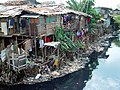
In areas of high population density and high poverty, shacks are often the most prevalent form of housing; it is possible that up to a billion people worldwide live in shacks.[1] Fire is a significant hazard in tight-knit shack settlements.[2] Settlements composed mostly or entirely of shacks are known as slums or shanty towns.
In Australian English, shack can also refer to a small holiday house with limited conveniences, for instance it may not have running water or electricity.
In Canadian oilfield drilling, a shack can also be the word for a wellsite trailer. These structures are notorious among oilfield workers for being cramped, uncomfortable and generally unpleasant to be in.
In the 19th and early 20th centuries, tar paper shacks consisting of wooden frames covered with tar paper were a common form of very low-cost housing in the rural United States and Canada.[3][4]
Cultural role in freethought
In the frontier history of the United States, freethinkers have often used shacks—small, rundown buildings or structures—as a place to develop new ideas outside the literal confines of the establishment. Professor Michael Lannoo and science writer and editor Eric Engles note the role of shacks in American culture as simple structures that "allow an uncluttered perspective on life's larger questions". Lanoo writes that shacks played a large role in the development of environmental and ecological ideas and philosophy in the United States, allowing people to interact with and investigate nature at a closer level, particularly in the work of Henry David Thoreau, John Muir, Aldo Leopold, and Ed Ricketts. These shacks also served as a meeting place for like-minded people.[5]
Gallery
-
 Shacks in Kayamandi, South Africa
 -

-
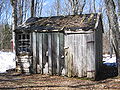 In relatively affluent areas, shacks are often used for storage or have been abandoned.
 -
-
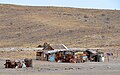 Shacks of Damara people within Namib Desert
 -
 Shack near railway line
 -
 Tar paper shack in the United States, 1930s
 -


See also
References


- ^ Planet of Slums, Verso, 2006
- ^ A Big Devil in the Jondolos: A report on shack fires by Matt Birkinshaw
- ^ "Tar paper shack in Minnesota cut-over area, Beltrami County, Minnesota". Library of Congress.
- ^ "Flashback Friday: Carrie Ingalls & Her Tar Paper Shack".
- ^ Lanoo, Michael J. (2010). Leopold's Shack and Ricketts's Lab. University of California Press. pp. 1-7; ISBN 9780520946064. OCLC 646788647.
| Traditional immobile |
|  |
|---|---|---|
| Traditional mobile | ||
| Open-air | ||
| Modern | ||
| Related topics | ||


Content Disclaimer
Informasi ini disarikan dari Wikipedia dan disajikan kembali untuk tujuan edukasi. Konten tersedia di bawah lisensi CC BY-SA 3.0. Kami tidak bertanggung jawab atas ketidakakuratan data yang bersumber dari kontribusi publik tersebut.
- The information displayed on this website is sourced in part or in whole from Wikipedia and has been adapted for the purpose of restating it. We strive to provide accurate and relevant information, however:
- There is no guarantee of absolute accuracy. Wikipedia is an open, collaborative project that can be edited by anyone, so information is subject to change.
- It is not intended to constitute professional advice. The content displayed is for informational and educational purposes only. For important decisions (e.g., medical, legal, or financial), please consult a professional.
- Content copyright. Wikipedia is licensed under the Creative Commons Attribution-ShareAlike License (CC BY-SA). This means that content may be reused with appropriate attribution and shared under a similar license.
- Responsible use. Any risk arising from the use of information from this website is entirely the responsibility of the user.