Humpy
.jpg)


A humpy, also known as a gunyah,[1][2][3][4] wurley, wurly, wurlie, mia-mia, or wiltija, is a small, temporary shelter, traditionally used by Australian Aboriginal people. These impermanent dwellings, made of branches and bark, are sometimes called a lean-to, since they often rely on a standing tree for support.
Etymology
The word humpy comes from the Turrubal language (a Murri people from now-inner Brisbane, e.g. Coorparoo, Nundah). Other languages had different names for the structure. In South Australia, such a shelter is known as a "wurley" (also spelled "wurlie"), possibly from the Kaurna language.[5][6][7] They are called wiltjas in Pitjantjatjara and Yankunytjatjara languages; mia-mia in Wadawurrung language around Melbourne.[8][9]
Usage
They were temporary shelters made of bark, branches, leaves and grass used by Indigenous Australians.[10] Both names were adopted by early white settlers, and now form part of the Australian lexicon. The use of the term appears to have broadened in later usage to include any temporary building made from any available materials, including canvas, flattened metal drums, and sheets of corrugated iron.
In Dark Emu, Bruce Pascoe argues that contrary to popular perception of Aboriginal dwellings being only temporary, some gunyahs in the Channel Country could accommodate up to 50 people and formed part of permanent agricultural communities.[11]
Gallery
-
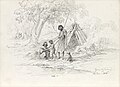 Aboriginal family and their temporary bark gunya (shelter), c. 1856
 -
 Aboriginal woman in front of bark gunya (shelter), Victoria, c. 1872
 -
 Two Aboriginal woman in front of bark gunya, c. 1850s
 -
 Temporary lean-to bark gunyah, c. 1888
 -
 Temporary lean-to bark gunyah, 1889
 -
 Aboriginal people at the entrance to their dwelling, Western Australia, c. 1876
 -
 Framework of a humpy in far western Queensland, 1937
 -
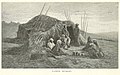 Native Wurley, 1886
 -
 Bushman humpy, 1910s
 -
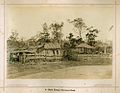 Bark humpy, Brisbane, 1874
 -
![[Aboriginal people] and wurlie near Alice Springs (Mparntwe), c. 1930s.](//upload.wikimedia.org/wikipedia/commons/thumb/6/69/Govers_067.tif/lossy-page1-120px-Govers_067.tif.jpg) [Aboriginal people] and wurlie near Alice Springs (Mparntwe), c. 1930s.
[Aboriginal people] and wurlie near Alice Springs (Mparntwe), c. 1930s. -
 Aboriginal wurlie near Alice Springs, c. 1930s

,_Johns_Album_ca._1872.jpg)
_wrapped_in_traditional_pelt_cloaks,_John_Hunter_Kerr._ca._1850s.jpg)
,_ca._1888.jpg)
,_ca._1870.jpg)

_(19306853893).jpg)


![[Aboriginal people] and wurlie near Alice Springs (Mparntwe), c. 1930s.](http://upload.wikimedia.org/wikipedia/commons/thumb/6/69/Govers_067.tif/lossy-page1-120px-Govers_067.tif.jpg)

See also
Notes
- ^ "Definition of gunyah". www.allwords.com.
- ^ Memmott, Paul (2007), Gunyah, Goondie and Wurley : the Aboriginal architecture of Australia (1st ed.), University of Queensland Press, ISBN 978-0-7022-3245-9
- ^ "Tents". One Planet. Retrieved 6 December 2012.
- ^ Cannot, Jack; Prince, Victor (1912), I'll build a gunyah for you : song, Allan & Co. Pty. Ltd, retrieved 7 January 2019
- ^ Peters, Pam, The Cambridge Australian English Style Guide, Cambridge University Press, 1996, p818
- ^ "A Bark Humpy. How to Build it?". The Queenslander. Queensland, Australia. 30 October 1930. p. 57. Retrieved 7 January 2019 – via National Library of Australia.
- ^ "Humpies and Gunyahs : Coloured Families on the Tweed". Sunday Mail. No. 550. Queensland, Australia. 10 December 1933. p. 7. Retrieved 7 January 2019 – via National Library of Australia.
- ^ Australian Indigenous tools and technology - Australia's Culture Portal Archived 2010-04-16 at the Wayback Machine
- ^ "Our People". Borough of Queenscliffe.
- ^ Australian National Research Council (1930). Oceania. University of Sydney. p. 288.
- ^ Westaway, Michael; Gorringe, Joshua (17 June 2021). Freeman-Greene, Suzy; Beaumont, Lucy (eds.). "Friday essay: How our new archaeological research investigates Dark Emu's idea of Aboriginal 'agriculture' and villages". doi:10.64628/AA.9f5jnr66f.
External links
Tents and overnight shelters | |
|---|---|
| Traditional types | |
| Modern types | |
| Equipment | |
| Related topics | |

| Traditional immobile |
|  |
|---|---|---|
| Traditional mobile | ||
| Open-air | ||
| Modern | ||
| Related topics | ||


 | This Indigenous Australians-related article is a stub. You can help Wikipedia by adding missing information. |
Content Disclaimer
Informasi ini disarikan dari Wikipedia dan disajikan kembali untuk tujuan edukasi. Konten tersedia di bawah lisensi CC BY-SA 3.0. Kami tidak bertanggung jawab atas ketidakakuratan data yang bersumber dari kontribusi publik tersebut.
- The information displayed on this website is sourced in part or in whole from Wikipedia and has been adapted for the purpose of restating it. We strive to provide accurate and relevant information, however:
- There is no guarantee of absolute accuracy. Wikipedia is an open, collaborative project that can be edited by anyone, so information is subject to change.
- It is not intended to constitute professional advice. The content displayed is for informational and educational purposes only. For important decisions (e.g., medical, legal, or financial), please consult a professional.
- Content copyright. Wikipedia is licensed under the Creative Commons Attribution-ShareAlike License (CC BY-SA). This means that content may be reused with appropriate attribution and shared under a similar license.
- Responsible use. Any risk arising from the use of information from this website is entirely the responsibility of the user.