K-function
In mathematics, the K-function, typically denoted K(z), is a generalization of the hyperfactorial to complex numbers, similar to the generalization of the factorial to the gamma function.
Definition
There are multiple equivalent definitions of the K-function.
The direct definition:
![{\displaystyle K(z)=(2\pi )^{-{\frac {z-1}{2}}}\exp \left[{\binom {z}{2}}+\int _{0}^{z-1}\ln \Gamma (t+1)\,dt\right].}](https://wikimedia.org/api/rest_v1/media/math/render/svg/92baaaf4dc396046aef97cda91dd4f102aa06973)
Definition via
![{\displaystyle K(z)=\exp {\bigl [}\zeta '(-1,z)-\zeta '(-1){\bigr ]}}](https://wikimedia.org/api/rest_v1/media/math/render/svg/12668025758db5c6b204ac5b1f43c1e8e05785a5)
where ζ′(z) denotes the derivative of the Riemann zeta function, ζ(a,z) denotes the Hurwitz zeta function and

Definition via polygamma function:[1]
![{\displaystyle K(z)=\exp \left[\psi ^{(-2)}(z)+{\frac {z^{2}-z}{2}}-{\frac {z}{2}}\ln 2\pi \right]}](https://wikimedia.org/api/rest_v1/media/math/render/svg/527eb0c1daf22e5bb0b92ff2ff331e64b68f597e)
Definition via balanced generalization of the polygamma function:[2]
![{\displaystyle K(z)=A\exp \left[\psi (-2,z)+{\frac {z^{2}-z}{2}}\right]}](https://wikimedia.org/api/rest_v1/media/math/render/svg/e7e5a0771140cd752c427198127287d5cc8b0466)
where A is the Glaisher constant.
It can be defined via unique characterization, similar to how the gamma function can be uniquely characterized by the Bohr-Mollerup Theorem:
Let be a solution to the functional equation , such that there exists some , such that given any distinct , the divided difference . Such functions are precisely , where is an arbitrary constant.[3]



![{\displaystyle f[x_{0},x_{1},x_{2},x_{3}]\geq 0}](https://wikimedia.org/api/rest_v1/media/math/render/svg/8c0cd26e190d4f5b18250e540cf85b9a25d78d8d)


Properties
For α > 0:

Let
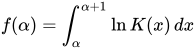
Differentiating this identity now with respect to α yields:

Applying the logarithm rule we get
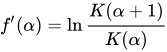
By the definition of the K-function we write
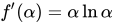
And so

Setting α = 0 we have
![{\displaystyle \int _{0}^{1}\ln K(x)\,dx=\lim _{t\rightarrow 0}\left[{\tfrac {1}{2}}t^{2}\left(\ln t-{\tfrac {1}{2}}\right)\right]+C\ =C}](https://wikimedia.org/api/rest_v1/media/math/render/svg/b8e8c9ffa5aadcb54c1d1df9e5a769e78d7fa08a)
Functional equations
The K-function is closely related to the gamma function and the Barnes G-function. For all complex ,


Multiplication formula
Similar to the multiplication formula for the gamma function:

there exists a multiplication formula for the K-Function involving Glaisher's constant:[4]

Integer values
For all non-negative integers,where is the hyperfactorial.


The first values are
References
- ^ Adamchik, Victor S. (1998), "PolyGamma Functions of Negative Order", Journal of Computational and Applied Mathematics, 100 (2): 191–199, doi:10.1016/S0377-0427(98)00192-7, archived from the original on 2016-03-03
- ^ Espinosa, Olivier; Moll, Victor Hugo (2004) [April 2004], "A Generalized polygamma function" (PDF), Integral Transforms and Special Functions, 15 (2): 101–115, doi:10.1080/10652460310001600573, archived (PDF) from the original on 2023-05-14
- ^ Marichal, Jean-Luc; Zenaïdi, Naïm (2024). "A Generalization of Bohr-Mollerup's Theorem for Higher Order Convex Functions: a Tutorial" (PDF). Bitstream. 98 (2): 455–481. arXiv:2207.12694. doi:10.1007/s00010-023-00968-9. Archived (PDF) from the original on 2023-04-05.
- ^ Sondow, Jonathan; Hadjicostas, Petros (2006-10-16). "The generalized-Euler-constant function γ(z) and a generalization of Somos's quadratic recurrence constant". Journal of Mathematical Analysis and Applications. 332: 292–314. arXiv:math/0610499. doi:10.1016/j.jmaa.2006.09.081.
External links
Content Disclaimer
Informasi ini disarikan dari Wikipedia dan disajikan kembali untuk tujuan edukasi. Konten tersedia di bawah lisensi CC BY-SA 3.0. Kami tidak bertanggung jawab atas ketidakakuratan data yang bersumber dari kontribusi publik tersebut.
- The information displayed on this website is sourced in part or in whole from Wikipedia and has been adapted for the purpose of restating it. We strive to provide accurate and relevant information, however:
- There is no guarantee of absolute accuracy. Wikipedia is an open, collaborative project that can be edited by anyone, so information is subject to change.
- It is not intended to constitute professional advice. The content displayed is for informational and educational purposes only. For important decisions (e.g., medical, legal, or financial), please consult a professional.
- Content copyright. Wikipedia is licensed under the Creative Commons Attribution-ShareAlike License (CC BY-SA). This means that content may be reused with appropriate attribution and shared under a similar license.
- Responsible use. Any risk arising from the use of information from this website is entirely the responsibility of the user.