Hyperfactorial
In mathematics, and more specifically number theory, the hyperfactorial of a positive integer is the product of the numbers of the form from to .


Definition
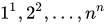
The hyperfactorial of a positive integer is the product of the numbers . That is,[1][2] Following the usual convention for the empty product, the hyperfactorial of 0 is 1. The sequence of hyperfactorials, beginning with , is:[1]


Interpolation and approximation
The hyperfactorials were studied beginning in the 19th century by Hermann Kinkelin[3][4] and James Whitbread Lee Glaisher.[5][4] As Kinkelin showed, just as the factorials can be continuously interpolated by the gamma function, the hyperfactorials can be continuously interpolated by the K-function as .[3]

Glaisher provided an asymptotic formula for the hyperfactorials, analogous to Stirling's formula for the factorials: where is the Glaisher–Kinkelin constant.[2][5]


Other properties
According to an analogue of Wilson's theorem on the behavior of factorials modulo prime numbers, when is an odd prime number where is the notation for the double factorial.[4]



The hyperfactorials give the sequence of discriminants of Hermite polynomials in their probabilistic formulation.[1]
See also
References
- ^ a b c Sloane, N. J. A. (ed.), "Sequence A002109 (Hyperfactorials: Product_{k = 1..n} k^k)", The On-Line Encyclopedia of Integer Sequences, OEIS Foundation
- ^ a b Alabdulmohsin, Ibrahim M. (2018), Summability Calculus: A Comprehensive Theory of Fractional Finite Sums, Cham: Springer, pp. 5–6, doi:10.1007/978-3-319-74648-7, ISBN 978-3-319-74647-0, MR 3752675, S2CID 119580816
- ^ a b Kinkelin, H. (1860), "Ueber eine mit der Gammafunction verwandte Transcendente und deren Anwendung auf die Integralrechung" [On a transcendental variation of the gamma function and its application to the integral calculus], Journal für die reine und angewandte Mathematik (in German), 1860 (57): 122–138, doi:10.1515/crll.1860.57.122, S2CID 120627417
- ^ a b c Aebi, Christian; Cairns, Grant (2015), "Generalizations of Wilson's theorem for double-, hyper-, sub- and superfactorials", The American Mathematical Monthly, 122 (5): 433–443, doi:10.4169/amer.math.monthly.122.5.433, JSTOR 10.4169/amer.math.monthly.122.5.433, MR 3352802, S2CID 207521192
- ^ a b Glaisher, J. W. L. (1877), "On the product 11.22.33... nn", Messenger of Mathematics, 7: 43–47
External links
Content Disclaimer
Informasi ini disarikan dari Wikipedia dan disajikan kembali untuk tujuan edukasi. Konten tersedia di bawah lisensi CC BY-SA 3.0. Kami tidak bertanggung jawab atas ketidakakuratan data yang bersumber dari kontribusi publik tersebut.
- The information displayed on this website is sourced in part or in whole from Wikipedia and has been adapted for the purpose of restating it. We strive to provide accurate and relevant information, however:
- There is no guarantee of absolute accuracy. Wikipedia is an open, collaborative project that can be edited by anyone, so information is subject to change.
- It is not intended to constitute professional advice. The content displayed is for informational and educational purposes only. For important decisions (e.g., medical, legal, or financial), please consult a professional.
- Content copyright. Wikipedia is licensed under the Creative Commons Attribution-ShareAlike License (CC BY-SA). This means that content may be reused with appropriate attribution and shared under a similar license.
- Responsible use. Any risk arising from the use of information from this website is entirely the responsibility of the user.