Finite difference coefficient
In mathematics, to approximate a derivative to an arbitrary order of accuracy, it is possible to use the finite difference. A finite difference can be central, forward or backward.
Central finite difference
This table contains the coefficients of the central differences, for several orders of accuracy and with uniform grid spacing:[1]
| Derivative | Accuracy | −5 | −4 | −3 | −2 | −1 | 0 | 1 | 2 | 3 | 4 | 5 |
|---|---|---|---|---|---|---|---|---|---|---|---|---|
| 1 | 2 | −1/2 | 0 | 1/2 | ||||||||
| 4 | 1/12 | −2/3 | 0 | 2/3 | −1/12 | |||||||
| 6 | −1/60 | 3/20 | −3/4 | 0 | 3/4 | −3/20 | 1/60 | |||||
| 8 | 1/280 | −4/105 | 1/5 | −4/5 | 0 | 4/5 | −1/5 | 4/105 | −1/280 | |||
| 2 | 2 | 1 | −2 | 1 | ||||||||
| 4 | −1/12 | 4/3 | −5/2 | 4/3 | −1/12 | |||||||
| 6 | 1/90 | −3/20 | 3/2 | −49/18 | 3/2 | −3/20 | 1/90 | |||||
| 8 | −1/560 | 8/315 | −1/5 | 8/5 | −205/72 | 8/5 | −1/5 | 8/315 | −1/560 | |||
| 3 | 2 | −1/2 | 1 | 0 | −1 | 1/2 | ||||||
| 4 | 1/8 | −1 | 13/8 | 0 | −13/8 | 1 | −1/8 | |||||
| 6 | −7/240 | 3/10 | −169/120 | 61/30 | 0 | −61/30 | 169/120 | −3/10 | 7/240 | |||
| 4 | 2 | 1 | −4 | 6 | −4 | 1 | ||||||
| 4 | −1/6 | 2 | −13/2 | 28/3 | −13/2 | 2 | −1/6 | |||||
| 6 | 7/240 | −2/5 | 169/60 | −122/15 | 91/8 | −122/15 | 169/60 | −2/5 | 7/240 | |||
| 5 | 2 | −1/2 | 2 | −5/2 | 0 | 5/2 | −2 | 1/2 | ||||
| 4 | 1/6 | −3/2 | 13/3 | −29/6 | 0 | 29/6 | −13/3 | 3/2 | −1/6 | |||
| 6 | −13/288 | 19/36 | −87/32 | 13/2 | −323/48 | 0 | 323/48 | −13/2 | 87/32 | −19/36 | 13/288 | |
| 6 | 2 | 1 | −6 | 15 | −20 | 15 | −6 | 1 | ||||
| 4 | −1/4 | 3 | −13 | 29 | −75/2 | 29 | −13 | 3 | −1/4 | |||
| 6 | 13/240 | −19/24 | 87/16 | −39/2 | 323/8 | −1023/20 | 323/8 | −39/2 | 87/16 | −19/24 | 13/240 |
For example, the third derivative with a second-order accuracy is

where represents a uniform grid spacing between each finite difference interval, and .


For the -th derivative with accuracy , there are central coefficients . These are given by the solution of the linear equation system


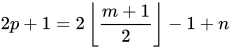

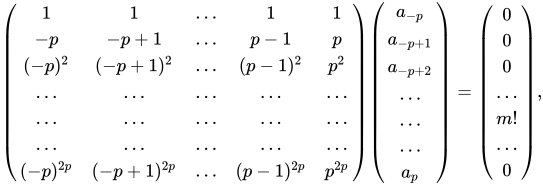
where the only non-zero value on the right hand side is in the -th row.

An open source implementation for calculating finite difference coefficients of arbitrary derivates and accuracy order in one dimension is available.[2]
Given that the left-hand side matrix is a transposed Vandermonde matrix, a rearrangement reveals that the coefficients are basically computed by fitting and deriving a -th order polynomial to a window of points. Consequently, the coefficients can also be computed as the -th order derivative of a fully determined Savitzky–Golay filter with polynomial degree and a window size of . For this, open source implementations are also available.[3] There are two possible definitions which differ in the ordering of the coefficients: a filter for filtering via discrete convolution or via a matrix-vector-product. The coefficients given in the table above correspond to the latter definition.


The theory of Lagrange polynomials provides explicit formulas for the finite difference coefficients.[4] For the first six derivatives we have the following:
| Derivative | ||
|---|---|---|
| 1 | ||
| 2 | ||
| 3 | ||
| 4 | ||
| 5 | ||
| 6 |


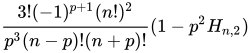
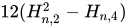




where are generalized harmonic numbers.

Forward finite difference
This table contains the coefficients of the forward differences, for several orders of accuracy and with uniform grid spacing:[1]
| Derivative | Accuracy | 0 | 1 | 2 | 3 | 4 | 5 | 6 | 7 | 8 |
|---|---|---|---|---|---|---|---|---|---|---|
| 1 | 1 | −1 | 1 | |||||||
| 2 | −3/2 | 2 | −1/2 | |||||||
| 3 | −11/6 | 3 | −3/2 | 1/3 | ||||||
| 4 | −25/12 | 4 | −3 | 4/3 | −1/4 | |||||
| 5 | −137/60 | 5 | −5 | 10/3 | −5/4 | 1/5 | ||||
| 6 | −49/20 | 6 | −15/2 | 20/3 | −15/4 | 6/5 | −1/6 | |||
| 2 | 1 | 1 | −2 | 1 | ||||||
| 2 | 2 | −5 | 4 | −1 | ||||||
| 3 | 35/12 | −26/3 | 19/2 | −14/3 | 11/12 | |||||
| 4 | 15/4 | −77/6 | 107/6 | −13 | 61/12 | −5/6 | ||||
| 5 | 203/45 | −87/5 | 117/4 | −254/9 | 33/2 | −27/5 | 137/180 | |||
| 6 | 469/90 | −223/10 | 879/20 | −949/18 | 41 | −201/10 | 1019/180 | −7/10 | ||
| 3 | 1 | −1 | 3 | −3 | 1 | |||||
| 2 | −5/2 | 9 | −12 | 7 | −3/2 | |||||
| 3 | −17/4 | 71/4 | −59/2 | 49/2 | −41/4 | 7/4 | ||||
| 4 | −49/8 | 29 | −461/8 | 62 | −307/8 | 13 | −15/8 | |||
| 5 | −967/120 | 638/15 | −3929/40 | 389/3 | −2545/24 | 268/5 | −1849/120 | 29/15 | ||
| 6 | −801/80 | 349/6 | −18353/120 | 2391/10 | −1457/6 | 4891/30 | −561/8 | 527/30 | −469/240 | |
| 4 | 1 | 1 | −4 | 6 | −4 | 1 | ||||
| 2 | 3 | −14 | 26 | −24 | 11 | −2 | ||||
| 3 | 35/6 | −31 | 137/2 | −242/3 | 107/2 | −19 | 17/6 | |||
| 4 | 28/3 | −111/2 | 142 | −1219/6 | 176 | −185/2 | 82/3 | −7/2 | ||
| 5 | 1069/80 | −1316/15 | 15289/60 | −2144/5 | 10993/24 | −4772/15 | 2803/20 | −536/15 | 967/240 |
For example, the first derivative with a third-order accuracy and the second derivative with a second-order accuracy are


while the corresponding backward approximations are given by


Backward finite difference
To get the coefficients of the backward approximations from those of the forward ones, give all odd derivatives listed in the table in the previous section the opposite sign, whereas for even derivatives the signs stay the same. The following table illustrates this:[5]
| Derivative | Accuracy | −8 | −7 | −6 | −5 | −4 | −3 | −2 | −1 | 0 |
|---|---|---|---|---|---|---|---|---|---|---|
| 1 | 1 | −1 | 1 | |||||||
| 2 | 1/2 | −2 | 3/2 | |||||||
| 3 | −1/3 | 3/2 | −3 | 11/6 | ||||||
| 2 | 1 | 1 | −2 | 1 | ||||||
| 2 | −1 | 4 | −5 | 2 | ||||||
| 3 | 1 | −1 | 3 | −3 | 1 | |||||
| 2 | 3/2 | −7 | 12 | −9 | 5/2 | |||||
| 4 | 1 | 1 | −4 | 6 | −4 | 1 | ||||
| 2 | −2 | 11 | −24 | 26 | −14 | 3 |
Arbitrary stencil points
For arbitrary stencil points and any derivative of order up to one less than the number of stencil points, the finite difference coefficients can be obtained by solving the linear equations [6]


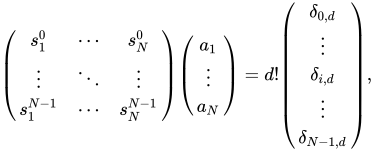
where is the Kronecker delta, equal to one if , and zero otherwise.


Example, for , order of differentiation :
![{\displaystyle s=[-3,-2,-1,0,1]}](https://wikimedia.org/api/rest_v1/media/math/render/svg/0755a78dd45f6b4c6e64c8fc2f2d15a68dee9893)

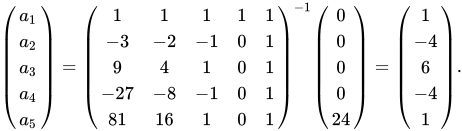
The order of accuracy of the approximation takes the usual form (or better in the case of central finite difference).[citation needed]

See also
References
- ^ a b Fornberg, Bengt (1988), "Generation of Finite Difference Formulas on Arbitrarily Spaced Grids", Mathematics of Computation, 51 (184): 699–706, doi:10.1090/S0025-5718-1988-0935077-0, ISSN 0025-5718.
- ^ "A Python package for finite difference numerical derivatives in arbitrary number of dimensions". GitHub. 14 October 2021.
- ^ "scipy.signal.savgol_filter". Scipy Online documentation. 2008–2024.
- ^ "Finite differences coefficients". StackExchange. 5 June 2023.
- ^ Taylor, Cameron (12 December 2019). "Finite Difference Coefficients Calculator". MIT.
- ^ "Finite Difference Coefficients Calculator".
Content Disclaimer
Informasi ini disarikan dari Wikipedia dan disajikan kembali untuk tujuan edukasi. Konten tersedia di bawah lisensi CC BY-SA 3.0. Kami tidak bertanggung jawab atas ketidakakuratan data yang bersumber dari kontribusi publik tersebut.
- The information displayed on this website is sourced in part or in whole from Wikipedia and has been adapted for the purpose of restating it. We strive to provide accurate and relevant information, however:
- There is no guarantee of absolute accuracy. Wikipedia is an open, collaborative project that can be edited by anyone, so information is subject to change.
- It is not intended to constitute professional advice. The content displayed is for informational and educational purposes only. For important decisions (e.g., medical, legal, or financial), please consult a professional.
- Content copyright. Wikipedia is licensed under the Creative Commons Attribution-ShareAlike License (CC BY-SA). This means that content may be reused with appropriate attribution and shared under a similar license.
- Responsible use. Any risk arising from the use of information from this website is entirely the responsibility of the user.