MacCormack method
In computational fluid dynamics, the MacCormack method (/məˈkɔːrmæk ˈmɛθəd/) is a widely used discretization scheme for the numerical solution of hyperbolic partial differential equations. This second-order finite difference method was introduced by Robert W. MacCormack in 1969.[1] The MacCormack method is elegant and easy to understand and program.[2]
The algorithm
The MacCormack method is designed to solve hyperbolic partial differential equations of the form
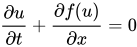
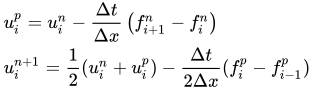
To update this equation one timestep on a grid with spacing at grid cell , the MacCormack method uses a "predictor step" and a "corrector step", given below[3]


Linear Example
To illustrate the algorithm, consider the following first order hyperbolic equation
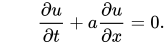
The application of MacCormack method to the above equation proceeds in two steps; a predictor step which is followed by a corrector step.
Predictor step: In the predictor step, a "provisional" value of at time level (denoted by ) is estimated as follows



The above equation is obtained by replacing the spatial and temporal derivatives in the previous first order hyperbolic equation using forward differences.
Corrector step: In the corrector step, the predicted value is corrected according to the equation

Note that the corrector step uses backward finite difference approximations for spatial derivative. The time-step used in the corrector step is in contrast to the used in the predictor step.

Replacing the term by the temporal average

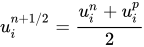
to obtain the corrector step as

Some remarks
The MacCormack method is well suited for nonlinear equations (Inviscid Burgers' equation, Euler equations, etc.) The order of differencing can be reversed for the time step (i.e., forward/backward followed by backward/forward). For nonlinear equations, this procedure provides the best results. For linear equations, the MacCormack scheme is equivalent to the Lax–Wendroff method.[4]
Unlike first-order upwind scheme, the MacCormack does not introduce diffusive errors in the solution. However, it is known to introduce dispersive errors (Gibbs phenomenon) in the region where the gradient is high.
See also
References
- ^ MacCormack, R. W., The Effect of viscosity in hypervelocity impact cratering, AIAA Paper, 69-354 (1969).
- ^ Anderson, J. D., Jr., Computational Fluid Dynamics: The Basics with Applications, McGraw Hill (1994).
- ^ Cameron, Maria (2011). "Notes on Burger's Equation" (PDF). University of Maryland.
- ^ Tannehill, J. C., Anderson, D. A., and Pletcher, R. H., Computational Fluid Mechanics and Heat Transfer, 2nd ed., Taylor & Francis (1997).
Content Disclaimer
Informasi ini disarikan dari Wikipedia dan disajikan kembali untuk tujuan edukasi. Konten tersedia di bawah lisensi CC BY-SA 3.0. Kami tidak bertanggung jawab atas ketidakakuratan data yang bersumber dari kontribusi publik tersebut.
- The information displayed on this website is sourced in part or in whole from Wikipedia and has been adapted for the purpose of restating it. We strive to provide accurate and relevant information, however:
- There is no guarantee of absolute accuracy. Wikipedia is an open, collaborative project that can be edited by anyone, so information is subject to change.
- It is not intended to constitute professional advice. The content displayed is for informational and educational purposes only. For important decisions (e.g., medical, legal, or financial), please consult a professional.
- Content copyright. Wikipedia is licensed under the Creative Commons Attribution-ShareAlike License (CC BY-SA). This means that content may be reused with appropriate attribution and shared under a similar license.
- Responsible use. Any risk arising from the use of information from this website is entirely the responsibility of the user.