CSS code
In quantum error correction, Calderbank–Shor–Steane (CSS) codes, named after their inventors, Robert Calderbank, Peter Shor[1] and Andrew Steane,[2] are a special type of stabilizer code constructed from classical linear codes with some special properties. Examples of CSS codes include the Shor code, Steane code, the toric code, and more general surface codes.
Construction
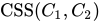
Let and be two (classical) and linear codes such, that and both have minimal distance , where is the dual code to . Then define , the CSS code of over as an code, with as follows:


![{\displaystyle [n,k_{1}]}](https://wikimedia.org/api/rest_v1/media/math/render/svg/d1b760a34ce84d3ac1f3183af8e28ee651234add)
![{\displaystyle [n,k_{2}]}](https://wikimedia.org/api/rest_v1/media/math/render/svg/e04fa207bc8eaeb59e03b6d1a96a182a5d259dad)


![{\displaystyle [n,k_{1}-k_{2},d]}](https://wikimedia.org/api/rest_v1/media/math/render/svg/9271f0930d48737e6d3f740be8b6389778517f12)

Define for where is bitwise addition modulo 2. Then as quantum correcting code defined as .[3]


![{\displaystyle [[n,k_{1}-k_{2},d]]}](https://wikimedia.org/api/rest_v1/media/math/render/svg/a8cb40d727f58f03e8d89c2b4021f468c0c3749c)

Properties
In the stabilizer code formalism, all CSS codes have stabilizers composed of tensor products of Pauli matrices such that each stabilizer contains either only Pauli X operations or only Pauli Z operations. The Shor code and the Steane code are examples of this condition. The five-qubit error correcting code is not a CSS code because it mixes X and Z in its stabilizers.[4]
As with classical linear codes, the limit of how many qubits can be corrected is also given by the Gilbert–Varshamov bound.[3]
References
- ^ Robert Calderbank and Peter Shor (1996). "Good quantum error-correcting codes exist". Physical Review A. 54 (2): 1098–1105. arXiv:quant-ph/9512032. Bibcode:1996PhRvA..54.1098C. doi:10.1103/PhysRevA.54.1098. PMID 9913578. S2CID 11524969.
- ^ Steane, Andrew (1996). "Multiple-Particle Interference and Quantum Error Correction". Proc. R. Soc. Lond. A. 452 (1954): 2551–2577. arXiv:quant-ph/9601029. Bibcode:1996RSPSA.452.2551S. doi:10.1098/rspa.1996.0136. S2CID 8246615.
- ^ a b Nielsen, Michael A.; Chuang, Isaac L. (2010-12-09). Quantum Computation and Quantum Information: 10th Anniversary Edition. Cambridge University Press. ISBN 978-1-139-49548-6.
- ^ Williams, Colin P. (2010-12-07). Explorations in Quantum Computing. Springer Science & Business Media. ISBN 978-1-84628-887-6.
External links
- Nielsen, Michael A.; Chuang, Isaac L. (2010). Quantum Computation and Quantum Information (2nd ed.). Cambridge: Cambridge University Press. ISBN 978-1-107-00217-3. OCLC 844974180.
| General | |||||||||
|---|---|---|---|---|---|---|---|---|---|
| Theorems | |||||||||
| Quantum communication |
| ||||||||
| Quantum algorithms | |||||||||
| Quantum complexity theory | |||||||||
| Quantum processor benchmarks | |||||||||
| Quantum computing models | |||||||||
| Quantum error correction | |||||||||
| Physical implementations |
| ||||||||
| Quantum programming | |||||||||


 | This quantum mechanics–related article is a stub. You can help Wikipedia by adding missing information. |
Content Disclaimer
Informasi ini disarikan dari Wikipedia dan disajikan kembali untuk tujuan edukasi. Konten tersedia di bawah lisensi CC BY-SA 3.0. Kami tidak bertanggung jawab atas ketidakakuratan data yang bersumber dari kontribusi publik tersebut.
- The information displayed on this website is sourced in part or in whole from Wikipedia and has been adapted for the purpose of restating it. We strive to provide accurate and relevant information, however:
- There is no guarantee of absolute accuracy. Wikipedia is an open, collaborative project that can be edited by anyone, so information is subject to change.
- It is not intended to constitute professional advice. The content displayed is for informational and educational purposes only. For important decisions (e.g., medical, legal, or financial), please consult a professional.
- Content copyright. Wikipedia is licensed under the Creative Commons Attribution-ShareAlike License (CC BY-SA). This means that content may be reused with appropriate attribution and shared under a similar license.
- Responsible use. Any risk arising from the use of information from this website is entirely the responsibility of the user.