Young function
 | This article has multiple issues. Please help improve it or discuss these issues on the talk page. (Learn how and when to remove these messages)
|


In mathematics, Young functions are a class of functions that arise in functional analysis, especially in the study of Orlicz spaces.
Definition
A function is called a Young function if it is convex, even, lower semicontinuous, and non-trivial, in the sense that it is neither the zero function nor its convex dual
![{\displaystyle \theta :\mathbb {R} \to [0,\infty ]}](https://wikimedia.org/api/rest_v1/media/math/render/svg/d8319d32a909713a35e181a8d5214b14669f54d7)


A Young function said to be finite if it does not take the value .

A Young function is strict if both and its convex dual are finite; i.e.,


The inverse of a Young function is given by .

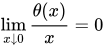
Some authors (such as Krasnosel'skii and Rutickii)[citation needed] also require that
- .
Norm
Let be a σ-finite measure on a set , and a Young function. For any measurable function on , we define the Luxemburg norm as


Examples
The following functions are Young functions:
- .

- for all . This function leads to the usual norm on .


References
- Léonard, Christian. "Orlicz spaces." (2007).
- O’Neil, Richard (1965). "Fractional integration in Orlicz spaces. I". Transactions of the American Mathematical Society. 115: 300–328. doi:10.1090/S0002-9947-1965-0194881-0. ISSN 0002-9947.. Gives another definition of Young's function.
- Krasnosel'skii, M.A.; Rutickii, Ya B. (1961-01-01). Convex Functions and Orlicz Spaces (1 ed.). Gordon & Breach. ISBN 978-0-677-20210-5.
{{cite book}}: ISBN / Date incompatibility (help) In the book, a slight strengthening of Young functions is studied as "N-functions". - Rao, M.M.; Ren, Z.D. (1991). Theory of Orlicz Spaces. Pure and Applied Mathematics. Marcel Dekker. ISBN 0-8247-8478-2.
| Spaces |
| ||||
|---|---|---|---|---|---|
| Theorems | |||||
| Operators | |||||
| Algebras | |||||
| Open problems | |||||
| Applications | |||||
| Advanced topics | |||||

 | This mathematical analysis–related article is a stub. You can help Wikipedia by adding missing information. |
Content Disclaimer
Informasi ini disarikan dari Wikipedia dan disajikan kembali untuk tujuan edukasi. Konten tersedia di bawah lisensi CC BY-SA 3.0. Kami tidak bertanggung jawab atas ketidakakuratan data yang bersumber dari kontribusi publik tersebut.
- The information displayed on this website is sourced in part or in whole from Wikipedia and has been adapted for the purpose of restating it. We strive to provide accurate and relevant information, however:
- There is no guarantee of absolute accuracy. Wikipedia is an open, collaborative project that can be edited by anyone, so information is subject to change.
- It is not intended to constitute professional advice. The content displayed is for informational and educational purposes only. For important decisions (e.g., medical, legal, or financial), please consult a professional.
- Content copyright. Wikipedia is licensed under the Creative Commons Attribution-ShareAlike License (CC BY-SA). This means that content may be reused with appropriate attribution and shared under a similar license.
- Responsible use. Any risk arising from the use of information from this website is entirely the responsibility of the user.