Word RAM
In theoretical computer science, the word RAM (word random-access machine) model is a model of computation in which a random-access machine does arithmetic and bitwise operations on a word of w bits. Michael Fredman and Dan Willard created it in 1990 to simulate programming languages like C.[1]
Model
The word RAM model is an abstract machine similar to a random-access machine, but with finite memory and word-length. It works with words of size up to w bits, meaning it can store integers up to . Because the model assumes that the word size matches the problem size, that is, for a problem of size n, , the word RAM model is a transdichotomous model.[2] The model allows both arithmetic operations and bitwise operations including logical shifts to be done in constant time (the precise instruction set assumed by an algorithm or proof using the model may vary).


Algorithms and data structures
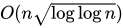
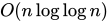
In the word RAM model, integer sorting can be done fairly efficiently. Yijie Han and Mikkel Thorup created a randomized algorithm to sort integers in expected time of (in Big O notation) ,[3] while Han also created a deterministic variant with running time .[4]
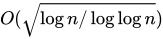
The dynamic predecessor problem is also commonly analyzed in the word RAM model, and was the original motivation for the model. Dan Willard used y-fast tries to solve this in time, or, more precisely, where U is a bound on the values stored.[5] Michael Fredman and Willard also solved the problem using fusion trees in time.[1] Using exponential search trees, a query can be performed in .[6]


Additional results in the word RAM model are listed in the article on range searching.
Lower bounds applicable to word RAM algorithms are often proved in the cell-probe model.
See also
References
- ^ a b Fredman, Michael; Willard, Dan (1990). "Blasting through the information theoretic barrier with fusion trees". Symposium on Theory of Computing: 1–7.
- ^ In fact one usually assumes n to be smaller than , so that the data-structure considered can be indexed with w-bit addresses.
- ^ Han, Yijie; Thorup, M. (2002), "Integer sorting in O(n√log log n) expected time and linear space", Proceedings of the 43rd Annual Symposium on Foundations of Computer Science (FOCS 2002), IEEE Computer Society, pp. 135–144, CiteSeerX 10.1.1.671.5583, doi:10.1109/SFCS.2002.1181890, ISBN 978-0-7695-1822-0
- ^ Han, Yijie (2004), "Deterministic sorting in O(n log log n) time and linear space", Journal of Algorithms, 50 (1): 96–105, doi:10.1016/j.jalgor.2003.09.001, MR 2028585
- ^ Willard, Dan E. (1983). "Log-logarithmic worst-case range queries are possible in space Θ (N)". Information Processing Letters. 17 (2): 81–84. doi:10.1016/0020-0190(83)90075-3.
- ^ Andersson, Arne; Thorup, Mikkel (2007). "Dynamic ordered sets with exponential search trees". Journal of the ACM. 54 (3): 13. arXiv:cs/0210006. doi:10.1145/1236457.1236460.

Content Disclaimer
Informasi ini disarikan dari Wikipedia dan disajikan kembali untuk tujuan edukasi. Konten tersedia di bawah lisensi CC BY-SA 3.0. Kami tidak bertanggung jawab atas ketidakakuratan data yang bersumber dari kontribusi publik tersebut.
- The information displayed on this website is sourced in part or in whole from Wikipedia and has been adapted for the purpose of restating it. We strive to provide accurate and relevant information, however:
- There is no guarantee of absolute accuracy. Wikipedia is an open, collaborative project that can be edited by anyone, so information is subject to change.
- It is not intended to constitute professional advice. The content displayed is for informational and educational purposes only. For important decisions (e.g., medical, legal, or financial), please consult a professional.
- Content copyright. Wikipedia is licensed under the Creative Commons Attribution-ShareAlike License (CC BY-SA). This means that content may be reused with appropriate attribution and shared under a similar license.
- Responsible use. Any risk arising from the use of information from this website is entirely the responsibility of the user.