Wave function renormalization
 | This article needs additional citations for verification. (June 2025) |
In quantum field theory, wave function renormalization is a rescaling (or renormalization) of quantum fields to take into account the effects of interactions.[1][2]
For a noninteracting or free field, the field operator creates or annihilates a single particle with probability 1. Once interactions are included, however, this probability is modified in general to Z 1.[3]

This appears when one calculates the propagator beyond leading order; e.g. for a scalar field,
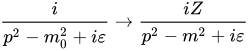
(The shift of the mass from m0 to m constitutes the mass renormalization.)
One possible wave function renormalization, which happens to be scale independent, is to rescale the fields so that the Lehmann weight (Z in the formula above) of their quanta is 1. For the purposes of studying renormalization group flows, if the coefficient of the kinetic term in the action at the scale Λ is Z, then the field is rescaled by . A scale dependent wave function renormalization for a field means that that field has an anomalous scaling dimension.

See also
References
- ^ Kopietz, Peter; Bartosch, Lorenz; Schütz, Florian (2010). Introduction to the Functional Renormalization Group. Springer. pp. 113–117. ISBN 9783642050930. Retrieved June 9, 2025.
- ^ Sterman, George (1993). An Introduction to Quantum Field Theory. Cambridge University Press. pp. 384–385. ISBN 9780521311328. Retrieved June 9, 2025.
- ^ Maggiore, Michele (2005). A Modern Introduction to Quantum Field Theory. Oxford University Press. pp. 137–138. ISBN 9780198520733. Retrieved June 9, 2025.
 | This quantum mechanics–related article is a stub. You can help Wikipedia by adding missing information. |
Content Disclaimer
Informasi ini disarikan dari Wikipedia dan disajikan kembali untuk tujuan edukasi. Konten tersedia di bawah lisensi CC BY-SA 3.0. Kami tidak bertanggung jawab atas ketidakakuratan data yang bersumber dari kontribusi publik tersebut.
- The information displayed on this website is sourced in part or in whole from Wikipedia and has been adapted for the purpose of restating it. We strive to provide accurate and relevant information, however:
- There is no guarantee of absolute accuracy. Wikipedia is an open, collaborative project that can be edited by anyone, so information is subject to change.
- It is not intended to constitute professional advice. The content displayed is for informational and educational purposes only. For important decisions (e.g., medical, legal, or financial), please consult a professional.
- Content copyright. Wikipedia is licensed under the Creative Commons Attribution-ShareAlike License (CC BY-SA). This means that content may be reused with appropriate attribution and shared under a similar license.
- Responsible use. Any risk arising from the use of information from this website is entirely the responsibility of the user.