Walchia
| Walchia Temporal range: ~
| |
|---|---|

| |
| Walchia piniformis | |
Scientific classification 
| |
| Kingdom: | Plantae |
| Clade: | Embryophytes |
| Clade: | Tracheophytes |
| Clade: | Spermatophytes |
| Clade: | Gymnospermae |
| Division: | Pinophyta |
| Class: | Pinopsida |
| Order: | †Voltziales |
| Family: | †Utrechtiaceae |
| Genus: | †Walchia Sternberg |
| Species | |
Walchia is a primitive fossil conifer found in upper Pennsylvanian (Carboniferous) and lower Permian (about 310-290 Mya) rocks of Europe and North America. A forest of in-situ Walchia tree-stumps is located on the Northumberland Strait coast at Brule, Nova Scotia.
Besides the Walchia forest, fallen tree trunks, and leaflet impressions, the forest, fossil-rich layer contains numerous, 4-legged, tetrapod fossil trackways.

Individual species
Walchia hypnoides: from the schists of Lodeve; also copper slates of the Zechstein in Mansfeld.
Monuran trackways
At the same time period of 290 mya, another species was making fossil trackways, now preserved in New Mexico; Walchia leaflets are found in the same fossil layers. The Monuran trackways were made by Permian, wingless insects called monurans, (meaning "one-tail"); the insects' means of locomotion was hopping, then walking.
These 290 mya layers contain footprints of the large Dimetrodon, large/small raindrop impact marks, and also these fossil trackways of insects.
References
External links
- General articles
- Chemosystematic and microstructural investigations--(including Walchia)
- Book preview-(1854)--W. hypnoides discussion
- Walchia Fossil examples
- Graphic of W. piniformis branchlets, from James D. Dana, "Manual of Geology" [1]
- Photo-High Res; Article – www.news.ucdavis.edu--"A Bumpy Shift from Icehouse to Greenhouse", Fossil from Smithsonian. Walchia went from the 'Uplands' to the lower basins-(floodplain forest region of Brule, Nova Scotia).
- Photo-High Res--4 cm width Leaflet-(Order Voltziales); Article – www.colby.edu-"Carboniferous Paleoecological Scenarios"
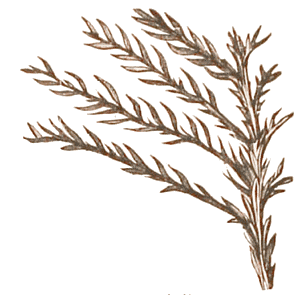


- Walchia fossils, with Monuran trackways
- "The Footfalls and Bellyflops of Permian Insects" – (from the Robledo Mountains of New Mexico)
Content Disclaimer
Informasi ini disarikan dari Wikipedia dan disajikan kembali untuk tujuan edukasi. Konten tersedia di bawah lisensi CC BY-SA 3.0. Kami tidak bertanggung jawab atas ketidakakuratan data yang bersumber dari kontribusi publik tersebut.
- The information displayed on this website is sourced in part or in whole from Wikipedia and has been adapted for the purpose of restating it. We strive to provide accurate and relevant information, however:
- There is no guarantee of absolute accuracy. Wikipedia is an open, collaborative project that can be edited by anyone, so information is subject to change.
- It is not intended to constitute professional advice. The content displayed is for informational and educational purposes only. For important decisions (e.g., medical, legal, or financial), please consult a professional.
- Content copyright. Wikipedia is licensed under the Creative Commons Attribution-ShareAlike License (CC BY-SA). This means that content may be reused with appropriate attribution and shared under a similar license.
- Responsible use. Any risk arising from the use of information from this website is entirely the responsibility of the user.