User:Programmatically/Gamow Peak
Reaction rate
The reaction rate density between species A and B, having number densities nA,B is given by:

where k is the reaction rate constant of each single elementary binary reaction composing the nuclear fusion process:

here, σ(v) is the cross-section at relative velocity v, and averaging is performed over all velocities.
Semi-classically, the cross section is proportional to , where is the de Broglie wavelength. Thus semi-classically the cross section is proportional to .


However, since the reaction involves quantum tunneling, there is an exponential damping at low energies that depends on Gamow factor EG, giving an Arrhenius equation:

where S(E) depends on the details of the nuclear interaction, and has the dimension of an energy multiplied for a cross section.
One then integrates over all energies to get the total reaction rate, using the Maxwell–Boltzmann distribution and the relation :

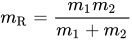
where is the reduced mass.
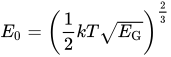
Since this integration has an exponential damping at high energies of the form and at low energies from the Gamow factor, the integral almost vanished everywhere except around the peak, called Gamow peak,[1]: 185 at E0, where:

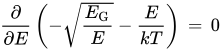
Thus:
The exponent can then be approximated around E0 as:

And the reaction rate is approximated as:[2]

Values of S(E0) are typically 10−3 – 103 keV·b, but are damped by a huge factor when involving a beta decay, due to the relation between the intermediate bound state (e.g. diproton) half-life and the beta decay half-life, as in the proton–proton chain reaction. Note that typical core temperatures in main-sequence stars give kT of the order of keV.[3]: ch. 3
Thus, the limiting reaction in the CNO cycle, proton capture by 14
7N, has S(E0) ~ S(0) = 3.5 keV·b, while the limiting reaction in the proton–proton chain reaction, the creation of deuterium from two protons, has a much lower S(E0) ~ S(0) = 4×10⁻²² keV·b.[4][5] Incidentally, since the former reaction has a much higher Gamow factor, and due to the relative abundance of elements in typical stars, the two reaction rates are equal at a temperature value that is within the core temperature ranges of main-sequence stars.
- ^ Iliadis, C., Nuclear Physics of Stars (Weinheim: Wiley-VCH, 2015), p. 185.
- ^ "University College London astrophysics course: lecture 7 – Stars" (PDF). Archived from the original (PDF) on January 15, 2017. Retrieved May 8, 2020.
- ^ Maoz, D., Astrophysics in a Nutshell (Princeton: Princeton University Press, 2007), ch. 3.
- ^ Adelberger, Eric G.; Austin, Sam M.; Bahcall, John N.; Balantekin, A. B.; Bogaert, Gilles; Brown, Lowell S.; Buchmann, Lothar; Cecil, F. Edward; Champagne, Arthur E.; de Braeckeleer, Ludwig; Duba, Charles A. (1998-10-01). "Solar fusion cross sections". Reviews of Modern Physics. 70 (4): 1265–1291. arXiv:astro-ph/9805121. Bibcode:1998RvMP...70.1265A. doi:10.1103/RevModPhys.70.1265. ISSN 0034-6861. S2CID 16061677.
- ^ Adelberger, E. G. (2011). "Solar fusion cross sections. II. Theppchain and CNO cycles". Reviews of Modern Physics. 83 (1): 195–245. arXiv:1004.2318. Bibcode:2011RvMP...83..195A. doi:10.1103/RevModPhys.83.195. S2CID 119117147.
Content Disclaimer
Informasi ini disarikan dari Wikipedia dan disajikan kembali untuk tujuan edukasi. Konten tersedia di bawah lisensi CC BY-SA 3.0. Kami tidak bertanggung jawab atas ketidakakuratan data yang bersumber dari kontribusi publik tersebut.
- The information displayed on this website is sourced in part or in whole from Wikipedia and has been adapted for the purpose of restating it. We strive to provide accurate and relevant information, however:
- There is no guarantee of absolute accuracy. Wikipedia is an open, collaborative project that can be edited by anyone, so information is subject to change.
- It is not intended to constitute professional advice. The content displayed is for informational and educational purposes only. For important decisions (e.g., medical, legal, or financial), please consult a professional.
- Content copyright. Wikipedia is licensed under the Creative Commons Attribution-ShareAlike License (CC BY-SA). This means that content may be reused with appropriate attribution and shared under a similar license.
- Responsible use. Any risk arising from the use of information from this website is entirely the responsibility of the user.