Upside potential ratio
The upside-potential ratio is a measure of a return of an investment asset relative to the minimal acceptable return. The measurement allows a firm or individual to choose investments which have had relatively good upside performance, per unit of downside risk.
![{\displaystyle U={{\sum _{\min }^{+\infty }{(R_{r}-R_{\min }})P_{r}} \over {\sqrt {\sum _{-\infty }^{\min }{(R_{r}-R_{\min }})^{2}P_{r}}}}={\frac {\mathbb {E} [(R_{r}-R_{\min })_{+}]}{\sqrt {\mathbb {E} [(R_{r}-R_{\min })_{-}^{2}]}}},}](https://wikimedia.org/api/rest_v1/media/math/render/svg/abcd5489b263121412d9410b308e25c9a35b1c03)
where the returns have been put into increasing order. Here is the probability of the return and which occurs at is the minimal acceptable return. In the secondary formula and .[1]


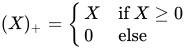

The upside-potential ratio may also be expressed as a ratio of partial moments since is the first upper moment and is the second lower partial moment.
![{\displaystyle \mathbb {E} [(R_{r}-R_{\min })_{+}]}](https://wikimedia.org/api/rest_v1/media/math/render/svg/fc5ed98f0009bdceee1fa36321fbbecd2da576e2)
![{\displaystyle \mathbb {E} [(R_{r}-R_{\min })_{-}^{2}]}](https://wikimedia.org/api/rest_v1/media/math/render/svg/eb9eb89e130b04703dc3efd8c4976a8c3e706b53)
The measure was developed by Frank A. Sortino.
Discussion
The upside-potential ratio is a measure of risk-adjusted returns. All such measures are dependent on some measure of risk. In practice, standard deviation is often used, perhaps because it is mathematically easy to manipulate. However, standard deviation treats deviations above the mean (which are desirable, from the investor's perspective) exactly the same as it treats deviations below the mean (which are less desirable, at the very least). In practice, rational investors have a preference for good returns (e.g., deviations above the mean) and an aversion to bad returns (e.g., deviations below the mean).
Sortino further found that investors are (or, at least, should be) averse not to deviations below the mean, but to deviations below some "minimal acceptable return" (MAR), which is meaningful to them specifically. Thus, this measure uses deviations above the MAR in the numerator, rewarding performance above the MAR. In the denominator, it has deviations below the MAR, thus penalizing performance below the MAR.
Thus, by rewarding desirable results in the numerator and penalizing undesirable results in the denominator, this measure attempts to serve as a pragmatic measure of the goodness of an investment portfolio's returns in a sense that is not just mathematically simple (a primary reason to use standard deviation as a risk measure), but one that considers the realities of investor psychology and behavior.
See also
References
- ^ Chen, L.; He, S.; Zhang, S. (2011). "When all risk-adjusted performance measures are the same: In praise of the Sharpe ratio". Quantitative Finance. 11 (10): 1439. CiteSeerX 10.1.1.701.141. doi:10.1080/14697680903081881. S2CID 15825491.
Content Disclaimer
Informasi ini disarikan dari Wikipedia dan disajikan kembali untuk tujuan edukasi. Konten tersedia di bawah lisensi CC BY-SA 3.0. Kami tidak bertanggung jawab atas ketidakakuratan data yang bersumber dari kontribusi publik tersebut.
- The information displayed on this website is sourced in part or in whole from Wikipedia and has been adapted for the purpose of restating it. We strive to provide accurate and relevant information, however:
- There is no guarantee of absolute accuracy. Wikipedia is an open, collaborative project that can be edited by anyone, so information is subject to change.
- It is not intended to constitute professional advice. The content displayed is for informational and educational purposes only. For important decisions (e.g., medical, legal, or financial), please consult a professional.
- Content copyright. Wikipedia is licensed under the Creative Commons Attribution-ShareAlike License (CC BY-SA). This means that content may be reused with appropriate attribution and shared under a similar license.
- Responsible use. Any risk arising from the use of information from this website is entirely the responsibility of the user.