Two-point tensor
 | This article needs additional citations for verification. (December 2013) |
Two-point tensors, or double vectors, are tensor-like quantities which transform as Euclidean vectors with respect to each of their indices. They are used in continuum mechanics to transform between reference ("material") and present ("configuration") coordinates.[1] Examples include the deformation gradient and the first Piola–Kirchhoff stress tensor.
As with many applications of tensors, Einstein summation notation is frequently used. To clarify this notation, capital indices are often used to indicate reference coordinates and lowercase for present coordinates. Thus, a two-point tensor will have one capital and one lower-case index; for example, AjM.
Continuum mechanics
A conventional tensor can be viewed as a transformation of vectors in one coordinate system to other vectors in the same coordinate system. In contrast, a two-point tensor transforms vectors from one coordinate system to another. That is, a conventional tensor,
- ,

actively transforms a vector u to a vector v such that

where v and u are measured in the same space and their coordinates representation is with respect to the same basis (denoted by the "e").
In contrast, a two-point tensor, G will be written as

and will transform a vector, U, in E system to a vector, v, in the e system as
- .

The transformation law for two-point tensor
Suppose we have two coordinate systems one primed and another unprimed and a vectors' components transform between them as
- .

For tensors suppose we then have
- .

A tensor in the system . In another system, let the same tensor be given by

- .

We can say
- .

Then

is the routine tensor transformation. But a two-point tensor between these systems is just

which transforms as
- .

Simple example
The most mundane example of a two-point tensor is the transformation tensor, the Q in the above discussion. Note that
- .

Now, writing out in full,

and also
- .

This then requires Q to be of the form
- .
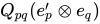
By definition of tensor product,
| 1 |

So we can write

Thus

Incorporating (1), we have
- .

See also
References
- ^ Humphrey, Jay D. Cardiovascular solid mechanics: cells, tissues, and organs. Springer Verlag, 2002.
External links
Content Disclaimer
Informasi ini disarikan dari Wikipedia dan disajikan kembali untuk tujuan edukasi. Konten tersedia di bawah lisensi CC BY-SA 3.0. Kami tidak bertanggung jawab atas ketidakakuratan data yang bersumber dari kontribusi publik tersebut.
- The information displayed on this website is sourced in part or in whole from Wikipedia and has been adapted for the purpose of restating it. We strive to provide accurate and relevant information, however:
- There is no guarantee of absolute accuracy. Wikipedia is an open, collaborative project that can be edited by anyone, so information is subject to change.
- It is not intended to constitute professional advice. The content displayed is for informational and educational purposes only. For important decisions (e.g., medical, legal, or financial), please consult a professional.
- Content copyright. Wikipedia is licensed under the Creative Commons Attribution-ShareAlike License (CC BY-SA). This means that content may be reused with appropriate attribution and shared under a similar license.
- Responsible use. Any risk arising from the use of information from this website is entirely the responsibility of the user.