Translational partition function
 | This article relies largely or entirely on a single source. (March 2024) |
In statistical mechanics, the translational partition function, is that part of the partition function resulting from the movement (translation) of the center of mass. For a single atom or molecule in a low pressure gas, neglecting the interactions of molecules, the canonical ensemble can be approximated by:[1]

- where

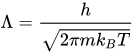
Here, V is the volume of the container holding the molecule (volume per single molecule so, e.g., for 1 mole of gas the container volume should be divided by the Avogadro number), Λ is the Thermal de Broglie wavelength, h is the Planck constant, m is the mass of a molecule, kB is the Boltzmann constant and T is the absolute temperature. This approximation is valid as long as Λ is much less than any dimension of the volume the atom or molecule is in. Since typical values of Λ are on the order of 10-100 pm, this is almost always an excellent approximation.
When considering a set of N non-interacting but identical atoms or molecules, when QT ≫ N , or equivalently when ρ Λ ≪ 1 where ρ is the density of particles, the total translational partition function can be written
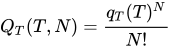
The factor of N! arises from the restriction of allowed N particle states due to Quantum exchange symmetry. Most substances form liquids or solids at temperatures much higher than when this approximation breaks down significantly.
See also
References
- ^ Donald A. McQuarrie, Statistical Mechanics, Harper \& Row, 1973
| Theory |  | |
|---|---|---|
| Statistical thermodynamics | ||
| Models | ||
| Mathematical approaches | ||
| Critical phenomena | ||
| Entropy | ||
| Applications | ||
 | This quantum mechanics–related article is a stub. You can help Wikipedia by adding missing information. |
 | This article about statistical mechanics is a stub. You can help Wikipedia by adding missing information. |
Content Disclaimer
Informasi ini disarikan dari Wikipedia dan disajikan kembali untuk tujuan edukasi. Konten tersedia di bawah lisensi CC BY-SA 3.0. Kami tidak bertanggung jawab atas ketidakakuratan data yang bersumber dari kontribusi publik tersebut.
- The information displayed on this website is sourced in part or in whole from Wikipedia and has been adapted for the purpose of restating it. We strive to provide accurate and relevant information, however:
- There is no guarantee of absolute accuracy. Wikipedia is an open, collaborative project that can be edited by anyone, so information is subject to change.
- It is not intended to constitute professional advice. The content displayed is for informational and educational purposes only. For important decisions (e.g., medical, legal, or financial), please consult a professional.
- Content copyright. Wikipedia is licensed under the Creative Commons Attribution-ShareAlike License (CC BY-SA). This means that content may be reused with appropriate attribution and shared under a similar license.
- Responsible use. Any risk arising from the use of information from this website is entirely the responsibility of the user.