Targetoid

In medicine, a targetoid object is a structure or lesion that has the appearance of a target or is target-like.
Targetoid lesions are distinguished by a concentric ring-like appearance that resembles a target or bull's-eye. Classic target lesions with three concentric zones are commonly associated with erythema multiforme (a type of skin rash), while targetoid lesions with only two zones can appear in various dermatological conditions.[1][2] Such lesions can be critical in diagnosing numerous skin disorders, ranging from infectious and inflammatory diseases to drug reactions and some neoplasms.[3] Recognizing differences in morphology, distribution, and symptoms of targetoid lesions is important for accurate diagnosis and management of these distinctive skin lesions.[1] The differential diagnosis of targetoid lesions is broad and includes conditions such as hives (urticaria), fixed drug eruptions, and lupus erythematosus.[2][3]
Michaelis-Gutmann bodies
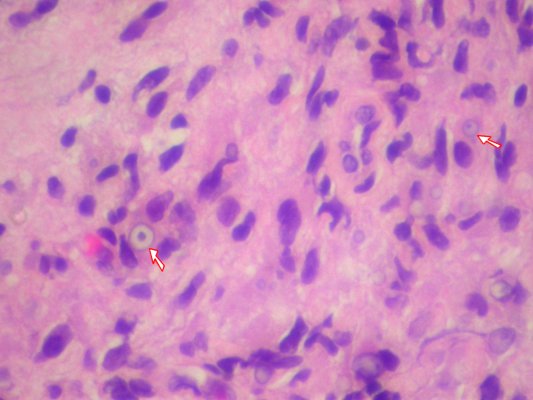
The concept of targetoid structures applies not only to macroscopic skin lesions but also to microscopic features. For instance, the Michaelis-Gutmann body, a characteristic histological finding in malakoplakia, exhibits a targetoid or "bull's-eye" appearance under light microscopy.[4][5] These intracellular and extracellular inclusions, composed of mineralized bacterial debris, illustrate how the targetoid pattern can manifest at both clinical and histopathological levels.[4][6]
Michaelis-Gutmann bodies are generally 1–10 μm in size and appear as laminated or targetoid basophilic inclusions containing iron and calcium salts.[5] Under light microscopy, they often exhibit a concentric "bird's-eye" or "owl-eye" (targetoid) appearance due to a central hydroxyapatite core.[4][7] This targetoid structure results from mineralization of the matrix cores and the peripheral accumulation of phospholipids and microvesicles representing incompletely digested debris.[4]
Examples
Examples of targetoid lesions include:
- Target lesion
- Targetoid hemosiderotic hemangioma
- Targetoid Michaelis-Gutmann bodies
- Targetoid calcification
References
- ^ a b Cartron AM, Blaszczak A, Kaffenberger BH, Trinidad JC (December 2020). "Approaching Target and Targetoid Eruptions in Inpatient Dermatology". Current Dermatology Reports. 9 (4): 210–219. doi:10.1007/s13671-020-00308-z.
- ^ a b Chan L (October 2015). Oakley A (ed.). "Target and Targetoid Lesions". DermNet.
- ^ a b Bhandari M, Khullar G (2022). "Target and Targetoid Lesions in Dermatology". Indian Journal of Dermatology, Venereology and Leprology. 88 (3): 430–434. doi:10.25259/IJDVL_901_20. PMID 34379958.
- ^ a b c d Yousef GM, Naghibi B, Hamodat MM (February 2007). "Malakoplakia Outside the Urinary Tract". Archives of Pathology & Laboratory Medicine. 131 (2): 297–300. doi:10.5858/2007-131-297-MOTUT. PMID 17284117. (Erratum: doi:10.5858/133.6.850.b, PMID 17284117)
- ^ a b Luong D (13 December 2022). "Michaelis-Gutmann Bodies". Radiopaedia.
- ^ Samian C, Ghaffar S, Nandapalan V, Santosh S (May 2019). "Malakoplakia of the Parotid Gland: A Case Report and Review of Localized Malakoplakia of the Head and Neck". Annals of the Royal College of Surgeons of England. 101 (5): 309–312. doi:10.1308/rcsann.2019.0024. PMC 6513360. PMID 30855168.
- ^ Afonso JP, Ando PN, Padilha MH, Michalany NS, Porro AM (2013). "Cutaneous Malakoplakia: Case Report and Review". Anais Brasileiros de Dermatologia. 88 (3): 432–437. doi:10.1590/abd1806-4841.20131790. PMC 3754379. PMID 23793204.
External links
- Targetoid Michaelis-Gutmann bodies - granuloma.homestead.com.
- Targetoid nevus - pbase.com.
 | This dermatology-related article is a stub. You can help Wikipedia by adding missing information. |
Content Disclaimer
Informasi ini disarikan dari Wikipedia dan disajikan kembali untuk tujuan edukasi. Konten tersedia di bawah lisensi CC BY-SA 3.0. Kami tidak bertanggung jawab atas ketidakakuratan data yang bersumber dari kontribusi publik tersebut.
- The information displayed on this website is sourced in part or in whole from Wikipedia and has been adapted for the purpose of restating it. We strive to provide accurate and relevant information, however:
- There is no guarantee of absolute accuracy. Wikipedia is an open, collaborative project that can be edited by anyone, so information is subject to change.
- It is not intended to constitute professional advice. The content displayed is for informational and educational purposes only. For important decisions (e.g., medical, legal, or financial), please consult a professional.
- Content copyright. Wikipedia is licensed under the Creative Commons Attribution-ShareAlike License (CC BY-SA). This means that content may be reused with appropriate attribution and shared under a similar license.
- Responsible use. Any risk arising from the use of information from this website is entirely the responsibility of the user.