Talk:Two envelopes problem
| This is the talk page for discussing improvements to the Two envelopes problem article. This is not a forum for general discussion of the subject of the article. |
Article policies
|
| Find sources: Google (books · news · scholar · free images · WP refs) · FENS · JSTOR · TWL |
Archives (index): 1, 2, 3, 4, 5, 6, 7, 8, 9, 10Auto-archiving period: 30 days  |
 | This is the talk page for discussing editorial changes to the two envelopes problem article. Please place discussions concerning solutions to the two envelopes problem itself on the Arguments page. Questions or statements of this kind here will be moved to that page without notice. A list of publications on the two envelopes problem can be found at the sources page |
 | Two envelopes problem/sources was merged into this article. The discussion was closed on 24 August 2011 with a consensus to merge. The original page is now a redirect to this article. For the contribution history and old versions of the redirected article, please see its history; for its talk page, see here. |
 | This article is rated C-class on Wikipedia's content assessment scale. It is of interest to the following WikiProjects: | |||||||
| ||||||||


Bibliography
An extensive literature list is available at Talk:Two envelopes problem/Literature Paradoctor (talk) 04:10, 8 October 2020 (UTC)
The forgotten fact
If the amount of money is odd, it's better to switch. Since it can't be the X2 enveloppe. If it's even, switching is slightly riskier since maybe one of the envelopes is odd amount of money and you want to avoid it... — Preceding unsigned comment added by 70.48.133.1 (talk) 11:00, 6 November 2017 (UTC)
- Nice comment. However, as far as we know, there are just slips of paper in the envelopes with the amounts of money written on them. The envelopes need not contain US bank notes. Richard Gill (talk) 07:48, 21 July 2020 (UTC)
New publication coming up
My manuscript on TEP is now posted on arXiv (will appear on Tuesday) and submitted to a journal. Here is a sneak preview. https://www.math.leidenuniv.nl/~gill/tep.pdf Richard Gill (talk) 10:08, 7 March 2020 (UTC)
- Nice paper, but you might consider removing your reference to Talk:Two_envelopes_problem/Literature as this turned out to be an illegal talk page and will consequently soon be deleted. iNic (talk) 12:18, 7 July 2020 (UTC)
- That doesn't worry me. Richard Gill (talk) 14:36, 14 July 2020 (UTC)
- Ok that's good but I'm quite sure it will be deleted from Wikipedia. iNic (talk) 11:43, 15 July 2020 (UTC)
Another reference
A correspondent tells me that the following paper is not referenced and seems to them to be the definitive solution: The Two-Envelope Paradox Resolved. Author(s): Timothy J. McGrew, David Shier and Harry S. Silverstein. Source: Analysis , Jan., 1997, Vol. 57, No. 1 (Jan., 1997), pp. 28-33 Published by: Oxford University Press on behalf of The Analysis Committee. Stable URL: http://www.jstor.com/stable/3328431 Richard Gill (talk) 07:50, 21 July 2020 (UTC)
- There are indeed many solutions and ideas not mentioned in the article. Why? Well there are simply too many of them and many are quite technical and thus not easily explained in an encyclopaedic article. Wikipedia can never be a replacement for the literature itself. An obvious fact that many people need to be reminded of over and over. This paper was, however, referenced indirectly until just recently in Talk:Two_envelopes_problem/Literature. It is the first entry for 1997. But this list is now so kindly removed as a reference by Rolf H Nelson so yes, now this paper is not mentioned at all at Wikipedia. iNic (talk) 11:10, 21 July 2020 (UTC)
List of inconsistencies
I found an interesting list of inconsistencies of the article here iNic (talk) 02:00, 25 November 2020 (UTC)
- Latest version of that article is dated 2018-01-02. A quick glance lets me doubt its value even when it was current. Paradoctor (talk) 02:28, 25 November 2020 (UTC)
Would be useful to put the simple, non-technical explanation first
Although "the person stands to gain twice as much money if they switch, while the only risk is halving what they currently have", what this omits to mention is that they stand to double only the SMALL amount, but risk losing half the LARGE amount, so in fact the gains and losses even out, and the "paradox" evaporates. I think it would be useful to mention this up front, for the benefit of readers who maybe can't cope with the more mathematical explanations. 2A00:23C8:7B0C:9A01:87F:AA06:BD33:A284 (talk) 13:30, 15 April 2024 (UTC)
- The simple explanation is not useful because it doesn't state which step in the incorrect resolution is the fallacy. To "resolve the paradox", you have to state which step in the switching argument is wrong, and why it's wrong. The simple resolution doesn't tell you where the mistake in the switching argument is. The mistake in the switching argument is in combining the terms in step 7, because they aren't the same A. it's not an expression with 1 variable, it's an expression with 2 of them. Solving for both variables gives the correct expected value, which is not in terms of A. 73.151.32.230 (talk) 00:12, 30 August 2025 (UTC)
Monty Hall
maybe put something about the monty hall problem in there? it's very similar. 174.176.97.132 (talk) 20:52, 22 August 2025 (UTC)
Detailed derivations moved from the article
The following material was moved from the article during cleanup and condensation. It includes more detailed derivations and explanatory material related to the standard (simple) resolution. The article now presents a concise summary with citations, while the content below is retained here for reference and future discussion. Sufficient statistics (talk) 01:33, 2 January 2026 (UTC)
- I think it's very good to clean up this page and condense it. It is way too long in my opinion, even after your cleanup. However, we need to include a paragraph explaining to the reader that this is still a controversial subject as there is no consensus among scholars on how to solve the paradox. Otherwise it be a mystery why there are so many articles written about it with different proposed solutions. Our job as editors is not to single out one of these proposed solutions and present it as the correct solution. We need to present the subject from a neutral point of view. iNic (talk) 02:43, 2 January 2026 (UTC)
- I agree your point about neutrality and context, and it does make sense to explain why there is a substantial literature on this topic. That said, there are the original problem vs various extensions. In standard treatment, e.g. McGrew1997 treat this as a probability fallacy, where the argument mixes conditional and unconditional expectations. The vast literature and apparent controversy comes from different variations, which are interesting but not the original formulation. My concern is that saying simply “there is no consensus” without qualification risks suggesting that even the basic flaw in the standard argument is disputed, which doesn’t reflect how the problem is typically taught. A reasonable middle ground might be to explain the core error clearly, and then note that the large literature largely concerns generalized versions of the problem. Sufficient statistics (talk) 04:08, 2 January 2026 (UTC)
- There's not one unambiguous original problem with one generally agreed upon solution. This is simply not true. To claim this is precisely why your edit is not a good edit. If you read the papers (and not just one of them) you will see why this is the case. iNic (talk) 14:15, 2 January 2026 (UTC)
- Thanks for the clarification. I see the concern about implicit authority created by section placement. My intent is simply to reduce redundancy and improve readability, not to treat any formulation as canonical.
- I am planning to move the discussion of the switching argument under “Multiplicity of proposed solutions,” collapsing the two existing long explanations into a shorter one. Placing it there should make it clear that this is one approach among several. I will keep the original title (“Example resolution”), since it is already established and doesn’t imply a definitive treatment.
- If there are concerns with this approach, I am happy to adjust it. Sufficient statistics (talk) 20:04, 2 January 2026 (UTC)
- OK great! We need to make this article much shorter and to the point. That it is currently much longer than for example the wikipedia entry about the St Petersburg paradox is just bizarre. This paradox is by no means as important and thoroughly debated as that one. iNic (talk) 14:28, 3 January 2026 (UTC)
Example resolution
Suppose that the total amount in both envelopes is a constant , with in one envelope and in the other. If you select the envelope with first you gain the amount by swapping. If you select the envelope with first you lose the amount by swapping. So you gain on average by swapping.



So on this supposition that the total amount is fixed, swapping is not better than keeping. The expected value is the same for both the envelopes. Thus no contradiction exists.[1]
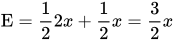
The famous mystification is evoked by confusing the situation where the total amount in the two envelopes is fixed with the situation where the amount in one envelope is fixed and the other can be either double or half that amount. The so-called paradox presents two already appointed and already locked envelopes, where one envelope is already locked with twice the amount of the other already locked envelope. Whereas step 6 boldly claims "Thus the other envelope contains 2A with probability 1/2 and A/2 with probability 1/2", in the given situation, that claim can never apply to any A nor to any average A.
This claim is never correct for the situation presented; this claim applies to the Nalebuff asymmetric variant only (see below). In the situation presented, the other envelope cannot generally contain 2A, but can contain 2A only in the very specific instance where envelope A, by chance contains the smaller amount of , but nowhere else. The other envelope cannot generally contain A/2 but can contain A/2 only in the very specific instance where envelope A, by chance, actually contains , but nowhere else. The difference between the two already appointed and locked envelopes is always . No "average amount A" can ever form any initial basis for any expected value, as this does not get to the heart of the problem.[2]


Other simple resolutions
A widely discussed way to resolve the paradox, both in popular literature and part of the academic literature, especially in philosophy, is to assume that the in step 7 is intended to be the expected value in envelope A and that we intended to write down a formula for the expected value in envelope B.

Step 7 states that the expected value in B is .

It is pointed out that the in the first part of the formula is the expected value, given that envelope A contains less than envelope B, but the in the second part of the formula is the expected value in A, given that envelope A contains more than envelope B. The flaw in the argument is that the same symbol is used with two different meanings in both parts of the same calculation but is assumed to have the same value in both cases. This line of argument is introduced by McGrew, Shier and Silverstein (1997).[3]
A correct calculation would be where represents expected value.


If we then take the sum in one envelope to be and the sum in the other to be , the expected value calculations become which is equal to the expected sum in A.

In non-technical language, what goes wrong is that, in the scenario provided, the mathematics use relative values of A and B (that is, it assumes that one would gain more money if A is less than B than one would lose if the opposite were true). However, the two values of money are fixed (one envelope contains, say, $20 and the other $40). If the values of the envelopes are restated as x and 2x, it's much easier to see that, if A were greater, one would lose x by switching and, if B were greater, one would gain x by switching. One does not gain a greater amount of money by switching because the total T of A and B (3x) remains the same, and the difference x is fixed to T/3.
Line 7 should have been worked out more carefully as follows:
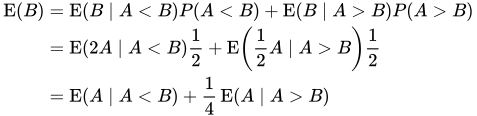
A will be larger when A is larger than B, than when it is smaller than B. So its average values (expectation values) in those two cases are different. And the average value of A is not the same as A itself, anyway. Two mistakes are being made: the writer forgot he was taking expectation values, and he forgot he was taking expectation values under two different conditions.
It would have been easier to compute E(B) directly. Denoting the lower of the two amounts by x, and taking it to be fixed (even if unknown) we find that
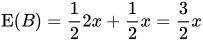
We learn that 1.5x is the expected value of the amount in Envelope B. By the same calculation it is also the expected value of the amount in Envelope A. They are the same hence there is no reason to prefer one envelope to the other. This conclusion was, of course, obvious in advance; the point is that we identified the false step in the argument for switching by explaining exactly where the calculation being made there went off the rails.
We could also continue from the correct but difficult to interpret result of the development in line 7:
so (of course) different routes to calculate the same thing all give the same answer.

Tsikogiannopoulos presented a different way to do these calculations.[4] It is by definition correct to assign equal probabilities to the events that the other envelope contains double or half that amount in envelope A. So the "switching argument" is correct up to step 6. Given that the player's envelope contains the amount A, he differentiates the actual situation in two different games: The first game would be played with the amounts (A, 2A) and the second game with the amounts (A/2, A). Only one of them is actually played but we don't know which one. These two games need to be treated differently. If the player wants to compute his/her expected return (profit or loss) in case of exchange, he/she should weigh the return derived from each game by the average amount in the two envelopes in that particular game. In the first case the profit would be A with an average amount of 3A/2, whereas in the second case the loss would be A/2 with an average amount of 3A/4. So the formula of the expected return in case of exchange, seen as a proportion of the total amount in the two envelopes, is:

This result means yet again that the player has to expect neither profit nor loss by exchanging his/her envelope.
We could actually open our envelope before deciding on switching or not and the above formula would still give us the correct expected return. For example, if we opened our envelope and saw that it contained 100 euros then we would set A=100 in the above formula and the expected return in case of switching would be:

- ^ Priest, Graham; Restall, Greg (2007), "Envelopes and Indifference" (PDF), Dialogues, Logics and Other Strange Things, College Publications: 135–140
- ^ Priest, Graham; Restall, Greg (2007), "Envelopes and Indifference" (PDF), Dialogues, Logics and Other Strange Things, College Publications: 135–140
- ^ Cite error: The named reference
McGrew1997was invoked but never defined (see the help page). - ^ Tsikogiannopoulos, Panagiotis (2012). "Παραλλαγές του προβλήματος της ανταλλαγής φακέλων" [Variations on the Two Envelopes Problem]. Mathematical Reviews (in Greek). arXiv:1411.2823. Bibcode:2014arXiv1411.2823T.
Content Disclaimer
Informasi ini disarikan dari Wikipedia dan disajikan kembali untuk tujuan edukasi. Konten tersedia di bawah lisensi CC BY-SA 3.0. Kami tidak bertanggung jawab atas ketidakakuratan data yang bersumber dari kontribusi publik tersebut.
- The information displayed on this website is sourced in part or in whole from Wikipedia and has been adapted for the purpose of restating it. We strive to provide accurate and relevant information, however:
- There is no guarantee of absolute accuracy. Wikipedia is an open, collaborative project that can be edited by anyone, so information is subject to change.
- It is not intended to constitute professional advice. The content displayed is for informational and educational purposes only. For important decisions (e.g., medical, legal, or financial), please consult a professional.
- Content copyright. Wikipedia is licensed under the Creative Commons Attribution-ShareAlike License (CC BY-SA). This means that content may be reused with appropriate attribution and shared under a similar license.
- Responsible use. Any risk arising from the use of information from this website is entirely the responsibility of the user.