Talk:Isotropic line
 | This article is rated Start-class on Wikipedia's content assessment scale. It is of interest to the following WikiProjects: | ||||||||||
| |||||||||||

Early questions
Are x, y, z, and a complex or real (or something else)? This would be good information to include. (I suspect complex but don't know.)
X, Y and Z are homogenous coordinates in the complex projective plane. They are complex numbers where there is an equivalence class between [X, Y, Z] and [λX, λY, λZ] for any complex, nonzero λ.
The last statement is untrue. A rotation of θ will change the y-intercept of the line from to while keeping the slope the same.


--Moly 03:30, 25 February 2012 (UTC)
One of the properties, "The euclidean distance between two points on an isotropic line is zero (hence null line)", looks a bit shady to me because the distance between the points (1, i) and (2,2i) (which are on the line y=ix) is (using the 2-norm). Can someone check this?
--NavinF 07:04, 26 March 2012 (UTC)

NavinF, you are correct. --Moly 20:07, 20 September 2012 (UTC) — Preceding unsigned comment added by Moly (talk • contribs)
Earlier version of page (no references)
An isotropic line or null line is a line in the complex projective plane with slope or


Equation
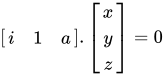
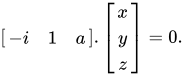
All isotropic lines have equations of the following form:
- or


or, in matrix-notation,
- or
Properties
- An isotropic line is perpendicular to itself
- The euclidean distance between two points on an isotropic line is zero (hence null line)
- The union of two conjugate isotropic lines is a circle
- The point at infinity of an isotropic line is always one of the two circular points at infinity
- If an isotropic line is rotated 90 degrees its image is itself
Citing Category:Projective geometry
The article has been changed to one consistent with isotropic quadratic form as that terminology is widely used.Rgdboer (talk) 01:51, 5 March 2015 (UTC)
Reference to the Complex projective plane has been re-instated, with reference to Springer. The Properties listed have yet to be confirmed.Rgdboer (talk) 01:46, 9 March 2015 (UTC)
- The statement "In the complex projective plane, points are represented by homogeneous coordinates" is phrased to suggest that this the representation (or only construction) of the complex plane. It is merely one such. It would be good to have a general (coordinate-independent) geometric description, followed by the interpretation in terms of homogeneous coordinates. Also it would be helpful to give the homogeneous coordinates of the two points at infinity, as well as to give an expression for the as-yet undefined concept "distance" given here. —Quondum 03:20, 9 March 2015 (UTC)
Cartan
Use of the term "isotropic" is common among physicists, especially since Elie Cartan used it in 1938 in The Theory of Spinors. Cartan combines the idea of a pseudo-Euclidean space (page 4)with exterior algebra on page 14:
- A p-vector is said to be isotropic if its volume is zero but not all components are zero; and if it spans a linear manifold M of dimension not less than p.
He then notes that ∃ y ∈ M, ∀ x ∈ M (y ⊥ x). The perpendicularity must be interpreted in the pseudo-Euclidean space.
An "isotropic line" corresponds here to a 1-vector of zero length.Rgdboer (talk) 02:00, 9 March 2015 (UTC)
Geology?
WP:NOTDIC says that homographs belong in different articles. Shouldn't the geological concept go into a hatnote? —Quondum 03:28, 9 March 2015 (UTC)
- Yes, now placed in Strain partitioning, a geology article. — Rgdboer (talk) 22:39, 18 July 2017 (UTC)
Content Disclaimer
Informasi ini disarikan dari Wikipedia dan disajikan kembali untuk tujuan edukasi. Konten tersedia di bawah lisensi CC BY-SA 3.0. Kami tidak bertanggung jawab atas ketidakakuratan data yang bersumber dari kontribusi publik tersebut.
- The information displayed on this website is sourced in part or in whole from Wikipedia and has been adapted for the purpose of restating it. We strive to provide accurate and relevant information, however:
- There is no guarantee of absolute accuracy. Wikipedia is an open, collaborative project that can be edited by anyone, so information is subject to change.
- It is not intended to constitute professional advice. The content displayed is for informational and educational purposes only. For important decisions (e.g., medical, legal, or financial), please consult a professional.
- Content copyright. Wikipedia is licensed under the Creative Commons Attribution-ShareAlike License (CC BY-SA). This means that content may be reused with appropriate attribution and shared under a similar license.
- Responsible use. Any risk arising from the use of information from this website is entirely the responsibility of the user.