Talk:Euclidean algorithm
 | Euclidean algorithm is a featured article; it (or a previous version of it) has been identified as one of the best articles produced by the Wikipedia community. Even so, if you can update or improve it, please do so. | |||||||||||||||
 | This article appeared on Wikipedia's Main Page as Today's featured article on June 18, 2009. | |||||||||||||||
| ||||||||||||||||
| Current status: Featured article | ||||||||||||||||
| This  level-4 vital article is rated FA-class on Wikipedia's content assessment scale. level-4 vital article is rated FA-class on Wikipedia's content assessment scale.It is of interest to the following WikiProjects: | ||||||||||||||||||||||||||||||
| |||||||||||||||||||||||||||||||


Inaccurate implementations
I feel the implementations given in the Implementations sections are all inaccurate. For example, gcd(-6, 0) is 6, but the implementations return -6. This is wrong because GCDs are always non-negative. Hexagonalpedia (talk) 12:18, 23 May 2021 (UTC)
 Fixed D.Lazard (talk) 16:39, 24 May 2021 (UTC)

Flowcharts
At least one flowchart that represents an Euclidean algorithm could be expected. Now no flowchart in the current article. So here are flowcharts.
As though there is no instruction modulo in computing, neither in Python nor in JavaScript for example, the first algorithm computes a remainder through successive subtractions. The second algorithm uses successive modulo operations — % in Python or in JavaScript —, in order to yield the GCD of two natural numbers. A little more complicated, the third algorith is conceived for the easiest mathematical proof of the existence of this “great” divisor, which is multiple of every common divisor of a given pair of natural numbers. This last algorithm keeps unchanged the common divisors of such a pair at every step, by replacing the greatest integer with the positive difference between the two.

calculation of n modulo d for n and d
members of ℕ, when d is not zero. Example:
if n = 85 and d = 20, then variable r passes
through the values: 85 ↠ 65 ↠ 45 ↠ 25 ↠ 5,
along four courses of the loop. Therefore,
according to the algorithm, divide 85 by 20
yields the remainder
85 – 4 × 20 = 85 modulo 20 = 5.

Euclidean algorithm, calculation of the GCD
of natural numbers d and g. For example,
if their starting values are 20 and 85, then
dividend, divisor and remainder of the unique
division of the loop are, at every step,
three successive terms of this sequence:
20, 85, 20, 5, 0 (5 being a divisor of 20).
Result: gcd(20, 85) = 5.

is the other number, because zero is the only multiple
of every integer, the “greatest” for the divisibility.
These three algorithms could be inserted in introduction just after the text, while the antique diagram,
less comprehensible than a flowchart, could be transfered in section
“Background: greatest common divisor” on the right,
the rectangle being placed on the left.
All captions of this multiple image are
well presented in the first two available font‑sizes.
Arthur Baelde (talk) 14:28, 5 September 2024 (UTC)
- Flowcharts were a popular method for describing algorithms whent the main control instruction of programming languages was the "go to". Presently, flowcharts are generally replaced by pseudo-code, which is more concise, easier to understand because of its linear structure, and more powerful (it describes programs that cannot be described with flowcharts). The article Flowchart contains
The flowchart became a popular tool for describing computer algorithms, but its popularity decreased in the 1970s, when interactive computer terminals and third-generation programming languages became common tools for computer programming, since algorithms can be expressed more concisely as source code in such languages. Often pseudo-code is used, which uses the common idioms of such languages without strictly adhering to the details of a particular one. Also, flowcharts are not well-suited for new programming techniques such as recursive programming.
- Also, the manual of style of Wikipedia MOS:MATH#Algorithms says
An article about an algorithm may include pseudocode or in some cases source code in some programming language.
, and does not mention flowcharts at all. Effectively, there are many Wikipedia articles that contain pseudocode, and very few that contain flowcharts. - Presently, the section § Implementations contains the pseudo-code of three versions of the Euclidean algorithm. The most complicate one consists of 7 short lines, and the third one can definitively not be converted into a flow chart. Also, the second one is a much better implementation than your thirs flowcharts.
- So, there is no reason for introducing flowcharts in this article, and, in any case, their place is not in the lead. D.Lazard (talk) 16:26, 5 September 2024 (UTC)
- I think it would be okay in principle to have a flowchart somewhere in this article, though an algorithm this simple can also be described as a paragraph or written as pseudocode.
- I find these particular flow charts pretty hard to read and visually distracting. The most important feature of flow charts is organizing information spatially so it can be easily visually scanned. –jacobolus (t) 17:16, 5 September 2024 (UTC)
Interactive worked examples
I've noticed that a lot of Wikipedia articles on algorithms have worked examples or sometimes GIF animations showing the algorithm step by step. I was thinking it would be cool if there could be an interactive worked example, where the reader can chose the inputs and then see the algorithm work step-by-step. I decided to have a go at trying to create something like that - see my demo on the right. I was wondering what people think of the idea? Bawolff (talk) 16:42, 14 November 2024 (UTC)
- I think this is fantastic. Unfortunately though, it doesn't show some of the numbers on dark mode, and doesn't work at all in the actual article for me. IAWW (talk) 21:08, 7 April 2025 (UTC)
- I think i fixed the dark mode issues. Can you describe what's happening for you in the article? Does it not show up at all? Does it show up but the buttons don't work? Bawolff (talk) 04:46, 9 April 2025 (UTC)
- @Bawolff Ah yes you have fixed the dark mode issues. Thank you!
- When I click the start button in the article it doesn't do anything. Interestingly, it works on Chrome (I just tested it). It only happens on Firefox when on the article itself, and there are no errors in the console. I wouldn't worry about it, maybe it is one of my extensions messing things up. IAWW (talk) 08:15, 9 April 2025 (UTC)
- Hmm, i tried on firefox and it seems to work for me. Hopefully its just a conflict with some other user script but i'll try and keep an eye out for anyone reporting a similar issue. Bawolff (talk) 10:27, 9 April 2025 (UTC)
- Great, must be something about my browser or scripts. Thanks for the great work! IAWW (talk) 11:22, 9 April 2025 (UTC)
- Hmm, i tried on firefox and it seems to work for me. Hopefully its just a conflict with some other user script but i'll try and keep an eye out for anyone reporting a similar issue. Bawolff (talk) 10:27, 9 April 2025 (UTC)
- I think i fixed the dark mode issues. Can you describe what's happening for you in the article? Does it not show up at all? Does it show up but the buttons don't work? Bawolff (talk) 04:46, 9 April 2025 (UTC)
Equivalence of implementations
Giving both iterative and recursive codes in the implementation section will lead many to think they are somehow distinct, when merely converting the recursive tail call to iteration produces exactly the iterative code. — Preceding unsigned comment added by ~2026-30709-3 (talk) 03:46, 15 January 2026 (UTC)
Another clumsy proof
The following discussion is closed. Please do not modify it. Subsequent comments should be made on the appropriate discussion page. No further edits should be made to this discussion.
Let me guess. Lazard wrote the "proof".
1. That the algorithm terminates is part of the proof of validity. The section begins assuming some remainder is zero. Possibly the reason is mentioned elsewhere in the article, but it must be at least recalled in a section called Proof of validity.
2. So many words wasted doing badly presented inductions to get the two divisibility conditions and from them the inequalities. The very last line shows what is needed to write a much shorter and also more clear proof. Just prove that , for , and potentially .~2026-27374-44 (talk) 08:56, 6 May 2026 (UTC)

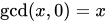


3. There is no need to introduce the name when there is already the name for the same entity.


4. The passage from divisibility to inequalities to then get equality is a clunky unnecessary approach. Take into account that the algorithm does not need a notion of order (other than divisibility and a notion of remainders getting smaller) to work. This should be an indication that introducing inequalities is something wasteful. In fact, just from the properties of divisibility, the sets of common divisors of the pairs, and are the same. In particular, the greatest common divisors are the same. ~2026-27900-38 (talk) 23:52, 7 May 2026 (UTC)


- This kind of rude tone has absolutely no place on Wikipedia talk pages. Please retract or revise your comment, and don't ever write such uncivil comments again in the future. For what it's worth, this material was added in 2009 by User:Proteins (now user:WillowW). –jacobolus (t) 22:32, 9 May 2026 (UTC)
- My guess was based on the "proof" in the article about the Extended Euclidean Algorithm, that had the same quality as the proof that was here, and he did write, and on knowing the quality of his writing in general. Which adjectives are appropriate to use in Wikipedia, in this case, that are not considered rude but are accurate? Please, re-write the note accordingly. ~2026-27876-20 (talk) 03:49, 12 May 2026 (UTC)
- When you lead with sarcastic personalization, and then go on to call the contribution "clumsy", "clunky", "badly presented", you are just going out of your way to be rude. Please don't do that here. If you just completely removed all of the insults, it would make your point clearer, a lot less distracting, and people would be more likely to take you seriously. You can also skip the scare quotes around "'proof'", which come across as extremely sarcastic/dismissive. Your second comment about "knowing the quality of his writing in general" is also entirely inappropriate. Daniel Lazard's first language is French, and his user page makes it clear that he considers himself to have an "intermediate" level of English fluency. (Personally I think that's too modest, and his English is much better than my French which I would consider "intermediate".) Have you ever tried writing professionally in a second language? –jacobolus (t) 04:52, 12 May 2026 (UTC)
- It is the quality of the mathematics, not English or grammar, to which I was referring in every case that I expressed an evaluation. ~2026-28732-75 (talk) 05:19, 12 May 2026 (UTC)
- When you lead with sarcastic personalization, and then go on to call the contribution "clumsy", "clunky", "badly presented", you are just going out of your way to be rude. Please don't do that here. If you just completely removed all of the insults, it would make your point clearer, a lot less distracting, and people would be more likely to take you seriously. You can also skip the scare quotes around "'proof'", which come across as extremely sarcastic/dismissive. Your second comment about "knowing the quality of his writing in general" is also entirely inappropriate. Daniel Lazard's first language is French, and his user page makes it clear that he considers himself to have an "intermediate" level of English fluency. (Personally I think that's too modest, and his English is much better than my French which I would consider "intermediate".) Have you ever tried writing professionally in a second language? –jacobolus (t) 04:52, 12 May 2026 (UTC)
- My guess was based on the "proof" in the article about the Extended Euclidean Algorithm, that had the same quality as the proof that was here, and he did write, and on knowing the quality of his writing in general. Which adjectives are appropriate to use in Wikipedia, in this case, that are not considered rude but are accurate? Please, re-write the note accordingly. ~2026-27876-20 (talk) 03:49, 12 May 2026 (UTC)
Content Disclaimer
Informasi ini disarikan dari Wikipedia dan disajikan kembali untuk tujuan edukasi. Konten tersedia di bawah lisensi CC BY-SA 3.0. Kami tidak bertanggung jawab atas ketidakakuratan data yang bersumber dari kontribusi publik tersebut.
- The information displayed on this website is sourced in part or in whole from Wikipedia and has been adapted for the purpose of restating it. We strive to provide accurate and relevant information, however:
- There is no guarantee of absolute accuracy. Wikipedia is an open, collaborative project that can be edited by anyone, so information is subject to change.
- It is not intended to constitute professional advice. The content displayed is for informational and educational purposes only. For important decisions (e.g., medical, legal, or financial), please consult a professional.
- Content copyright. Wikipedia is licensed under the Creative Commons Attribution-ShareAlike License (CC BY-SA). This means that content may be reused with appropriate attribution and shared under a similar license.
- Responsible use. Any risk arising from the use of information from this website is entirely the responsibility of the user.