Talbot cavity
A Talbot cavity is an external cavity used for the coherent beam combination of output from laser sets. It has been used experimentally for semiconductor laser diodes, carbon dioxide lasers, fiber lasers and solid-state disk lasers arranged in an array. In the simplest version, it is constructed with a single mirror at half the Talbot distance from the output facet of the laser array:

where is the period of the laser lattice and is the wavelength of laser emission. The constructive interference images the near field of the array back onto the array itself at the Talbot distance, creating optical feedback. This interference feedback forces the lasers in the array to transverse mode lock. The Fresnel number of the element laser array phase-locked by Talbot cavity is given by:[1]


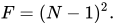
Talbot beam combination is highly sensitive to transverse phase distortions even at scale. [2] Theory developed for Talbot cavities [3] facilitated the development of thin disk diode-pumped solid-state laser arrays.[4]

References
- ^ Okulov, A Yu (1990). "Two-dimensional periodic structures in nonlinear resonator". JOSA B. 7 (6): 1045–1050. Bibcode:1990JOSAB...7.1045O. doi:10.1364/JOSAB.7.001045.
- ^ Okulov, A Yu (1991). "The effect of roughness of optical elements on the transverse structure of alight field in a nonlinear Talbot cavity". J. Mod. Opt. 53 (11): 1887–1890. Bibcode:1991JMOp...38.1887O. doi:10.1080/09500349114551991.
- ^ Golubentsev, A A; Likhanskii, V V; Napartovich, A P (1980). "Theory of phase locking of an array of lasers". Sov. Phys. JETP. 52 (5): 847.
- ^ Okulov, A Yu (1993). "Scaling of diode-array-pumped solid-state lasers via self-imaging". Opt. Commun. 99 (5–6): 350–354. Bibcode:1993OptCo..99..350O. doi:10.1016/0030-4018(93)90342-3.
- In-phase coherent coupling of tapered lasers in an external Talbot cavity
- Semiconductor laser array in an external Talbot cavity
 | This optics-related article is a stub. You can help Wikipedia by adding missing information. |
Content Disclaimer
Informasi ini disarikan dari Wikipedia dan disajikan kembali untuk tujuan edukasi. Konten tersedia di bawah lisensi CC BY-SA 3.0. Kami tidak bertanggung jawab atas ketidakakuratan data yang bersumber dari kontribusi publik tersebut.
- The information displayed on this website is sourced in part or in whole from Wikipedia and has been adapted for the purpose of restating it. We strive to provide accurate and relevant information, however:
- There is no guarantee of absolute accuracy. Wikipedia is an open, collaborative project that can be edited by anyone, so information is subject to change.
- It is not intended to constitute professional advice. The content displayed is for informational and educational purposes only. For important decisions (e.g., medical, legal, or financial), please consult a professional.
- Content copyright. Wikipedia is licensed under the Creative Commons Attribution-ShareAlike License (CC BY-SA). This means that content may be reused with appropriate attribution and shared under a similar license.
- Responsible use. Any risk arising from the use of information from this website is entirely the responsibility of the user.