Tacnode
 | This article needs additional citations for verification. (February 2010) |


In classical algebraic geometry, a tacnode (also called a point of osculation or double cusp)[1] is a kind of singular point of a curve. It is defined as a point where two (or more) osculating circles to the curve at that point are tangent. This means that two branches of the curve have ordinary tangency at the double point.[1]
The canonical example is

A tacnode of an arbitrary curve may then be defined from this example, as a point of self-tangency locally diffeomorphic to the point at the origin of this curve. Another example of a tacnode is given by the links curve shown in the figure, with equation
More general background
Consider a smooth real-valued function of two variables, say f (x, y) where x and y are real numbers. So f is a function from the plane to the line. The space of all such smooth functions is acted upon by the group of diffeomorphisms of the plane and the diffeomorphisms of the line, i.e. diffeomorphic changes of coordinate in both the source and the target. This action splits the whole function space up into equivalence classes, i.e. orbits of the group action.
One such family of equivalence classes is denoted by where k is a non-negative integer. This notation was introduced by V. I. Arnold. A function f is said to be of type if it lies in the orbit of i.e. there exists a diffeomorphic change of coordinate in source and target which takes f into one of these forms. These simple forms are said to give normal forms for the type -singularities.


A curve with equation f = 0 will have a tacnode, say at the origin, if and only if f has a type -singularity at the origin.

Notice that a node corresponds to a type -singularity. A tacnode corresponds to a type -singularity. In fact each type -singularity, where n ≥ 0 is an integer, corresponds to a curve with self-intersection. As n increases, the order of self-intersection increases: transverse crossing, ordinary tangency, etc.
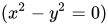


The type -singularities are of no interest over the real numbers: they all give an isolated point. Over the complex numbers, type -singularities and type -singularities are equivalent: (x, y) → (x, iy) gives the required diffeomorphism of the normal forms.

See also
References
- ^ a b Schwartzman, Steven (1994), The Words of Mathematics: An Etymological Dictionary of Mathematical Terms Used in English, MAA Spectrum, Mathematical Association of America, p. 217, ISBN 978-0-88385-511-9.
Further reading
- Salmon, George (1873). A Treatise on the Higher Plane Curves: Intended as a Sequel to a Treatise on Conic Sections.
External links
- Weisstein, Eric W. "Tacnode". MathWorld.
- Hazewinkel, M. (2001) [1994], "Tacnode", Encyclopedia of Mathematics, EMS Press
Content Disclaimer
Informasi ini disarikan dari Wikipedia dan disajikan kembali untuk tujuan edukasi. Konten tersedia di bawah lisensi CC BY-SA 3.0. Kami tidak bertanggung jawab atas ketidakakuratan data yang bersumber dari kontribusi publik tersebut.
- The information displayed on this website is sourced in part or in whole from Wikipedia and has been adapted for the purpose of restating it. We strive to provide accurate and relevant information, however:
- There is no guarantee of absolute accuracy. Wikipedia is an open, collaborative project that can be edited by anyone, so information is subject to change.
- It is not intended to constitute professional advice. The content displayed is for informational and educational purposes only. For important decisions (e.g., medical, legal, or financial), please consult a professional.
- Content copyright. Wikipedia is licensed under the Creative Commons Attribution-ShareAlike License (CC BY-SA). This means that content may be reused with appropriate attribution and shared under a similar license.
- Responsible use. Any risk arising from the use of information from this website is entirely the responsibility of the user.