TK 2000
 TK 2000 II Color Computer | |
| Also known as | TK 2000 Color Computer, TK 2000 II Color Computer |
|---|---|
| Manufacturer | Microdigital Eletrônica |
| Type | Personal computer |
| Released | 1984 |
| Discontinued | 1987 |
| Applesoft BASIC compatible, TKDOS 3.3 (Apple DOS 3.3 compatible) | |
| CPU | MOS Technology 6502 @ 1,02 MHz |
| Memory | 64KB (expandable to 128KB) |
| Floppy Disks, Audio Cassette | |
| Display | RF TV out or RGB; 40×24 text; 280×192 graphics; 8 colors |
| Sound | Beeper |
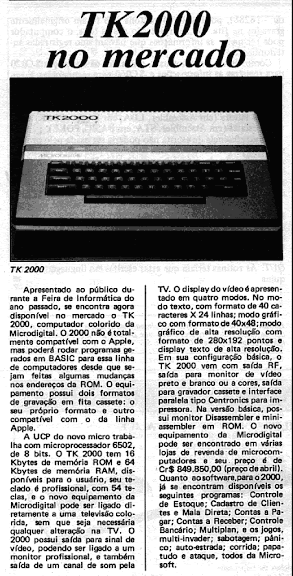
The TK 2000 microcomputer, produced by the Brazilian company Microdigital Eletrônica Ltda,[1][2][3] was presented to the public during the 1983 Computer Fair and launched in 1984.[4] It was a clone of the Microprofessor II manufactured by Multitech.[5][3] Based on the 6502 CPU, the machine was partially compatible with Apple II Plus software and hardware.[5][6] Some software was developed specifically for the machine, including productivity programs and games.[7][8]
In 1985 the TK2000/II was released and in 1987 the machine was discontinued.
Details
- CPU - MOS Technology 6502 at 1,02 MHz
- Memory - 16 KB ROM, 64 KB RAM (expandable to 128KB)
- Sound - one channel, up to 4 octaves with tones and semitones, 5 different tempos for each note, by software.
- Video - 280 x 192 with 8 colors, low-resolution mode emulates 16 colors through dithering.
- Keyboard - mechanical, 54 keys with QWERTY layout.
- Expansion - 1 slot
- Interfaces / Ports - TV output, RGB monitor, printer, joystick
- Storage - cassette recorder (1500 baud), external 5¼ floppy drive (140 Kb, double density)
- Operating system - BASIC, TKDOS 3.3 ( Apple DOS 3.3 compatible)
Models
TK 2000 Color Computer
.png)
This is the initial 1984 model.
TK 2000/II Color Computer
A 1985 rebranding of the initial model.[9][6][10]
TK 2000/II Color Computer 128Kb
This version adds a 64KB memory expansion, totaling 128KB,[10] compatible with the Saturn memory expansion standard. Two hardware revisions of this model are known: TD112 with a satellite board, mounted next to the main board and connected to the main board via auxiliary wiring and TD122 with all components consolidated on a single board.
See also
References
- ^ "TK2000". Museu da Tecnologia (in Brazilian Portuguese). Retrieved 2024-07-21.
- ^ "Microcomputador TK 2000". Museu de Tecnologia da Unoeste (in Brazilian Portuguese). 2015-12-18. Retrieved 2024-07-21.
- ^ a b "MICRODIGITAL TK-2000". OLD-COMPUTERS.COM : The Museum. 2023-10-02. Archived from the original on 2023-10-02. Retrieved 2024-07-21.
- ^ "TK 2000 no mercado". Micro Sistemas (32): 30. May 1984.
- ^ a b "O microcomputador Microdigital TK-2000 de 1984". MCC - Museu Capixaba do Computador (in Brazilian Portuguese). 2024-03-15. Retrieved 2024-07-21.
- ^ a b "Binary Dinosaurs - Microdigital TK2000". www.binarydinosaurs.co.uk. Retrieved 2024-07-21.
- ^ "Microideia catalog".
- ^ "Programas para TK-2000".
- ^ TK 2000/II Manual Técnico (PDF).
- ^ a b "Ficha Técnica do TK-2000 Color Computer". apple2pro.com.br. Retrieved 2024-07-21.
Content Disclaimer
Informasi ini disarikan dari Wikipedia dan disajikan kembali untuk tujuan edukasi. Konten tersedia di bawah lisensi CC BY-SA 3.0. Kami tidak bertanggung jawab atas ketidakakuratan data yang bersumber dari kontribusi publik tersebut.
- The information displayed on this website is sourced in part or in whole from Wikipedia and has been adapted for the purpose of restating it. We strive to provide accurate and relevant information, however:
- There is no guarantee of absolute accuracy. Wikipedia is an open, collaborative project that can be edited by anyone, so information is subject to change.
- It is not intended to constitute professional advice. The content displayed is for informational and educational purposes only. For important decisions (e.g., medical, legal, or financial), please consult a professional.
- Content copyright. Wikipedia is licensed under the Creative Commons Attribution-ShareAlike License (CC BY-SA). This means that content may be reused with appropriate attribution and shared under a similar license.
- Responsible use. Any risk arising from the use of information from this website is entirely the responsibility of the user.