Supergranulation

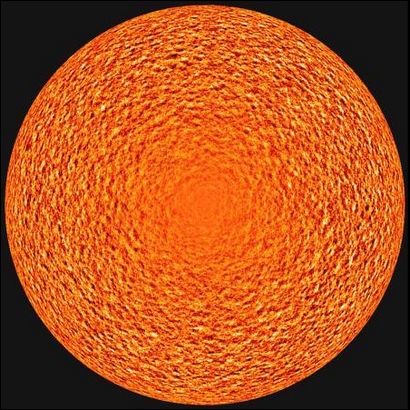
In solar physics and observation, supergranulation is a pattern of convection cells in the Sun's photosphere. The individual convection cells are typically referred to as supergranules. The pattern was discovered in the 1950s by A.B. Hart[1] using Doppler velocity measurements showing horizontal flows on the photosphere (flow speed about 300 to 500 m/s, a tenth of that in the smaller granules). Later work (1960s) by Leighton, Noyes and Simon established a typical size of about 30000 km for supergranules with a lifetime of about 24 hours.[2]
Origin
Supergranulation has long been interpreted as a specific convection scale, but its origin is not precisely known. Although the presence of granules in the solar photosphere is a well-documented phenomenon, there is still much debate on the true nature or even the existence of higher-order granulation patterns. Some authors suggest the existence of three distinct scales of organization: granulation (with typical diameters of 150–2500 km), mesogranulation (5000–10000 km) and supergranulation (over 20000 km). Granules are typically considered as being signs of convective cells forming a hierarchic structure: supergranules would be thus fragmented in their uppermost layers into smaller mesogranules, which in turn would split into even smaller granules at their surface. The solar material would flow downward in dark "lanes" separating granules with the divisions between supergranules being the biggest concentrations of cold gas, analogous to rivers connecting smaller tributaries. It should however be stressed that this picture is highly speculative and might turn out to be false in the light of future discoveries. Recent studies[3] show some evidence that mesogranulation was a ghost feature caused by averaging procedures.
See also
References
- ^ Hart, A. B. (1 February 1956). "Motions in the Sun at the Photospheric Level: VI. Large-Scale Motions in the Equatorial Region". Monthly Notices of the Royal Astronomical Society. 116 (1): 38–55. doi:10.1093/mnras/116.1.38.
- ^ Freedman, Roger A.; Kaufmann III, William J. (2008). Universe. New York, USA: W. H. Freeman and Company. pp. 762. ISBN 978-0-7167-8584-2.
- ^ "Living Reviews in Solar Physics". springer.com.
External links
- a SOHO/MDI Dopplergram showing supergranular speed pattern
- NASA: The Sun Does The Wave
- Information at Nature.com
- Michel Rieutord and François Rincon, "The Sun’s Supergranulation", Living Rev. Solar Phys. 7, (2010), 2. online article (cited on June 15, 2010).

Content Disclaimer
Informasi ini disarikan dari Wikipedia dan disajikan kembali untuk tujuan edukasi. Konten tersedia di bawah lisensi CC BY-SA 3.0. Kami tidak bertanggung jawab atas ketidakakuratan data yang bersumber dari kontribusi publik tersebut.
- The information displayed on this website is sourced in part or in whole from Wikipedia and has been adapted for the purpose of restating it. We strive to provide accurate and relevant information, however:
- There is no guarantee of absolute accuracy. Wikipedia is an open, collaborative project that can be edited by anyone, so information is subject to change.
- It is not intended to constitute professional advice. The content displayed is for informational and educational purposes only. For important decisions (e.g., medical, legal, or financial), please consult a professional.
- Content copyright. Wikipedia is licensed under the Creative Commons Attribution-ShareAlike License (CC BY-SA). This means that content may be reused with appropriate attribution and shared under a similar license.
- Responsible use. Any risk arising from the use of information from this website is entirely the responsibility of the user.