Sum of squares function
In number theory, the sum of squares function is an arithmetic function that gives the number of representations for a given positive integer as the sum of squares, where representations that differ only in the order of the summands or in the signs of the numbers being squared are counted as different. It is denoted by .


Definition
The function is defined as

where denotes the cardinality of a set. In other words, is the number of ways can be written as a sum of squares.

For example, since where each sum has two sign combinations, and also since with four sign combinations. On the other hand, because there is no way to represent 3 as a sum of two squares.





Formulae
k = 2

| • | Squares (and thus integer distances) in red |
| • | Non-unique representations (up to rotation and reflection) bolded |
The number of ways to write a natural number as sum of two squares is given by . It is given explicitly by


where is the number of divisors of which are congruent to 1 modulo 4 and is the number of divisors of which are congruent to 3 modulo 4. Using sums, the expression can be written as:


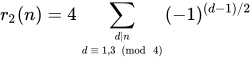
The prime factorization , where are the prime factors of the form and are the prime factors of the form gives another formula








k = 3
Gauss proved that for a squarefree number ,

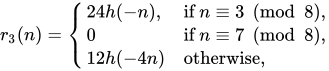
where denotes the class number of an integer .


There exist extensions of Gauss' formula to arbitrary integer .[1][2]
k = 4
The number of ways to represent as the sum of four squares was due to Carl Gustav Jakob Jacobi and it is eight times the sum of all its divisors which are not divisible by 4, i.e.

Representing , where is an odd integer, one can express in terms of the divisor function as follows:



k = 6
The number of ways to represent as the sum of six squares is given by

where is the Kronecker symbol.[3]

k = 8
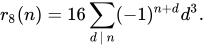
Jacobi also found an explicit formula for the case :[3]

Generating function
The generating function of the sequence for fixed k can be expressed in terms of the Jacobi theta function:[4]
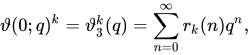
where

Numerical values
The first 30 values for are listed in the table below:

| n | = | ||||||||
|---|---|---|---|---|---|---|---|---|---|
| 0 | 0 | 1 | 1 | 1 | 1 | 1 | 1 | 1 | 1 |
| 1 | 1 | 2 | 4 | 6 | 8 | 10 | 12 | 14 | 16 |
| 2 | 2 | 0 | 4 | 12 | 24 | 40 | 60 | 84 | 112 |
| 3 | 3 | 0 | 0 | 8 | 32 | 80 | 160 | 280 | 448 |
| 4 | 22 | 2 | 4 | 6 | 24 | 90 | 252 | 574 | 1136 |
| 5 | 5 | 0 | 8 | 24 | 48 | 112 | 312 | 840 | 2016 |
| 6 | 2×3 | 0 | 0 | 24 | 96 | 240 | 544 | 1288 | 3136 |
| 7 | 7 | 0 | 0 | 0 | 64 | 320 | 960 | 2368 | 5504 |
| 8 | 23 | 0 | 4 | 12 | 24 | 200 | 1020 | 3444 | 9328 |
| 9 | 32 | 2 | 4 | 30 | 104 | 250 | 876 | 3542 | 12112 |
| 10 | 2×5 | 0 | 8 | 24 | 144 | 560 | 1560 | 4424 | 14112 |
| 11 | 11 | 0 | 0 | 24 | 96 | 560 | 2400 | 7560 | 21312 |
| 12 | 22×3 | 0 | 0 | 8 | 96 | 400 | 2080 | 9240 | 31808 |
| 13 | 13 | 0 | 8 | 24 | 112 | 560 | 2040 | 8456 | 35168 |
| 14 | 2×7 | 0 | 0 | 48 | 192 | 800 | 3264 | 11088 | 38528 |
| 15 | 3×5 | 0 | 0 | 0 | 192 | 960 | 4160 | 16576 | 56448 |
| 16 | 24 | 2 | 4 | 6 | 24 | 730 | 4092 | 18494 | 74864 |
| 17 | 17 | 0 | 8 | 48 | 144 | 480 | 3480 | 17808 | 78624 |
| 18 | 2×32 | 0 | 4 | 36 | 312 | 1240 | 4380 | 19740 | 84784 |
| 19 | 19 | 0 | 0 | 24 | 160 | 1520 | 7200 | 27720 | 109760 |
| 20 | 22×5 | 0 | 8 | 24 | 144 | 752 | 6552 | 34440 | 143136 |
| 21 | 3×7 | 0 | 0 | 48 | 256 | 1120 | 4608 | 29456 | 154112 |
| 22 | 2×11 | 0 | 0 | 24 | 288 | 1840 | 8160 | 31304 | 149184 |
| 23 | 23 | 0 | 0 | 0 | 192 | 1600 | 10560 | 49728 | 194688 |
| 24 | 23×3 | 0 | 0 | 24 | 96 | 1200 | 8224 | 52808 | 261184 |
| 25 | 52 | 2 | 12 | 30 | 248 | 1210 | 7812 | 43414 | 252016 |
| 26 | 2×13 | 0 | 8 | 72 | 336 | 2000 | 10200 | 52248 | 246176 |
| 27 | 33 | 0 | 0 | 32 | 320 | 2240 | 13120 | 68320 | 327040 |
| 28 | 22×7 | 0 | 0 | 0 | 192 | 1600 | 12480 | 74048 | 390784 |
| 29 | 29 | 0 | 8 | 72 | 240 | 1680 | 10104 | 68376 | 390240 |
| 30 | 2×3×5 | 0 | 0 | 48 | 576 | 2720 | 14144 | 71120 | 395136 |


See also
References
- ^ P. T. Bateman (1951). "On the Representation of a Number as the Sum of Three Squares" (PDF). Trans. Amer. Math. Soc. 71: 70–101. doi:10.1090/S0002-9947-1951-0042438-4.
- ^ S. Bhargava; Chandrashekar Adiga; D. D. Somashekara (1993). "Three-Square Theorem as an Application of Andrews' Identity" (PDF). Fibonacci Quart. 31 (2): 129–133. doi:10.1080/00150517.1993.12429300.
- ^ a b Cohen, H. (2007). "5.4 Consequences of the Hasse–Minkowski Theorem". Number Theory Volume I: Tools and Diophantine Equations. Springer. ISBN 978-0-387-49922-2.
- ^ Milne, Stephen C. (2002). "Introduction". Infinite Families of Exact Sums of Squares Formulas, Jacobi Elliptic Functions, Continued Fractions, and Schur Functions. Springer Science & Business Media. p. 9. ISBN 1402004915.
Further reading
Grosswald, Emil (1985). Representations of integers as sums of squares. Springer-Verlag. ISBN 0387961267.
External links
- Weisstein, Eric W. "Sum of Squares Function". MathWorld.
- Sloane, N. J. A. (ed.). "Sequence A122141 (number of ways of writing n as a sum of d squares)". The On-Line Encyclopedia of Integer Sequences. OEIS Foundation.
- Sloane, N. J. A. (ed.). "Sequence A004018 (Theta series of square lattice, r_2(n))". The On-Line Encyclopedia of Integer Sequences. OEIS Foundation.
Content Disclaimer
Informasi ini disarikan dari Wikipedia dan disajikan kembali untuk tujuan edukasi. Konten tersedia di bawah lisensi CC BY-SA 3.0. Kami tidak bertanggung jawab atas ketidakakuratan data yang bersumber dari kontribusi publik tersebut.
- The information displayed on this website is sourced in part or in whole from Wikipedia and has been adapted for the purpose of restating it. We strive to provide accurate and relevant information, however:
- There is no guarantee of absolute accuracy. Wikipedia is an open, collaborative project that can be edited by anyone, so information is subject to change.
- It is not intended to constitute professional advice. The content displayed is for informational and educational purposes only. For important decisions (e.g., medical, legal, or financial), please consult a professional.
- Content copyright. Wikipedia is licensed under the Creative Commons Attribution-ShareAlike License (CC BY-SA). This means that content may be reused with appropriate attribution and shared under a similar license.
- Responsible use. Any risk arising from the use of information from this website is entirely the responsibility of the user.