Structural reliability

Structural reliability is about applying reliability engineering theories to buildings and, more generally, structural analysis.[1][2] Reliability is also used as a probabilistic measure of structural safety. The reliability of a structure is defined as the probability of complement of failure . The failure occurs when the total applied load is larger than the total resistance of the structure. Structural reliability has become known as a design philosophy in the twenty-first century, and it might replace traditional deterministic ways of design[3] and maintenance.[2]

Theory
In structural reliability studies, both loads and resistances are modeled as probabilistic variables. Using this approach the probability of failure of a structure is calculated. When loads and resistances are explicit and have their own independent function, the probability of failure could be formulated as follows.[1][2]
| 1 |
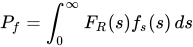
where is the probability of failure, is the cumulative distribution function of resistance (R), and is the probability density of load (S).


However, in most cases, the distribution of loads and resistances are not independent and the probability of failure is defined via the following more general formula.
| 2 |
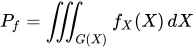
where 𝑋 is the vector of the basic variables, and G(X) that is called is the limit state function could be a line, surface or volume that the integral is taken on its surface.
Solution approaches
Analytical solutions
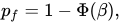
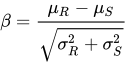
In some cases when load and resistance are explicitly expressed (such as equation (1) above), and their distributions are normal, the integral of equation (1) has a closed-form solution as follows.
| 3 |
Simulation
In most cases load and resistance are not normally distributed. Therefore, solving the integrals of equations (1) and (2) analytically is impossible. Using Monte Carlo simulation is an approach that could be used in such cases.[1][4]
References
- ^ a b c Melchers, R. E. (2002), "Structural Reliability Analysis and Prediction," 2nd Ed., John Wiley, Chichester, UK.
- ^ a b c Piryonesi, Sayed Madeh; Tavakolan, Mehdi (9 January 2017). "A mathematical programming model for solving cost-safety optimization (CSO) problems in the maintenance of structures". KSCE Journal of Civil Engineering. 21 (6): 2226–2234. Bibcode:2017KSJCE..21.2226P. doi:10.1007/s12205-017-0531-z. S2CID 255532962.
- ^ Choi, S. K., Grandhi, R., & Canfield, R. A. (2006). Reliability-based structural design. Springer Science & Business Media.
- ^ Okasha, N. M., & Frangopol, D. M. (2009). Lifetime-oriented multi-objective optimization of structural maintenance considering system reliability, redundancy and life-cycle cost using GA. Structural Safety, 31(6), 460-474.
Content Disclaimer
Informasi ini disarikan dari Wikipedia dan disajikan kembali untuk tujuan edukasi. Konten tersedia di bawah lisensi CC BY-SA 3.0. Kami tidak bertanggung jawab atas ketidakakuratan data yang bersumber dari kontribusi publik tersebut.
- The information displayed on this website is sourced in part or in whole from Wikipedia and has been adapted for the purpose of restating it. We strive to provide accurate and relevant information, however:
- There is no guarantee of absolute accuracy. Wikipedia is an open, collaborative project that can be edited by anyone, so information is subject to change.
- It is not intended to constitute professional advice. The content displayed is for informational and educational purposes only. For important decisions (e.g., medical, legal, or financial), please consult a professional.
- Content copyright. Wikipedia is licensed under the Creative Commons Attribution-ShareAlike License (CC BY-SA). This means that content may be reused with appropriate attribution and shared under a similar license.
- Responsible use. Any risk arising from the use of information from this website is entirely the responsibility of the user.