Strict differentiability
In mathematics, strict differentiability is a modification of the usual notion of differentiability of functions that is particularly suited to p-adic analysis. In short, the definition is made more restrictive by allowing both points used in the difference quotient to "move".
Basic definition
The simplest setting in which strict differentiability can be considered, is that of a real-valued function defined on an interval I of the real line. The function f:I → R is said strictly differentiable in a point a ∈ I if
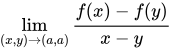
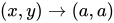
exists, where is to be considered as limit in , and of course requiring .


A strictly differentiable function is obviously differentiable, but the converse is wrong, as can be seen from the counter-example

One has however the equivalence of strict differentiability on an interval I, and being of differentiability class (i.e. continuously differentiable).

In analogy with the Fréchet derivative, the previous definition can be generalized to the case where R is replaced by a Banach space E (such as ), and requiring existence of a continuous linear map L such that


where is defined in a natural way on E × E.

Motivation from p-adic analysis
In the p-adic setting, the usual definition of the derivative fails to have certain desirable properties. For instance, it is possible for a function that is not locally constant to have zero derivative everywhere. An example of this is furnished by the function F: Zp → Zp, where Zp is the ring of p-adic integers, defined by
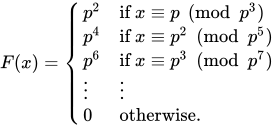
One checks that the derivative of F, according to the usual definition of the derivative, exists and is zero everywhere, including at x = 0. That is, for any x in Zp,
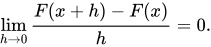
Nevertheless F fails to be locally constant at the origin.
The problem with this function is that the difference quotients
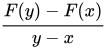
do not approach zero for x and y close to zero. For example, taking x = pn − p2n and y = pn, we have

which does not approach zero. The definition of strict differentiability avoids this problem by imposing a condition directly on the difference quotients.
Definition in p-adic case
Let K be a complete extension of Qp (for example K = Cp), and let X be a subset of K with no isolated points. Then a function F : X → K is said to be strictly differentiable at x = a if the limit
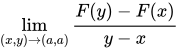
exists.
References
- Alain M. Robert (2000). A Course in p-adic Analysis. Springer. ISBN 0-387-98669-3.
Content Disclaimer
Informasi ini disarikan dari Wikipedia dan disajikan kembali untuk tujuan edukasi. Konten tersedia di bawah lisensi CC BY-SA 3.0. Kami tidak bertanggung jawab atas ketidakakuratan data yang bersumber dari kontribusi publik tersebut.
- The information displayed on this website is sourced in part or in whole from Wikipedia and has been adapted for the purpose of restating it. We strive to provide accurate and relevant information, however:
- There is no guarantee of absolute accuracy. Wikipedia is an open, collaborative project that can be edited by anyone, so information is subject to change.
- It is not intended to constitute professional advice. The content displayed is for informational and educational purposes only. For important decisions (e.g., medical, legal, or financial), please consult a professional.
- Content copyright. Wikipedia is licensed under the Creative Commons Attribution-ShareAlike License (CC BY-SA). This means that content may be reused with appropriate attribution and shared under a similar license.
- Responsible use. Any risk arising from the use of information from this website is entirely the responsibility of the user.