Strict-feedback form
 | This article relies largely or entirely on a single source. (July 2011) |
In control theory, dynamical systems are in strict-feedback form when they can be expressed as
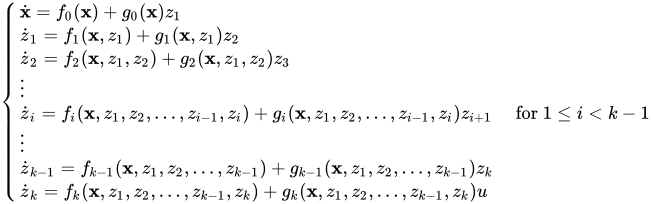
where
- with ,
- are scalars,
- is a scalar input to the system,
- vanish at the origin (i.e., ),
- are nonzero over the domain of interest (i.e., for ).









Here, strict feedback refers to the fact that the nonlinear functions and in the equation only depend on states that are fed back to that subsystem.[1][page needed] That is, the system has a kind of lower triangular form.


Stabilization
Systems in strict-feedback form can be stabilized by recursive application of backstepping.[1][page needed] That is,
- It is given that the system
- is already stabilized to the origin by some control where . That is, choice of to stabilize this system must occur using some other method. It is also assumed that a Lyapunov function for this stable subsystem is known.
- A control is designed so that the system
- is stabilized so that follows the desired control. The control design is based on the augmented Lyapunov function candidate
- The control can be picked to bound away from zero.
- A control is designed so that the system
- is stabilized so that follows the desired control. The control design is based on the augmented Lyapunov function candidate
- The control can be picked to bound away from zero.
- This process continues until the actual is known, and
- The real control stabilizes to fictitious control .
- The fictitious control stabilizes to fictitious control .
- The fictitious control stabilizes to fictitious control .
- ...
- The fictitious control stabilizes to fictitious control .
- The fictitious control stabilizes to fictitious control .
- The fictitious control stabilizes to the origin.













This process is known as backstepping because it starts with the requirements on some internal subsystem for stability and progressively steps back out of the system, maintaining stability at each step. Because
- vanish at the origin for ,
- are nonzero for ,
- the given control has ,

then the resulting system has an equilibrium at the origin (i.e., where , , , ... , , and ) that is globally asymptotically stable.


See also
References
- ^ a b Khalil, Hassan K. (2002). Nonlinear Systems (3rd ed.). Upper Saddle River, NJ: Prentice Hall. ISBN 0-13-067389-7.
Content Disclaimer
Informasi ini disarikan dari Wikipedia dan disajikan kembali untuk tujuan edukasi. Konten tersedia di bawah lisensi CC BY-SA 3.0. Kami tidak bertanggung jawab atas ketidakakuratan data yang bersumber dari kontribusi publik tersebut.
- The information displayed on this website is sourced in part or in whole from Wikipedia and has been adapted for the purpose of restating it. We strive to provide accurate and relevant information, however:
- There is no guarantee of absolute accuracy. Wikipedia is an open, collaborative project that can be edited by anyone, so information is subject to change.
- It is not intended to constitute professional advice. The content displayed is for informational and educational purposes only. For important decisions (e.g., medical, legal, or financial), please consult a professional.
- Content copyright. Wikipedia is licensed under the Creative Commons Attribution-ShareAlike License (CC BY-SA). This means that content may be reused with appropriate attribution and shared under a similar license.
- Responsible use. Any risk arising from the use of information from this website is entirely the responsibility of the user.