Stream thrust averaging
In fluid dynamics, stream thrust averaging is a process used to convert three-dimensional flow through a duct into one-dimensional uniform flow. It makes the assumptions that the flow is mixed adiabatically and without friction. However, due to the mixing process, there is a net increase in the entropy of the system. Although there is an increase in entropy, the stream thrust averaged values are more representative of the flow than a simple average as a simple average would violate the second law of thermodynamics.
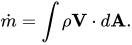
Equations for a perfect gas
Stream thrust:

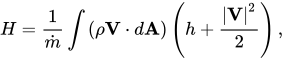
Stagnation enthalpy:

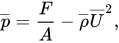
Solutions
Solving for yields two solutions. They must both be analyzed to determine which is the physical solution. One will usually be a subsonic root and the other a supersonic root. If it is not clear which value of velocity is correct, the second law of thermodynamics may be applied.



Second law of thermodynamics:
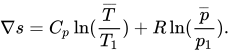
The values and are unknown and may be dropped from the formulation. The value of entropy is not necessary, only that the value is positive.



One possible unreal solution for the stream thrust averaged velocity yields a negative entropy. Another method of determining the proper solution is to take a simple average of the velocity and determining which value is closer to the stream thrust averaged velocity.
References
- DeBonis, J.R.; Trefny, C.J.; Steffen, Jr., C.J. (1999). "Inlet Development for a Rocket Based Combined Cycle, Single Stage to Orbit Vehicle Using Computational Fluid Dynamics" (PDF). NASA/TM—1999-209279. NASA. Retrieved 18 February 2013.
Content Disclaimer
Informasi ini disarikan dari Wikipedia dan disajikan kembali untuk tujuan edukasi. Konten tersedia di bawah lisensi CC BY-SA 3.0. Kami tidak bertanggung jawab atas ketidakakuratan data yang bersumber dari kontribusi publik tersebut.
- The information displayed on this website is sourced in part or in whole from Wikipedia and has been adapted for the purpose of restating it. We strive to provide accurate and relevant information, however:
- There is no guarantee of absolute accuracy. Wikipedia is an open, collaborative project that can be edited by anyone, so information is subject to change.
- It is not intended to constitute professional advice. The content displayed is for informational and educational purposes only. For important decisions (e.g., medical, legal, or financial), please consult a professional.
- Content copyright. Wikipedia is licensed under the Creative Commons Attribution-ShareAlike License (CC BY-SA). This means that content may be reused with appropriate attribution and shared under a similar license.
- Responsible use. Any risk arising from the use of information from this website is entirely the responsibility of the user.