Standard deviation line

In statistics, the standard deviation line (or SD line) marks points on a scatter plot that are an equal number of standard deviations away from the average in each dimension. For example, in a 2-dimensional scatter diagram with variables and , points that are 1 standard deviation away from the mean of and also 1 standard deviation away from the mean of are on the SD line.[1] The SD line is a useful visual tool since points in a scatter diagram tend to cluster around it,[1] more or less tightly depending on their correlation.


Properties
Relation to regression line
The SD line goes through the point of averages and has a slope of when the correlation between and is positive, and when the correlation is negative.[1][2] Unlike the regression line, the SD line does not take into account the relationship between and .[3] The slope of the SD line is related to that of the regression line by where is the slope of the regression line, is the correlation coefficient, and is the magnitude of the slope of the SD line.[2]


Typical distance of points to SD line
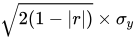
The root mean square vertical distance of points from the SD line is .[1] This gives an idea of the spread of points around the SD line.
- ^ a b c d Freedman, David (1998). Statistics. Robert Pisani, Roger Purves (3rd ed.). New York: W.W. Norton. ISBN 0-393-97083-3. OCLC 36922529.
- ^ a b Stark. "Regression". www.stat.berkeley.edu. Retrieved 2022-11-12.
- ^ Cochran. "Regression". www.stat.ucla.edu. Retrieved 2022-11-12.
Content Disclaimer
Informasi ini disarikan dari Wikipedia dan disajikan kembali untuk tujuan edukasi. Konten tersedia di bawah lisensi CC BY-SA 3.0. Kami tidak bertanggung jawab atas ketidakakuratan data yang bersumber dari kontribusi publik tersebut.
- The information displayed on this website is sourced in part or in whole from Wikipedia and has been adapted for the purpose of restating it. We strive to provide accurate and relevant information, however:
- There is no guarantee of absolute accuracy. Wikipedia is an open, collaborative project that can be edited by anyone, so information is subject to change.
- It is not intended to constitute professional advice. The content displayed is for informational and educational purposes only. For important decisions (e.g., medical, legal, or financial), please consult a professional.
- Content copyright. Wikipedia is licensed under the Creative Commons Attribution-ShareAlike License (CC BY-SA). This means that content may be reused with appropriate attribution and shared under a similar license.
- Responsible use. Any risk arising from the use of information from this website is entirely the responsibility of the user.