Stable module category
In mathematics, especially representation theory, the stable module category is a quotient of a module category in which projectives are "factored out."
Definition
Let R be a ring. For two modules M and N over R, define to be the set of R-linear maps from M to N modulo the relation that f ~ g if f − g factors through a projective module. The stable module category is defined by setting the objects to be the R-modules, and the morphisms are the equivalence classes .

Given a module M, let P be a projective module with a surjection . Then set to be the kernel of p. Suppose we are given a morphism and a surjection where Q is projective. Then one can lift f to a map which maps into . This gives a well-defined functor from the stable module category to itself.


For certain rings, such as Frobenius algebras, is an equivalence of categories. In this case, the inverse can be defined as follows. Given M, find an injective module I with an inclusion . Then is defined to be the cokernel of i. A case of particular interest is when the ring R is a group algebra.


The functor Ω−1 can even be defined on the module category of a general ring (without factoring out projectives), as the cokernel of the injective envelope. It need not be true in this case that the functor Ω−1 is actually an inverse to Ω. One important property of the stable module category is it allows defining the Ω functor for general rings. When R is perfect (or M is finitely generated and R is semiperfect), then Ω(M) can be defined as the kernel of the projective cover, giving a functor on the module category. However, in general projective covers need not exist, and so passing to the stable module category is necessary.
Connections with cohomology
Now we suppose that R = kG is a group algebra for some field k and some group G. One can show that there exist isomorphisms

for every positive integer n. The group cohomology of a representation M is given by where k has a trivial G-action, so in this way the stable module category gives a natural setting in which group cohomology lives.

Furthermore, the above isomorphism suggests defining cohomology groups for negative values of n, and in this way one recovers Tate cohomology.
Triangulated structure

in the usual module category defines an element of , and hence an element of , so that we get a sequence
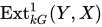
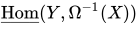

Taking to be the translation functor and such sequences as above to be exact triangles, the stable module category becomes a triangulated category.
See also
References
- J. F. Carlson, Lisa Townsley, Luis Valero-Elizondo, Mucheng Zhang, Cohomology Rings of Finite Groups, Springer-Verlag, 2003.
Content Disclaimer
Informasi ini disarikan dari Wikipedia dan disajikan kembali untuk tujuan edukasi. Konten tersedia di bawah lisensi CC BY-SA 3.0. Kami tidak bertanggung jawab atas ketidakakuratan data yang bersumber dari kontribusi publik tersebut.
- The information displayed on this website is sourced in part or in whole from Wikipedia and has been adapted for the purpose of restating it. We strive to provide accurate and relevant information, however:
- There is no guarantee of absolute accuracy. Wikipedia is an open, collaborative project that can be edited by anyone, so information is subject to change.
- It is not intended to constitute professional advice. The content displayed is for informational and educational purposes only. For important decisions (e.g., medical, legal, or financial), please consult a professional.
- Content copyright. Wikipedia is licensed under the Creative Commons Attribution-ShareAlike License (CC BY-SA). This means that content may be reused with appropriate attribution and shared under a similar license.
- Responsible use. Any risk arising from the use of information from this website is entirely the responsibility of the user.