Spherical pendulum

In physics, a spherical pendulum is a higher dimensional analogue of the pendulum. It consists of a mass m moving without friction on the surface of a sphere. The only forces acting on the mass are the reaction from the sphere and gravity.
It is convenient to use the spherical coordinates to describe the position of the mass in terms of , where r is fixed such that .


Lagrangian mechanics
Routinely, in order to write down the kinetic and potential parts of the Lagrangian in arbitrary generalized coordinates the position of the mass is expressed along Cartesian axes. Here, following the conventions shown in the diagram,


- .



Next, time derivatives of these coordinates are taken, to obtain velocities along the axes
- .



Thus,

and


The Lagrangian, with constant parts removed, is[1]

The Euler–Lagrange equation involving the polar angle

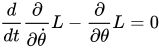
gives

and

When the equation reduces to the differential equation for the motion of a simple gravity pendulum.

Similarly, the Euler–Lagrange equation involving the azimuth ,

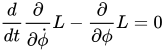
gives
- .
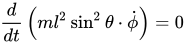
The last equation shows that angular momentum around the vertical axis, is conserved. The factor will play a role in the Hamiltonian formulation below.


The second order differential equation determining the evolution of is thus
- .

The azimuth , being absent from the Lagrangian, is a cyclic coordinate, which implies that its conjugate momentum is a constant of motion.
The conical pendulum refers to the special solutions where and is a constant not depending on time.


Hamiltonian mechanics
The Hamiltonian is

where conjugate momenta are
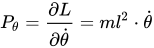
and
- .
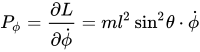
In terms of coordinates and momenta it reads
![{\displaystyle H=\underbrace {\left[{\frac {1}{2}}ml^{2}{\dot {\theta }}^{2}+{\frac {1}{2}}ml^{2}\sin ^{2}\theta {\dot {\phi }}^{2}\right]} _{T}+\underbrace {{\bigg [}-mgl\cos \theta {\bigg ]}} _{V}={P_{\theta }^{2} \over 2ml^{2}}+{P_{\phi }^{2} \over 2ml^{2}\sin ^{2}\theta }-mgl\cos \theta }](https://wikimedia.org/api/rest_v1/media/math/render/svg/0c4b7476a113f2067241e09d80ffab01076fbd3b)
Hamilton's equations will give time evolution of coordinates and momenta in four first-order differential equations

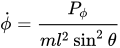
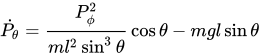

Momentum is a constant of motion. That is a consequence of the rotational symmetry of the system around the vertical axis.[dubious – discuss]

Trajectory

Trajectory of the mass on the sphere can be obtained from the expression for the total energy
![{\displaystyle E=\underbrace {\left[{\frac {1}{2}}ml^{2}{\dot {\theta }}^{2}+{\frac {1}{2}}ml^{2}\sin ^{2}\theta {\dot {\phi }}^{2}\right]} _{T}+\underbrace {{\bigg [}-mgl\cos \theta {\bigg ]}} _{V}}](https://wikimedia.org/api/rest_v1/media/math/render/svg/9a7c71e33f8c8fec5de31a3f9ead6918ad2eac4f)
by noting that the vertical component of angular momentum is a constant of motion, independent of time.[1] This is true because neither gravity nor the reaction from the sphere act in directions that would affect this component of angular momentum.

Hence

![{\displaystyle \left({\frac {d\theta }{dt}}\right)^{2}={\frac {2}{ml^{2}}}\left[E-{\frac {1}{2}}{\frac {L_{z}^{2}}{ml^{2}\sin ^{2}\theta }}+mgl\cos \theta \right]}](https://wikimedia.org/api/rest_v1/media/math/render/svg/743df9be7b10527d8ce22bb907390d1bc09d3309)
which leads to an elliptic integral of the first kind[1] for
![{\displaystyle t(\theta )={\sqrt {{\tfrac {1}{2}}ml^{2}}}\int \left[E-{\frac {1}{2}}{\frac {L_{z}^{2}}{ml^{2}\sin ^{2}\theta }}+mgl\cos \theta \right]^{-{\frac {1}{2}}}\,d\theta }](https://wikimedia.org/api/rest_v1/media/math/render/svg/1e232c62317bab07efd86d2c4c851acbf6139155)
and an elliptic integral of the third kind for
- .
![{\displaystyle \phi (\theta )={\frac {L_{z}}{l{\sqrt {2m}}}}\int \sin ^{-2}\theta \left[E-{\frac {1}{2}}{\frac {L_{z}^{2}}{ml^{2}\sin ^{2}\theta }}+mgl\cos \theta \right]^{-{\frac {1}{2}}}\,d\theta }](https://wikimedia.org/api/rest_v1/media/math/render/svg/129038d5e92ee236cab05e797bff7e66c5ceec20)
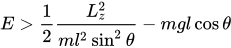
The angle lies between two circles of latitude,[1] where
- .
See also
- Foucault pendulum
- Conical pendulum
- Newton's three laws of motion
- Pendulum
- Pendulum (mathematics)
- Routhian mechanics
References
Further reading
- Weinstein, Alexander (1942). "The spherical pendulum and complex integration". The American Mathematical Monthly. 49 (8): 521–523. doi:10.1080/00029890.1942.11991275.
- Kohn, Walter (1946). "Contour integration in the theory of the spherical pendulum and the heavy symmetrical top". Transactions of the American Mathematical Society. 59 (1): 107–131. doi:10.2307/1990314. JSTOR 1990314.
- Olsson, M. G. (1981). "Spherical pendulum revisited". American Journal of Physics. 49 (6): 531–534. Bibcode:1981AmJPh..49..531O. doi:10.1119/1.12666.
- Horozov, Emil (1993). "On the isoenergetical non-degeneracy of the spherical pendulum". Physics Letters A. 173 (3): 279–283. Bibcode:1993PhLA..173..279H. doi:10.1016/0375-9601(93)90279-9.
- Richter, Peter H.; Dullin, Holger R.; Waalkens, Holger; Wiersig, Jan (1996). "Spherical pendulum, actions and spin". J. Phys. Chem. 100 (49): 19124–19135. doi:10.1021/jp9617128. S2CID 18023607.
- Shiriaev, A. S.; Ludvigsen, H.; Egeland, O. (2004). "Swinging up the spherical pendulum via stabilization of its first integrals". Automatica. 40: 73–85. doi:10.1016/j.automatica.2003.07.009.
- Essen, Hanno; Apazidis, Nicholas (2009). "Turning points of the spherical pendulum and the golden ratio". European Journal of Physics. 30 (2): 427–432. Bibcode:2009EJPh...30..427E. doi:10.1088/0143-0807/30/2/021. S2CID 121216295.
- Dullin, Holger R. (2013). "Semi-global symplectic invariants of the spherical pendulum". Journal of Differential Equations. 254 (7): 2942–2963. arXiv:1108.4962. Bibcode:2013JDE...254.2942D. doi:10.1016/j.jde.2013.01.018.
Content Disclaimer
Informasi ini disarikan dari Wikipedia dan disajikan kembali untuk tujuan edukasi. Konten tersedia di bawah lisensi CC BY-SA 3.0. Kami tidak bertanggung jawab atas ketidakakuratan data yang bersumber dari kontribusi publik tersebut.
- The information displayed on this website is sourced in part or in whole from Wikipedia and has been adapted for the purpose of restating it. We strive to provide accurate and relevant information, however:
- There is no guarantee of absolute accuracy. Wikipedia is an open, collaborative project that can be edited by anyone, so information is subject to change.
- It is not intended to constitute professional advice. The content displayed is for informational and educational purposes only. For important decisions (e.g., medical, legal, or financial), please consult a professional.
- Content copyright. Wikipedia is licensed under the Creative Commons Attribution-ShareAlike License (CC BY-SA). This means that content may be reused with appropriate attribution and shared under a similar license.
- Responsible use. Any risk arising from the use of information from this website is entirely the responsibility of the user.