Span loop
| Span loop | |
|---|---|
 | |
| Category | Loop |
| Related | Butterfly loop, Farmer's loop, Artillery loop |
| Releasing | Non-jamming |
| ABoK | #1049 |
A span loop is a non-jamming loop that can be tied away from the ends of the rope.
Information
The span loop is known for being extremely easy to untie. The beginning of tying this knot begins with tying a Half Sheepshank, which is also known as a Bell Ringer's Knot. In order to tie this, the same one-handed twist method employed for tying a bowline can be used. One bight or loop will poke up through the half-hitch, and it will perfectly match the end of the rope that is also poking up through the signature half-hitch part of a bowline as it is done with the one hand twist method. The next thing to do is to push the bottom loop back up and through the top loop.[1]
-
 half a sheepshank
 -
 loop through loop
 -
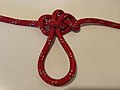 untightened
 -
 tightened


References
- ^ "Span Loop". Notable Knot Index. Retrieved 12 January 2013.
External links


 | This knot-related article is a stub. You can help Wikipedia by adding missing information. |
Content Disclaimer
Informasi ini disarikan dari Wikipedia dan disajikan kembali untuk tujuan edukasi. Konten tersedia di bawah lisensi CC BY-SA 3.0. Kami tidak bertanggung jawab atas ketidakakuratan data yang bersumber dari kontribusi publik tersebut.
- The information displayed on this website is sourced in part or in whole from Wikipedia and has been adapted for the purpose of restating it. We strive to provide accurate and relevant information, however:
- There is no guarantee of absolute accuracy. Wikipedia is an open, collaborative project that can be edited by anyone, so information is subject to change.
- It is not intended to constitute professional advice. The content displayed is for informational and educational purposes only. For important decisions (e.g., medical, legal, or financial), please consult a professional.
- Content copyright. Wikipedia is licensed under the Creative Commons Attribution-ShareAlike License (CC BY-SA). This means that content may be reused with appropriate attribution and shared under a similar license.
- Responsible use. Any risk arising from the use of information from this website is entirely the responsibility of the user.