Smith predictor
 | This article has multiple issues. Please help improve it or discuss these issues on the talk page. (Learn how and when to remove these messages)
|

The Smith predictor (invented by O. J. M. Smith in 1957) is a type of predictive controller designed to control systems with a significant feedback time delay. The idea can be illustrated as follows.
Suppose the plant consists of followed by a pure time delay . refers to the Z-transform of the transfer function relating the inputs and outputs of the plant .


As a first step, suppose we only consider (the plant without a delay) and design a controller with a closed-loop transfer function that we consider satisfactory.


Next, our objective is to design a controller for the plant so that the closed loop transfer function equals .


Solving , we obtain . The controller is implemented as shown in the following figure, where has been changed to to indicate that it is a model used by the controller.
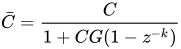


Note that there are two feedback loops. The outer control loop feeds the output back to the input, as usual. However, this loop alone would not provide satisfactory control, because of the delay; this loop is feeding back outdated information. Intuitively, for the k sample intervals during which no fresh information is available, the system is controlled by the inner loop which contains a predictor of what the (unobservable) output of the plant G currently is.
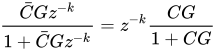
To check that this works, a re-arrangement can be made as follows:

Here we can see that if the model used in the controller, , matches the plant perfectly, then the outer and middle feedback loops cancel each other, and the controller generates the "correct" control action. In reality, however, it is impossible for the model to perfectly match the plant.

See also
References
- O. J. Smith, Closer control of loops with dead time, Chemical Engineering Progress, 53 (1957), pp. 217–219
- K. Warwick and D. Rees, Industrial Digital Control Systems, IET, 1988. [1]
External links
- "Overcoming process deadtime with a Smith Predictor". www.controleng.com. 17 February 2015.
- "Control of Processes with Long Dead Time: The Smith Predictor - MATLAB & Simulink Example". www.mathworks.com.
 | This systems-related article is a stub. You can help Wikipedia by adding missing information. |
Content Disclaimer
Informasi ini disarikan dari Wikipedia dan disajikan kembali untuk tujuan edukasi. Konten tersedia di bawah lisensi CC BY-SA 3.0. Kami tidak bertanggung jawab atas ketidakakuratan data yang bersumber dari kontribusi publik tersebut.
- The information displayed on this website is sourced in part or in whole from Wikipedia and has been adapted for the purpose of restating it. We strive to provide accurate and relevant information, however:
- There is no guarantee of absolute accuracy. Wikipedia is an open, collaborative project that can be edited by anyone, so information is subject to change.
- It is not intended to constitute professional advice. The content displayed is for informational and educational purposes only. For important decisions (e.g., medical, legal, or financial), please consult a professional.
- Content copyright. Wikipedia is licensed under the Creative Commons Attribution-ShareAlike License (CC BY-SA). This means that content may be reused with appropriate attribution and shared under a similar license.
- Responsible use. Any risk arising from the use of information from this website is entirely the responsibility of the user.