Sloop

_big_(cropped).png)
In modern usage, a sloop is a sailboat with a single mast[2] generally having only one headsail in front of the mast and one mainsail abaft (behind) the mast. It is a type of fore-and-aft rig. The mainsail may be of any type, most often Bermuda rig, but also others, such as gaff or gunter.
In naval terminology, "sloop-of-war" refers to the purpose of the craft, rather than to the specific size or sail-plan, and thus a sloop should not be confused with a sloop-of-war. As with many rig definitions, it was some time before the term sloop referred to the type of rig.
Regionally, the definition also takes into account the position of the mast. A forward mast placement and a fixed (as opposed to running) bowsprit, but with two headsails may give categorisation as a sloop. An example is the Friendship Sloop.[1]: 48-53
Origins
The name originates from the Dutch sloep, which is related to the Old English slūpan, to glide.[3] The original Dutch term applied to an open rowing boat.[1]: 49 A sloop is usually regarded as a single-masted rig with a single headsail and a fore-and-aft mainsail. In this form, the sloop is the commonest of all sailing rigs – with the Bermuda sloop being the default rig for leisure craft, being used on types that range from simple cruising dinghies to large racing yachts with high-tech sail fabrics and large powerful winches.[1]: 48–53 If the vessel has two or more headsails, the term cutter is usually applied, though there are regional and historic variations on this. A boat with a forward mast placement and a fixed bowsprit, but more than one headsail, may be called a sloop. The Friendship sloop is an example of this. Particularly with historic craft, categorisation as a cutter may rely on having a running bowsprit.[a][1]: 49–55
Variations

Before the Bermuda rig became popular outside of Bermuda in the early 20th century, a (non-Bermudian) sloop might carry one or more square-rigged topsails, hung from a topsail yard and sheeted to a lower yard.[4]
A sloop's headsail may be masthead-rigged or fractional-rigged. On a masthead-rigged sloop, the forestay (on which the headsail is carried) attaches at the top of the mast. On a fractional-rigged sloop, the forestay attaches to the mast at a point below the top. A sloop may use a bowsprit, a spar that projects forward from the bow.
Gallery
-

-
 Gunter-rigged sloop
 -
 Gaff-rigged sloop with a headsail and a gaff topsail
 -
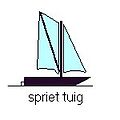 Spritsail sloop
 -
 Sloop sail with multiple foresails and topsail


See also
- Bermuda Fitted Dinghy: a scaled-down sloop used for racing in Bermuda
- Bermuda sloop, originally used for a type of sea-going, sloop-rigged vessel. Today used for any Bermuda-rigged sloop
- Chialoup, a historical type of sloop produced in the East Indies
- Mast aft rig, a single mast rig with a mast further back than a sloop or cutter
Notes
- ^ A running bowsprit is one which is regularly moved from the position in which it is used. This might be done in heavy weather or when entering harbour
References
- ^ a b c d e Bennett, Jenny (2005). Sailing Rigs, an Illustrated Guide. London: Chatham Publishing. ISBN 1-86176-243-7.
- ^ "SLOOP". Cambridge English Dictionary. Retrieved 2019-05-12.
- ^ "Sloop". Dictionary.com. Retrieved 12 May 2019.
- ^ Fallows, Samuel (1885). Progressive Dictionary of the English Language. Progressive. p. 148.
External links

| National | |
|---|---|
| Artists | |
| Other | |

Content Disclaimer
Informasi ini disarikan dari Wikipedia dan disajikan kembali untuk tujuan edukasi. Konten tersedia di bawah lisensi CC BY-SA 3.0. Kami tidak bertanggung jawab atas ketidakakuratan data yang bersumber dari kontribusi publik tersebut.
- The information displayed on this website is sourced in part or in whole from Wikipedia and has been adapted for the purpose of restating it. We strive to provide accurate and relevant information, however:
- There is no guarantee of absolute accuracy. Wikipedia is an open, collaborative project that can be edited by anyone, so information is subject to change.
- It is not intended to constitute professional advice. The content displayed is for informational and educational purposes only. For important decisions (e.g., medical, legal, or financial), please consult a professional.
- Content copyright. Wikipedia is licensed under the Creative Commons Attribution-ShareAlike License (CC BY-SA). This means that content may be reused with appropriate attribution and shared under a similar license.
- Responsible use. Any risk arising from the use of information from this website is entirely the responsibility of the user.