Singular control
In optimal control, problems of singular control are problems that are difficult to solve because a straightforward application of Pontryagin's minimum principle fails to yield a complete solution. Only a few such problems have been solved, such as Merton's portfolio problem in financial economics or trajectory optimization in aeronautics. A more technical explanation follows.
The most common difficulty in applying Pontryagin's principle arises when the Hamiltonian depends linearly on the control , i.e., is of the form: and the control is restricted to being between an upper and a lower bound: . To minimize , we need to make as big or as small as possible, depending on the sign of , specifically:




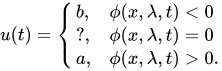
If is positive at some times, negative at others and is only zero instantaneously, then the solution is straightforward and is a bang-bang control that switches from to at times when switches from negative to positive.


The case when remains at zero for a finite length of time is called the singular control case. Between and the maximization of the Hamiltonian with respect to gives us no useful information and the solution in that time interval is going to have to be found from other considerations. One approach is to repeatedly differentiate with respect to time until the control u again explicitly appears, though this is not guaranteed to happen eventually. One can then set that expression to zero and solve for u. This amounts to saying that between and the control is determined by the requirement that the singularity condition continues to hold. The resulting so-called singular arc, if it is optimal, will satisfy the Kelley condition:[1]


![{\displaystyle (-1)^{k}{\frac {\partial }{\partial u}}\left[{\left({\frac {d}{dt}}\right)}^{2k}H_{u}\right]\geq 0,\,k=0,1,\cdots }](https://wikimedia.org/api/rest_v1/media/math/render/svg/f36f9fbe034353323599427be6c5a526b3d3d212)
Others refer to this condition as the generalized Legendre–Clebsch condition.
The term bang-singular control refers to a control that has a bang-bang portion as well as a singular portion.
References
- ^ Zelikin, M. I.; Borisov, V. F. (2005). "Singular Optimal Regimes in Problems of Mathematical Economics". Journal of Mathematical Sciences. 130 (1): 4409–4570 [Theorem 11.1]. doi:10.1007/s10958-005-0350-5. S2CID 122382003.
External links
- Bryson, Arthur E. Jr.; Ho, Yu-Chi (1969). "Singular Solutions of Optimization and Control Problems". Applied Optimal Control. Waltham: Blaisdell. pp. 246–270. ISBN 9780891162285.
Content Disclaimer
Informasi ini disarikan dari Wikipedia dan disajikan kembali untuk tujuan edukasi. Konten tersedia di bawah lisensi CC BY-SA 3.0. Kami tidak bertanggung jawab atas ketidakakuratan data yang bersumber dari kontribusi publik tersebut.
- The information displayed on this website is sourced in part or in whole from Wikipedia and has been adapted for the purpose of restating it. We strive to provide accurate and relevant information, however:
- There is no guarantee of absolute accuracy. Wikipedia is an open, collaborative project that can be edited by anyone, so information is subject to change.
- It is not intended to constitute professional advice. The content displayed is for informational and educational purposes only. For important decisions (e.g., medical, legal, or financial), please consult a professional.
- Content copyright. Wikipedia is licensed under the Creative Commons Attribution-ShareAlike License (CC BY-SA). This means that content may be reused with appropriate attribution and shared under a similar license.
- Responsible use. Any risk arising from the use of information from this website is entirely the responsibility of the user.