Shell keep

A shell keep is a style of medieval fortification, best described as a stone structure circling the top of a motte.
In English castle morphology, shell keeps are perceived as the successors to motte-and-bailey castles, with the wooden fence around the top of the motte replaced by a stone wall. Castle engineers during the Norman period did not trust the motte to support the enormous weight of a stone keep. A common solution to this problem was to replace the palisade with a stone wall and then build wooden buildings backing onto the inside of the wall. This construction was lighter than a keep and prevented the walls from being undermined, meaning they could be thinner and lighter.
Examples
A gazetteer compiled by archaeologist Robert Higham counted 21 shell keeps in England and Wales.[1] Examples include the Round Tower at Windsor Castle[2][3] and the majority were built in the 11th and 12th centuries.[4]
Surviving English examples of shell keeps include:
- Arundel, West Sussex (re-modelled post-medieval)
- Berkhamsted, Hertfordshire
- Carisbrooke, Isle of Wight
- Castle Acre, Norfolk (shell keep around an inner tower or manor House)
- Clare, Suffolk (part of wall on motte only)
- Fotheringhay, Northamptonshire (demolished - motte only survives)
- Launceston, Cornwall
- Lewes, East Sussex – two shell keeps on same site? One survives.
- Lincoln, Lincolnshire – two shell keeps on same site? One survives.
- Oxford, Oxfordshire
- Pickering, North Yorkshire
- Restormel, Cornwall (excellent example)
- Tamworth, Staffordshire
- Tonbridge, Kent (foundations on motte only)
- Totnes, Devon
- Trematon, Cornwall
- Warwick, shell demolished and incorporated into bailey wall post-medieval
- Wigmore, Herefordshire
- Windsor, Berkshire (re-modelled post-medieval)
- Wiston (Wales)
In addition Farnham and Berkeley castles have stone enclosed mottes which may be interpreted as shell keep variations. At other sites such as Durham, Warkworth, Clifford's Tower (York) and Sandal (Wakefield), shell keeps may have evolved into a tower proper. Clifford's Tower is often interpreted by modern visitors as a shell keep due to damage sustained during an explosion in 1684, which removed the roof and its central supporting masonry. True shell keeps were a stone wall around the upper perimeter of the motte with lean-to buildings against this outer wall and a small courtyard in the middle. See Restormel plan below.
Unusually Lewes and Lincoln castles both feature two separate mottes which may have had shell keeps upon both of them. The reason for this is unclear but given that Lincoln Castle is adjacent to the cathedral, one shell keep may have been for the castellan (castle holder) and the other for the bishop. In each case, only one shell keep survives.
Gallery
-
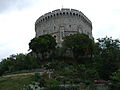 The shell keep of Windsor Castle was built by Henry II and remodelled in the 19th century.
 -
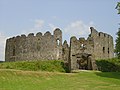 Restormel Castle built around the motte
 -
 Plan of Restormel Castle
 -
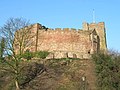 Tamworth Castle, Staffordshire
 -
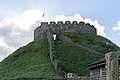 Totnes Castle, Devon
 -
 Wiston Castle, Pembrokeshire


.jpg)
Citations
- ^ Higham 2016, p. 63.
- ^ Pettifer 2002, p. 7.
- ^ Darvill, Stamper & Timby 2002, p. 196.
- ^ Hislop 2013, p. 96.
General and cited references
- Darvill, Timothy; Stamper, Paul; Timby, Jane (2002). England: an Oxford archaeological guide to sites from earliest times to AD 1600 (illustrated ed.). Oxford University Press. p. 196. ISBN 0-19-284101-7.
- Higham, Robert (2016). "Shell-keeps revisited: the bailey on the motte?" (PDF). Castle Studies Group.

- Hislop, Malcolm (2013). How to read castles. London: Bloomsbury Academic. ISBN 9781472521613.
- Pettifer, Adrian (2002). English Castles: A Guide by Counties (Illustrated ed.). Boydell & Brewer. p. 7. ISBN 0-85115-782-3.


Content Disclaimer
Informasi ini disarikan dari Wikipedia dan disajikan kembali untuk tujuan edukasi. Konten tersedia di bawah lisensi CC BY-SA 3.0. Kami tidak bertanggung jawab atas ketidakakuratan data yang bersumber dari kontribusi publik tersebut.
- The information displayed on this website is sourced in part or in whole from Wikipedia and has been adapted for the purpose of restating it. We strive to provide accurate and relevant information, however:
- There is no guarantee of absolute accuracy. Wikipedia is an open, collaborative project that can be edited by anyone, so information is subject to change.
- It is not intended to constitute professional advice. The content displayed is for informational and educational purposes only. For important decisions (e.g., medical, legal, or financial), please consult a professional.
- Content copyright. Wikipedia is licensed under the Creative Commons Attribution-ShareAlike License (CC BY-SA). This means that content may be reused with appropriate attribution and shared under a similar license.
- Responsible use. Any risk arising from the use of information from this website is entirely the responsibility of the user.