Separative work units
 | This article needs additional citations for verification. (January 2022) |
Separative work – the amount of separation done by a Uranium enrichment process – is a function of the concentrations of the feedstock, the enriched output, and the depleted tailings; and is expressed in units which are so calculated as to be proportional to the total input (energy / machine operation time) and to the mass processed.
The same amount of separative work will require different amounts of energy depending on the efficiency of the separation technology. Separative work is measured in Separative work units SWU, kg SW, or kg UTA (from the German Urantrennarbeit – literally uranium separation work)
- 1 SWU = 1 kg SW = 1 kg UTA
- 1 kSWU = 1 tSW = 1 t UTA
- 1 MSWU = 1 ktSW = 1 kt UTA
Separative work unit is not a unit of energy, but serves as a measure of the enrichment services. As of August 2025, spot prices per SWU were $188,[1] though most SWU are bought in long-term contracts which averaged $97/SWU in 2024.[2] The unit was introduced by Paul Dirac in 1941.[3]
Definition

The work necessary to separate a mass of feed of assay into a mass of product assay , and tails of mass and assay is given by the expression:[4]



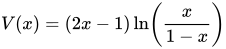
where is the value function, defined as:[3]

Given the desired amount of product , the necessary feed and resulting tails are:


Relation to energy required
The number of separative work units provided by an enrichment facility is directly related to the amount of energy that the facility consumes. Modern gaseous diffusion plants typically require 2,400 to 2,500 kilowatt-hours (kW·h), or 8.6–9 gigajoules, (GJ) of electricity per SWU while gas centrifuge plants require just 50 to 60 kW·h (180–220 MJ) of electricity per SWU.[5]
Examples
Simple NU to LEU example
For example, beginning with 102 kilograms (225 lb) of natural uranium (NU) at 0.71% 235U, and enriching to 4.5%, with tails at 0.3%, you will wind up with 10kg of enriched uranium and 92kg of tails.
The value function for the 4.5% product is
- (2*0.045 - 1) ln (0.045/(1-0.045))
- = (-0.91) ln(0.04712)
- = (-0.91) (-3.055)
- = 2.78
Similarly, the value for the 0.71% feed material is 4.87, and the value for the 0.3% tails is 5.77.
Therefore, the combined SWU value is:
- 10 * V(4.5%) + 92 * V(0.3%) - 102 * V(0.71%)
- = 10*2.78 + 92*5.77 - 102*4.87
- = 27.8 + 531.0 - 496.7
- = 62.1 SWU
This operation therefore takes about 62 SWU to complete.
Fuel generation: example for power stations
A large nuclear power station with a net electrical capacity of 1300 MW requires about 25 tonnes per year (25 t/a) of LEU with a 235U concentration of 3.75%. This quantity is produced from about 210 t of NU using about 120 kSWU. An enrichment plant with a capacity of 1000 kSWU/a is, therefore, able to enrich the uranium needed to fuel about eight large nuclear power stations.
See also
References
- ^ "Half Year 2025 unaudited financial results" (data for 2025). urenco.com. Urenco. 6 August 2025. Retrieved 8 October 2025.
- ^ "Uranium Marketing Annual Report" (data for 2024). eia.gov. Energy Information Administration. 30 September 2025. Retrieved 8 October 2025.
- ^ a b Bernstein, Jeremy (13 June 2009). "SWU for You and Me". arXiv:0906.2505 [physics.hist-ph].
- ^ Fuchs, Karl (1997). Selected Scientific Papers Of Sir Rudolf Peierls, With Commentary By The Author. World Scientific Publishing Company. p. 303. ISBN 9789814498883.
- ^ Smil, Vaclav (2017). Energy and civilization: a history (2nd ed.). Cambridge, Massachusetts: the MIT press. p. 374. ISBN 9780262035774.
[typo:]…works to or [out to] about 41 GJ/kg.
External links
- [1] Urenco Group SWU Calculator
Content Disclaimer
Informasi ini disarikan dari Wikipedia dan disajikan kembali untuk tujuan edukasi. Konten tersedia di bawah lisensi CC BY-SA 3.0. Kami tidak bertanggung jawab atas ketidakakuratan data yang bersumber dari kontribusi publik tersebut.
- The information displayed on this website is sourced in part or in whole from Wikipedia and has been adapted for the purpose of restating it. We strive to provide accurate and relevant information, however:
- There is no guarantee of absolute accuracy. Wikipedia is an open, collaborative project that can be edited by anyone, so information is subject to change.
- It is not intended to constitute professional advice. The content displayed is for informational and educational purposes only. For important decisions (e.g., medical, legal, or financial), please consult a professional.
- Content copyright. Wikipedia is licensed under the Creative Commons Attribution-ShareAlike License (CC BY-SA). This means that content may be reused with appropriate attribution and shared under a similar license.
- Responsible use. Any risk arising from the use of information from this website is entirely the responsibility of the user.