Saddlepoint approximation method
The saddlepoint approximation method, initially proposed by Daniels (1954)[1] is a specific example of the mathematical saddlepoint technique applied to statistics, in particular to the distribution of the sum of independent random variables. It provides a highly accurate approximation formula for any PDF or probability mass function of a distribution, based on the moment generating function. There is also a formula for the CDF of the distribution, proposed by Lugannani and Rice (1980).[2]

Definition
If the moment generating function of a random variable is written as and the cumulant generating function as then the saddlepoint approximation to the PDF of the distribution is defined as:[1]

![{\displaystyle M(t)=E\left[e^{tX}\right]=E\left[e^{t\sum _{i=1}^{N}X_{i}}\right]}](https://wikimedia.org/api/rest_v1/media/math/render/svg/69b603d391315740af1123851e4666f0a11a72e4)
![{\displaystyle K(t)=\log(M(t))=\sum _{i=1}^{N}\log E\left[e^{tX_{i}}\right]}](https://wikimedia.org/api/rest_v1/media/math/render/svg/22e46894af8949bdd615166a2cc4c61d515ea9a5)


where contains higher order terms to refine the approximation[1] and the saddlepoint approximation to the CDF is defined as:[1]


where is the solution to , ,, and and are the cumulative distribution function and the probability density function of a normal distribution, respectively, and is the mean of the random variable :



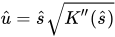


.
![{\displaystyle \mu \triangleq E\left[X\right]=\int _{-\infty }^{+\infty }xf_{X}(x)\,{\text{d}}x=\sum _{i=1}^{N}E\left[X_{i}\right]=\sum _{i=1}^{N}\int _{-\infty }^{+\infty }x_{i}f_{X_{i}}(x_{i})\,{\text{d}}x_{i}}](https://wikimedia.org/api/rest_v1/media/math/render/svg/398ab8a0a213c0f23f5a1df8d4e3fad03f39cc72)
When the distribution is that of a sample mean, Lugannani and Rice's saddlepoint expansion for the cumulative distribution function may be differentiated to obtain Daniels' saddlepoint expansion for the probability density function (Routledge and Tsao, 1997). This result establishes the derivative of a truncated Lugannani and Rice series as an alternative asymptotic approximation for the density function . Unlike the original saddlepoint approximation for , this alternative approximation in general does not need to be renormalized.


References
- ^ a b c d Daniels, H. E. (December 1954). "Saddlepoint Approximations in Statistics". The Annals of Mathematical Statistics. 25 (4): 631–650. doi:10.1214/aoms/1177728652. ISSN 0003-4851.
- ^ Lugannani, Robert; Rice, Stephen (June 1980). "Saddle point approximation for the distribution of the sum of independent random variables". Advances in Applied Probability. 12 (2): 475–490. doi:10.2307/1426607. ISSN 0001-8678.
- Butler, Ronald W. (2007), Saddlepoint approximations with applications, Cambridge: Cambridge University Press, ISBN 9780521872508
- Daniels, H. E. (1954), "Saddlepoint Approximations in Statistics", The Annals of Mathematical Statistics, 25 (4): 631–650, doi:10.1214/aoms/1177728652
- Daniels, H. E. (1980), "Exact Saddlepoint Approximations", Biometrika, 67 (1): 59–63, doi:10.1093/biomet/67.1.59, JSTOR 2335316
- Lugannani, R.; Rice, S. (1980), "Saddle Point Approximation for the Distribution of the Sum of Independent Random Variables", Advances in Applied Probability, 12 (2): 475–490, doi:10.2307/1426607, JSTOR 1426607, S2CID 124484743
- Reid, N. (1988), "Saddlepoint Methods and Statistical Inference", Statistical Science, 3 (2): 213–227, doi:10.1214/ss/1177012906
- Routledge, R. D.; Tsao, M. (1997), "On the relationship between two asymptotic expansions for the distribution of sample mean and its applications", Annals of Statistics, 25 (5): 2200–2209, doi:10.1214/aos/1069362394
Content Disclaimer
Informasi ini disarikan dari Wikipedia dan disajikan kembali untuk tujuan edukasi. Konten tersedia di bawah lisensi CC BY-SA 3.0. Kami tidak bertanggung jawab atas ketidakakuratan data yang bersumber dari kontribusi publik tersebut.
- The information displayed on this website is sourced in part or in whole from Wikipedia and has been adapted for the purpose of restating it. We strive to provide accurate and relevant information, however:
- There is no guarantee of absolute accuracy. Wikipedia is an open, collaborative project that can be edited by anyone, so information is subject to change.
- It is not intended to constitute professional advice. The content displayed is for informational and educational purposes only. For important decisions (e.g., medical, legal, or financial), please consult a professional.
- Content copyright. Wikipedia is licensed under the Creative Commons Attribution-ShareAlike License (CC BY-SA). This means that content may be reused with appropriate attribution and shared under a similar license.
- Responsible use. Any risk arising from the use of information from this website is entirely the responsibility of the user.