SKYNET (surveillance program)
SKYNET is a program by the U.S. National Security Agency that performs machine learning analysis on communications data to extract information about possible terror suspects. The tool is used to identify targets, such as al-Qaeda couriers, who move between GSM cellular networks. Specifically, mobile usage patterns such as swapping SIM cards within phones that have the same ESN, MEID or IMEI number are deemed indicative of covert activities.[1][2] Like many other security programs, SKYNET uses graphs that consist of a set of nodes and edges to visually represent social networks.[3] The tool also uses classification techniques like random forest analysis. Because the data set includes a very large proportion of true negatives and a small training set, there is a risk of overfitting.[1] Bruce Schneier argues that a false positive rate of 0.008% would be low for commercial applications where "if Google makes a mistake, people see an ad for a car they don't want to buy" but "if the government makes a mistake, they kill innocents."[1]
It has partnerships with TMAC/FASTSCOPE, MIT Lincoln labs and Harvard.[4]
Controversy
The SKYNET project was linked with drone systems, thus creating the potential for false-positives to lead to deaths.[1][5]
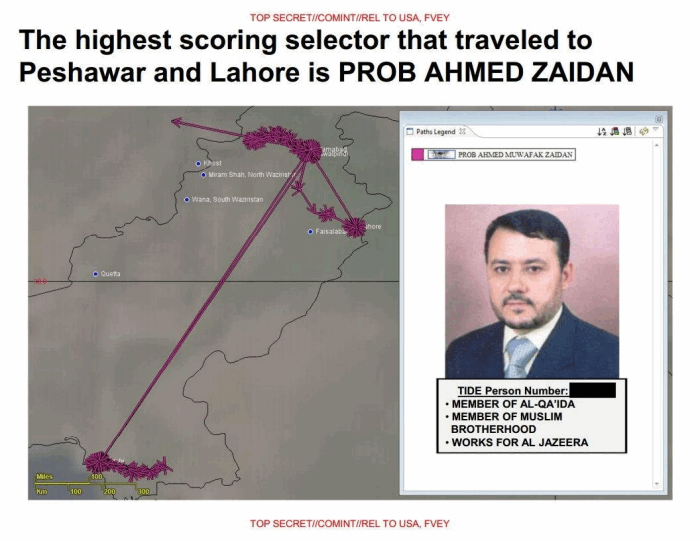
According to NSA, the SKYNET project is able to accurately reconstruct crucial information about the suspects including their social relationships, habits, and patterns of movements through graph-based visualization of GSM data.[3] However, scholars criticize that current security literature conflate statistical discrepancies with behavioral abnormalities and that the anomaly detection methodology SKYNET perpetuates the self/other binary.[6] For example, Al-Jazeera's bureau chief in Islamabad, Ahmad Zaidan, was wrongly identified as the most probable member of al-Qaeda and the Muslim Brotherhood on their records.[1][5][7]
See also
References
- ^ a b c d e Grothoff, Christian; Porup, J. M. (16 February 2016). "The NSA's SKYNET program may be killing thousands of innocent people". Ars Technica UK.
- ^ "SKYNET: Applying Advanced Cloud-based Behavior Analytics". The Intercept. 8 May 2015. Archived from the original on 1 January 2020. Retrieved 17 February 2016.
- ^ a b NSA. "SKYNET: Courier Detection via Machine Learning". Snowden Doc Search. Archived from the original on 2019-12-08. Retrieved December 7, 2019.
- ^ Crockford, Kade (8 May 2015). "MIT and Harvard Worked with NSA on SKYNET Project". Privacy SOS.
- ^ a b Robbins, Martin (18 February 2016). "Has a rampaging AI algorithm really killed thousands in Pakistan?". The Guardian.
- ^ Aradau, Claudia; Blanke, Tobias (February 2018). "Governing others: Anomaly and the algorithmic subject of security". European Journal of International Security. 3 (1): 1–21. doi:10.1017/eis.2017.14. ISSN 2057-5637. S2CID 58923172.
- ^ "The highest scoring selector that traveled to Peshawar and Lahore is PROB AHMED ZAIDAN". Archived from the original (GIF) on 2016-03-04.

Content Disclaimer
Informasi ini disarikan dari Wikipedia dan disajikan kembali untuk tujuan edukasi. Konten tersedia di bawah lisensi CC BY-SA 3.0. Kami tidak bertanggung jawab atas ketidakakuratan data yang bersumber dari kontribusi publik tersebut.
- The information displayed on this website is sourced in part or in whole from Wikipedia and has been adapted for the purpose of restating it. We strive to provide accurate and relevant information, however:
- There is no guarantee of absolute accuracy. Wikipedia is an open, collaborative project that can be edited by anyone, so information is subject to change.
- It is not intended to constitute professional advice. The content displayed is for informational and educational purposes only. For important decisions (e.g., medical, legal, or financial), please consult a professional.
- Content copyright. Wikipedia is licensed under the Creative Commons Attribution-ShareAlike License (CC BY-SA). This means that content may be reused with appropriate attribution and shared under a similar license.
- Responsible use. Any risk arising from the use of information from this website is entirely the responsibility of the user.