Reynolds operator
In fluid dynamics and invariant theory, a Reynolds operator is a mathematical operator given by averaging something over a group action, satisfying a set of properties called Reynolds rules. In fluid dynamics, Reynolds operators are often encountered in models of turbulent flows, particularly the Reynolds-averaged Navier–Stokes equations, where the average is typically taken over the fluid flow under the group of time translations. In invariant theory, the average is often taken over a compact group or reductive algebraic group acting on a commutative algebra, such as a ring of polynomials. Reynolds operators were introduced into fluid dynamics by Osbourne Reynolds (1895) and named by J. Kampé de Fériet (1934, 1935, 1949).
Definition
Reynolds operators are used in fluid dynamics, functional analysis, and invariant theory, and the notation and definitions in these areas differ slightly. A Reynolds operator acting on is sometimes denoted by or . Reynolds operators are usually linear operators acting on some algebra of functions, satisfying the identity




and sometimes some other conditions, such as commuting with various group actions.
Invariant theory
In invariant theory a Reynolds operator R is usually a linear operator satisfying
and

Together these conditions imply that R is idempotent: R2 = R. The Reynolds operator will also usually commute with some group action, and project onto the invariant elements of this group action.
Functional analysis
In functional analysis a Reynolds operator is a linear operator R acting on some algebra of functions φ, satisfying the Reynolds identity

The operator R is called an averaging operator if it is linear and satisfies
If R(R(φ)) = R(φ) for all φ then R is an averaging operator if and only if it is a Reynolds operator. Sometimes the R(R(φ)) = R(φ) condition is added to the definition of Reynolds operators.
Fluid dynamics
Let and be two random variables, and be an arbitrary constant. Then the properties satisfied by Reynolds operators, for an operator include linearity and the averaging property:



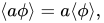
- which implies


In addition the Reynolds operator is often assumed to commute with space and time translations:


Any operator satisfying these properties is a Reynolds operator.[1]
Examples
Reynolds operators are often given by projecting onto an invariant subspace of a group action.
- The "Reynolds operator" considered by Reynolds (1895) was essentially the projection of a fluid flow to the "average" fluid flow, which can be thought of as projection to time-invariant flows. Here the group action is given by the action of the group of time-translations.
- Suppose that G is a reductive algebraic group or a compact group, and V is a finite-dimensional representation of G. Then G also acts on the symmetric algebra SV of polynomials. The Reynolds operator R is the G-invariant projection from SV to the subring SVG of elements fixed by G.
References
- ^ Sagaut, Pierre (2006). Large Eddy Simulation for Incompressible Flows (Third ed.). Springer. ISBN 3-540-26344-6.
- Kampé de Fériet, J. (1934), "L'état actuel du problème de la turbulence I", La Science Aérienne, 3: 9–34
- Kampé de Fériet, J. (1935), "L'état actuel du problème de la turbulence II", La Science Aérienne, 4: 12–52
- Kampé de Fériet, J. (1949), "Sur un problème d'algèbre abstraite posé par la définition de la moyenne dans la théorie de la turbulence", Annales de la Société Scientifique de Bruxelles. Série I. Sciences Mathématiques, Astronomiques et Physiques, 63: 165–180, ISSN 0037-959X, MR 0032718
- Reynolds, O. (1895), "On the dynamical theory of incompressible viscous fluids and the determination of the criterion", Philosophical Transactions of the Royal Society A, 186: 123–164, Bibcode:1895RSPTA.186..123R, doi:10.1098/rsta.1895.0004, JSTOR 90643
- Rota, Gian-Carlo (2003), Gian-Carlo Rota on analysis and probability, Contemporary Mathematicians, Boston, MA: Birkhäuser Boston, ISBN 978-0-8176-4275-4, MR 1944526 Reprints several of Rota's papers on Reynolds operators, with commentary.
- Rota, Gian-Carlo (1964), "Reynolds operators", Proc. Sympos. Appl. Math., vol. XVI, Providence, R.I.: Amer. Math. Soc., pp. 70–83, MR 0161140
- Sturmfels, Bernd (1993), Algorithms in invariant theory, Texts and Monographs in Symbolic Computation, Berlin, New York: Springer-Verlag, doi:10.1007/978-3-7091-4368-1, ISBN 978-3-211-82445-0, MR 1255980
Content Disclaimer
Informasi ini disarikan dari Wikipedia dan disajikan kembali untuk tujuan edukasi. Konten tersedia di bawah lisensi CC BY-SA 3.0. Kami tidak bertanggung jawab atas ketidakakuratan data yang bersumber dari kontribusi publik tersebut.
- The information displayed on this website is sourced in part or in whole from Wikipedia and has been adapted for the purpose of restating it. We strive to provide accurate and relevant information, however:
- There is no guarantee of absolute accuracy. Wikipedia is an open, collaborative project that can be edited by anyone, so information is subject to change.
- It is not intended to constitute professional advice. The content displayed is for informational and educational purposes only. For important decisions (e.g., medical, legal, or financial), please consult a professional.
- Content copyright. Wikipedia is licensed under the Creative Commons Attribution-ShareAlike License (CC BY-SA). This means that content may be reused with appropriate attribution and shared under a similar license.
- Responsible use. Any risk arising from the use of information from this website is entirely the responsibility of the user.