Reversible diffusion
In mathematics, a reversible diffusion is a specific example of a reversible stochastic process. Reversible diffusions have an elegant characterization due to the Russian mathematician Andrey Nikolaevich Kolmogorov.
Kolmogorov's characterization of reversible diffusions
Let B denote a d-dimensional standard Brownian motion; let b : Rd → Rd be a Lipschitz continuous vector field. Let X : [0, +∞) × Ω → Rd be an Itō diffusion defined on a probability space (Ω, Σ, P) and solving the Itō stochastic differential equation with square-integrable initial condition, i.e. X0 ∈ L2(Ω, Σ, P; Rd). Then the following are equivalent:

- The process X is reversible with stationary distribution μ on Rd.
- There exists a scalar potential Φ : Rd → R such that b = −∇Φ, μ has Radon–Nikodym derivative and
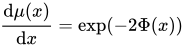
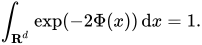
(Of course, the condition that b be the negative of the gradient of Φ only determines Φ up to an additive constant; this constant may be chosen so that exp(−2Φ(·)) is a probability density function with integral 1.)
References
- Voß, Jochen (2004). Some large deviation results for diffusion processes (Thesis). Universität Kaiserslautern: PhD thesis. (See theorem 1.4)
Content Disclaimer
Informasi ini disarikan dari Wikipedia dan disajikan kembali untuk tujuan edukasi. Konten tersedia di bawah lisensi CC BY-SA 3.0. Kami tidak bertanggung jawab atas ketidakakuratan data yang bersumber dari kontribusi publik tersebut.
- The information displayed on this website is sourced in part or in whole from Wikipedia and has been adapted for the purpose of restating it. We strive to provide accurate and relevant information, however:
- There is no guarantee of absolute accuracy. Wikipedia is an open, collaborative project that can be edited by anyone, so information is subject to change.
- It is not intended to constitute professional advice. The content displayed is for informational and educational purposes only. For important decisions (e.g., medical, legal, or financial), please consult a professional.
- Content copyright. Wikipedia is licensed under the Creative Commons Attribution-ShareAlike License (CC BY-SA). This means that content may be reused with appropriate attribution and shared under a similar license.
- Responsible use. Any risk arising from the use of information from this website is entirely the responsibility of the user.