Repoussoir
 | This article relies largely or entirely on a single source. (September 2022) |
In two-dimensional works of art, such as painting, printmaking, photography or bas-relief, repoussoir (French: [ʁəpuswaʁ], pushing back) is an object along the right or left foreground that directs the viewer's eye into the composition by bracketing (framing) the edge. It became popular with Mannerist and Baroque artists, and is found frequently in Dutch seventeenth-century landscape paintings. Jacob van Ruisdael, for example, often included a tree along one side to enclose the scene (see illustration). Figures are also commonly employed as repoussoir devices by artists such as Paolo Veronese, Peter Paul Rubens and Impressionists such as Gustave Caillebotte.[1]
- Examples of repoussoir
-
 Jacob Isaaksz. van Ruisdael, The Jewish Cemetery (1655–60, oil on canvas, 141 x 182.9 cm). The tree in the right-foreground of Ruisdael's painting is an example of repoussoir that pushes the viewer's eye into the composition.
 -
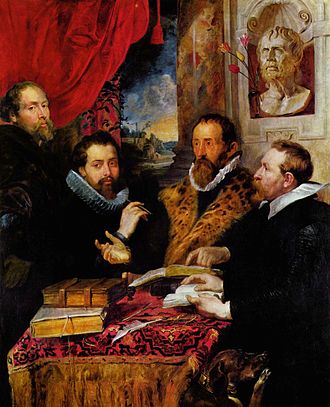 The Four Philosophers (c. 1615. Oil on panel; 167 x 143 cm, Pitti Palace, Florence). In his friendship portrait of himself, his brother Philip Rubens, Justus Lipsius and Jan van den Wouwer (left to right), the Flemish painter Peter Paul Rubens's self-portrait on the left is an example of a figural repoussoir that is further accentuated by the flowing red curtain.
 -
 Gustave Caillebotte. Paris Street; Rainy Day (1877, Art Institute of Chicago). The rear-facing man on the right with the tilted umbrella is an example of repoussoir figure leading the viewer's gaze into the composition.
 -
![Georges Seurat, Gray Weather, Grande Jatte (1888, 71 × 66 cm, oil on canvas, Metropolitan Museum of Art). In a similar manner to the van Ruisdael piece, the tree that takes up the entire right edge of this work is an example of repoussoir.[2]](//upload.wikimedia.org/wikipedia/commons/thumb/5/59/Gray_Weather%2C_Grand_Jatte_%281888%29_-_Georges_Seurat_%28Metropolitan_Museum_of_Art%29.jpg/500px-Gray_Weather%2C_Grand_Jatte_%281888%29_-_Georges_Seurat_%28Metropolitan_Museum_of_Art%29.jpg) Georges Seurat, Gray Weather, Grande Jatte (1888, 71 × 66 cm, oil on canvas, Metropolitan Museum of Art). In a similar manner to the van Ruisdael piece, the tree that takes up the entire right edge of this work is an example of repoussoir.[2]
Georges Seurat, Gray Weather, Grande Jatte (1888, 71 × 66 cm, oil on canvas, Metropolitan Museum of Art). In a similar manner to the van Ruisdael piece, the tree that takes up the entire right edge of this work is an example of repoussoir.[2]
.jpg)


![Georges Seurat, Gray Weather, Grande Jatte (1888, 71 × 66 cm, oil on canvas, Metropolitan Museum of Art). In a similar manner to the van Ruisdael piece, the tree that takes up the entire right edge of this work is an example of repoussoir.[2]](https://dosen.profillengkap.com/en/File:Gray_Weather,_Grand_Jatte_(1888)_-_Georges_Seurat_(Metropolitan_Museum_of_Art).jpg)
References
- ^ Wind, Edgar (October 1938). "The revolution of history painting". Journal of the Warburg Institute. 2 (2): 117. doi:10.2307/750085. JSTOR 750085. S2CID 195030759.
He fulfils the function of a 'repoussoir', and by leading the imagination into a distant land, effectively offsets the shock of seeing the hero die in a modern uniform.
- ^ Foa, Michelle; Seurat, Georges (2015). Georges Seurat: The Art of Vision. New Haven, Conn.: Yale University Press. pp. 105–107. ISBN 978-0-300-20835-1.

 | This article related to art techniques is a stub. You can help Wikipedia by adding missing information. |
Content Disclaimer
Informasi ini disarikan dari Wikipedia dan disajikan kembali untuk tujuan edukasi. Konten tersedia di bawah lisensi CC BY-SA 3.0. Kami tidak bertanggung jawab atas ketidakakuratan data yang bersumber dari kontribusi publik tersebut.
- The information displayed on this website is sourced in part or in whole from Wikipedia and has been adapted for the purpose of restating it. We strive to provide accurate and relevant information, however:
- There is no guarantee of absolute accuracy. Wikipedia is an open, collaborative project that can be edited by anyone, so information is subject to change.
- It is not intended to constitute professional advice. The content displayed is for informational and educational purposes only. For important decisions (e.g., medical, legal, or financial), please consult a professional.
- Content copyright. Wikipedia is licensed under the Creative Commons Attribution-ShareAlike License (CC BY-SA). This means that content may be reused with appropriate attribution and shared under a similar license.
- Responsible use. Any risk arising from the use of information from this website is entirely the responsibility of the user.