Removable singularity
 | This article needs additional citations for verification. (July 2021) |

In complex analysis, a removable singularity of a holomorphic function is a point at which the function is undefined, but it is possible to redefine the function at that point in such a way that the resulting function is regular in a neighbourhood of that point.
For instance, the (unnormalized) sinc function, as defined by

has a singularity at . This singularity can be removed by defining , which is the limit of sinc as tends to . The resulting function is holomorphic. In this case the problem was caused by sinc being given an indeterminate form. Taking a power series expansion for around the singular point shows that



Formally, if is an open subset of the complex plane , a point of , and is a holomorphic function, then is called a removable singularity for if there exists a holomorphic function which coincides with on . We say is holomorphically extendable over if such a exists.


Riemann's theorem
Riemann's theorem on removable singularities is as follows:
Theorem— Let be an open subset of the complex plane, a point of and a holomorphic function defined on the set . The following are equivalent:


- is holomorphically extendable over .
- is continuously extendable over .
- There exists a neighborhood of on which is bounded.
- .
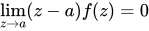
The implications 1 ⇒ 2 ⇒ 3 ⇒ 4 are trivial. To prove 4 ⇒ 1, we first recall that the holomorphy of a function at is equivalent to it being analytic at (proof), i.e. having a power series representation. Define
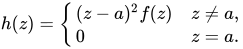
Clearly, is holomorphic on , and there exists


by 4, hence is holomorphic on and has a Taylor series about :

We have and ; therefore


Hence, where , we have:


However,

is holomorphic on , thus an extension of .
Other kinds of singularities
Unlike functions of a real variable, holomorphic functions are sufficiently rigid that their isolated singularities can be completely classified. A holomorphic function's singularity is either not really a singularity at all, i.e. a removable singularity, or one of the following two types:
- In light of Riemann's theorem, given a non-removable singularity, one might ask whether there exists a natural number such that . If so, is called a pole of and the smallest such is the order of . So removable singularities are precisely the poles of order . A meromorphic function blows up uniformly near its other poles.
- If an isolated singularity of is neither removable nor a pole, it is called an essential singularity. The Great Picard Theorem shows that such an maps every punctured open neighborhood to the entire complex plane, with the possible exception of at most one point.


See also
External links
- Removable singular point at Encyclopedia of Mathematics Deprecated link archived 2012-12-20 at archive.today
Content Disclaimer
Informasi ini disarikan dari Wikipedia dan disajikan kembali untuk tujuan edukasi. Konten tersedia di bawah lisensi CC BY-SA 3.0. Kami tidak bertanggung jawab atas ketidakakuratan data yang bersumber dari kontribusi publik tersebut.
- The information displayed on this website is sourced in part or in whole from Wikipedia and has been adapted for the purpose of restating it. We strive to provide accurate and relevant information, however:
- There is no guarantee of absolute accuracy. Wikipedia is an open, collaborative project that can be edited by anyone, so information is subject to change.
- It is not intended to constitute professional advice. The content displayed is for informational and educational purposes only. For important decisions (e.g., medical, legal, or financial), please consult a professional.
- Content copyright. Wikipedia is licensed under the Creative Commons Attribution-ShareAlike License (CC BY-SA). This means that content may be reused with appropriate attribution and shared under a similar license.
- Responsible use. Any risk arising from the use of information from this website is entirely the responsibility of the user.