Regenerative process

In applied probability, a regenerative process is a class of stochastic process with the property that certain portions of the process can be treated as being statistically independent of each other.[2] This property can be used in the derivation of theoretical properties of such processes.
History
Regenerative processes were first defined by Walter L. Smith in Proceedings of the Royal Society A in 1955.[3][4]
Definition
A regenerative process is a stochastic process with time points at which, from a probabilistic point of view, the process restarts itself.[5] These time point may themselves be determined by the evolution of the process. That is to say, the process {X(t), t ≥ 0} is a regenerative process if there exist time points 0 ≤ T0 < T1 < T2 < ... such that the post-Tk process {X(Tk + t) : t ≥ 0}
- has the same distribution as the post-T0 process {X(T0 + t) : t ≥ 0}
- is independent of the pre-Tk process {X(t) : 0 ≤ t < Tk}
for k ≥ 1.[6] Intuitively this means a regenerative process can be split into i.i.d. cycles.[7]
When T0 = 0, X(t) is called a nondelayed regenerative process. Else, the process is called a delayed regenerative process.[6]
Examples
- Renewal processes are regenerative processes, with T1 being the first renewal.[5]
- Alternating renewal processes, where a system alternates between an 'on' state and an 'off' state.[5]
- A recurrent Markov chain is a regenerative process, with T1 being the time of first recurrence.[5] This includes Harris chains.
- Reflected Brownian motion is a regenerative process (where one measures the time it takes particles to leave and come back).[7]
Properties
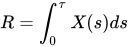
- By the renewal reward theorem, with probability 1,[8]
![{\displaystyle \lim _{t\to \infty }{\frac {1}{t}}\int _{0}^{t}X(s)ds={\frac {\mathbb {E} [R]}{\mathbb {E} [\tau ]}}.}](https://wikimedia.org/api/rest_v1/media/math/render/svg/6be9350adf772ff867cbb45a686b909bb1e86cac)
- where is the length of the first cycle and is the value over the first cycle.

- A measurable function of a regenerative process is a regenerative process with the same regeneration time[8]
References
- ^ Hurter, A. P.; Kaminsky, F. C. (1967). "An Application of Regenerative Stochastic Processes to a Problem in Inventory Control". Operations Research. 15 (3): 467–472. doi:10.1287/opre.15.3.467. JSTOR 168455.
- ^ Ross, S. M. (2010). "Renewal Theory and Its Applications". Introduction to Probability Models. pp. 421–641. doi:10.1016/B978-0-12-375686-2.00003-0. ISBN 9780123756862.
- ^ Schellhaas, Helmut (1979). "Semi-Regenerative Processes with Unbounded Rewards". Mathematics of Operations Research. 4: 70–78. doi:10.1287/moor.4.1.70. JSTOR 3689240.
- ^ Smith, W. L. (1955). "Regenerative Stochastic Processes". Proceedings of the Royal Society A: Mathematical, Physical and Engineering Sciences. 232 (1188): 6–31. Bibcode:1955RSPSA.232....6S. doi:10.1098/rspa.1955.0198.
- ^ a b c d Sheldon M. Ross (2007). Introduction to probability models. Academic Press. p. 442. ISBN 0-12-598062-0.
- ^ a b Haas, Peter J. (2002). "Regenerative Simulation". Stochastic Petri Nets. Springer Series in Operations Research and Financial Engineering. pp. 189–273. doi:10.1007/0-387-21552-2_6. ISBN 0-387-95445-7.
- ^ a b Asmussen, Søren (2003). "Regenerative Processes". Applied Probability and Queues. Stochastic Modelling and Applied Probability. Vol. 51. pp. 168–185. doi:10.1007/0-387-21525-5_6. ISBN 978-0-387-00211-8.
- ^ a b Sigman, Karl (2009) Regenerative Processes, lecture notes
Content Disclaimer
Informasi ini disarikan dari Wikipedia dan disajikan kembali untuk tujuan edukasi. Konten tersedia di bawah lisensi CC BY-SA 3.0. Kami tidak bertanggung jawab atas ketidakakuratan data yang bersumber dari kontribusi publik tersebut.
- The information displayed on this website is sourced in part or in whole from Wikipedia and has been adapted for the purpose of restating it. We strive to provide accurate and relevant information, however:
- There is no guarantee of absolute accuracy. Wikipedia is an open, collaborative project that can be edited by anyone, so information is subject to change.
- It is not intended to constitute professional advice. The content displayed is for informational and educational purposes only. For important decisions (e.g., medical, legal, or financial), please consult a professional.
- Content copyright. Wikipedia is licensed under the Creative Commons Attribution-ShareAlike License (CC BY-SA). This means that content may be reused with appropriate attribution and shared under a similar license.
- Responsible use. Any risk arising from the use of information from this website is entirely the responsibility of the user.