Reci
Reci
Réty | |
|---|---|
.jpg) Reformed church in Reci | |
 Coat of arms | |
 Location in Covasna County | |
  Reci Location in Romania | |
| Coordinates: 45°51′N 25°56′E / 45.850°N 25.933°E | |
| Country | Romania |
| County | Covasna |
| Government | |
| • Mayor (2020–2024) | Lehel-Lajos Dombora[2] (UDMR) |
Area | 39.92 km2 (15.41 sq mi) |
| Elevation | 548 m (1,798 ft) |
| Population (2021-12-01)[1] | 2,259 |
| • Density | 56.59/km2 (146.6/sq mi) |
| Time zone | UTC+02:00 (EET) |
| • Summer (DST) | UTC+03:00 (EEST) |
| Postal code | 527145 |
| Area code | (+40) 02 67 |
| Vehicle reg. | CV |
| Website | reci |
Reci (Hungarian: Réty, Hungarian pronunciation: [ˈreːc]) is a commune in Covasna County, Transylvania, Romania composed of four villages: Aninoasa (Egerpatak), Bita (Bita), Reci, and Saciova (Szacsva). It also included the village of Comolău (Komolló) until 1968, when it was disestablished.
Geography
The commune is situated in the Brașov Depression, in the historical Székely Land region of southeastern Transylvania. It is positioned southeast of the Bodoc Mountains, at an altitude of 548 m (1,798 ft), on the banks of the Râul Negru and its tributaries, the rivers Covasna and Pădureni.
Reci is located in the southern part of Covasna County, in between the county seat, Sfântu Gheorghe, 13 km (8.1 mi) to the west, the town of Covasna, 22 km (14 mi) to the east, and the city of Târgu Secuiesc, 27 km (17 mi) to the northeast. It is crossed by national road DN13E, which starts in Întorsura Buzăului, at the southern limit of the county, passes through Covasna and Sfântu Gheorghe, and ends in Feldioara, 38 km (24 mi) to the west, in Brașov County. At the western end of the commune is the DN11 road (part of European route E574), which starts in Brașov, passes through Târgu Secuiesc and Onești, and ends in Bacău. The Bita train station serves the CFR Line 404, which connects Sfântu Gheorghe to Covasna.
History
A Roman settlement (the Castra of Reci) was discovered in Comolău village (now part of Reci); dating from the 4th century, the castra belonged to the Sântana de Mureș culture. A settlement and a grave from the 10th–11th centuries were discovered on the right bank of the Râul Negru. Until 1918, the village belonged to the Háromszék County of Austro-Hungary. In the immediate aftermath of World War I, following the declaration of the Union of Transylvania with Romania, the area passed under Romanian administration during the Hungarian–Romanian War of 1918–1919. By the terms of the Treaty of Trianon of 1920, it became part of the Kingdom of Romania.
In 1925, the commune fell within Plasa Covasna of Trei Scaune County. In August 1940, under the auspices of Nazi Germany, which imposed the Second Vienna Award, Hungary retook the territory of Northern Transylvania (which included Reci) from Romania. Towards the end of World War II, however, the commune was taken back from Hungarian and German troops by Romanian and Soviet forces in September 1944. In 1950, after Communist Romania was established, Reci became part of the Târgu Secuiesc Raion of Stalin Region. From 1952 and 1960, it was part of the Magyar Autonomous Region, and between 1960 and 1968 it reverted to Brașov Region. In 1968, when Romania was reorganized based on counties rather than regions, Reci became part of Covasna County.
Demographics
| Year | Pop. | ±% |
|---|---|---|
| 1850 | 2,497 | — |
| 1941 | 2,857 | +14.4% |
| 2002 | 2,234 | −21.8% |
| 2011 | 2,304 | +3.1% |
| 2021 | 2,259 | −2.0% |
| Source: Census data | ||
The commune has an absolute Székely Hungarian majority. According to the 2002 census, it had a population of 2,234, of which 98.88% or 2,209 were Hungarians. At the 2021 census, Reci had 2,259 inhabitants; of those, 94.07% were Hungarians and 2.7% Romanians.[3]
Natives
- Imre Dimény (1922 – 2017), Hungarian agrarian engineer and Communist politician
Twin towns


References
- ^ "2021 Romanian census". National Institute of Statistics. 1 December 2021.
- ^ "Results of the 2020 local elections". Central Electoral Bureau. Retrieved 10 June 2021.
- ^ "Populația rezidentă după grupa de vârstă, pe județe și municipii, orașe, comune, la 1 decembrie 2021" (in Romanian). INSSE. 31 May 2023.
-
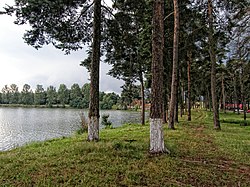 Reci Lake
 -
 Antos mansion in Reci
 -
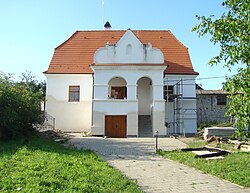 Salamon house in Reci
 -
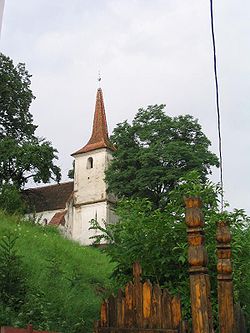 Reformed church in Saciova

.jpg)
.jpg)


Content Disclaimer
Informasi ini disarikan dari Wikipedia dan disajikan kembali untuk tujuan edukasi. Konten tersedia di bawah lisensi CC BY-SA 3.0. Kami tidak bertanggung jawab atas ketidakakuratan data yang bersumber dari kontribusi publik tersebut.
- The information displayed on this website is sourced in part or in whole from Wikipedia and has been adapted for the purpose of restating it. We strive to provide accurate and relevant information, however:
- There is no guarantee of absolute accuracy. Wikipedia is an open, collaborative project that can be edited by anyone, so information is subject to change.
- It is not intended to constitute professional advice. The content displayed is for informational and educational purposes only. For important decisions (e.g., medical, legal, or financial), please consult a professional.
- Content copyright. Wikipedia is licensed under the Creative Commons Attribution-ShareAlike License (CC BY-SA). This means that content may be reused with appropriate attribution and shared under a similar license.
- Responsible use. Any risk arising from the use of information from this website is entirely the responsibility of the user.